

The folder sat on Declan’s desk like a live thing. He hadn’t touched it since Elara slid it across her polished mahogany, her fingers lingering a half-second too long on the unmarked manila edge. She’d said nothing else. Just that look, the one that meant don’t open this here, and then she’d walked back to her corner office with the glass walls that caught the morning sun like a fishbowl.
Now it was 08:47. Matthias stood by the window, arms crossed, watching the street below with the patience of a man who’d learned to wait in places where waiting meant survival. His reflection in the glass was a dark silhouette against the gray Zurich morning, all sharp angles and coiled stillness. He hadn’t slept. Neither had Declan.
“You’re going to stare at it until it bursts into flames,” Matthias said without turning.
Declan’s fingers hovered over the folder. The paper was warm from Elara’s hands. Or maybe that was his imagination, the way fear heated everything it touched. “I’m building up to it.”
“Build faster. We’ve got twelve minutes before Risk starts their morning sweep.”
“Eleven now.”
Matthias turned, and his eyes were the color of winter slate. “Then stop stalling.”
Declan flipped the folder open.
The first thing he saw was the routing sheet. Board Risk Committee. Standard form, the kind that lived in templates and got filled out by interns who didn’t know what they were authorizing. But this one was different. The paper had weight, a slight watermark that caught the light when he tilted it. Official. Final. The kind of document that got filed in a vault and never saw daylight again.
The header read: Vendor Exception Request – Expedited Access-Control Service Window.
Below that, a series of boxes. Checked. Approved. Stamped.
The sponsor line stopped him cold.
Sponsor Code: BRC-SPON-07
He read it three times. The code meant nothing on its own. A string of letters and numbers, the kind of bureaucratic shorthand that filled every inch of Zurich’s systems. But Matthias had gone still behind him, his breath catching in a way that made the hair on Declan’s arms stand up.
“You know that code,” Declan said.
It wasn’t a question.
Matthias moved closer, his footsteps silent on the carpet. He leaned over Declan’s shoulder, and the heat of his body was a sudden, unwelcome distraction. Declan could smell him. Coffee and sweat and the faint metallic tang of adrenaline that hadn’t fully burned off from the night before.
“I’ve seen it before,” Matthias said. His voice was low, careful. “Three years ago. Another building. Same setup. Vendor exception, expedited window, board sponsorship. The code was different then, but the structure was identical.”
“What happened?”
“The building’s security director ended up in a coma. Car accident, they said. But the car was found in a locked garage with the engine running and the doors sealed from the outside.”
Declan’s stomach dropped. He turned to look at Matthias, and what he saw in the man’s face was not fear. It was recognition. The quiet, terrible recognition of someone who had seen the machine work before and knew exactly what it could do.
“You’re telling me this is a kill switch.”
“I’m telling you it’s a pathway.” Matthias straightened, his hand brushing Declan’s shoulder as he pulled away. The touch was brief, but it burned. “The kill switch comes later, if you don’t follow the path they’ve laid out.”
Declan looked back at the folder. There were more papers beneath the routing sheet. Work orders, serial numbers, approval chains. A clean, damning paper trail that reframed everything he thought he knew about the night before.
The intruder wasn’t a ghost.
It was governance.
He flipped to the next page. A maintenance log, timestamped 02:17, matching the exact moment they’d seen the figure in his office. The entry was signed by a vendor ID he didn’t recognize, but the authorization stamp was from the Board Risk Committee. The same committee that had approved the exception. The same committee that had created the pathway.
“They’re covering their tracks,” Declan said. “This document makes the intrusion look legitimate. If anyone questions it, they point to the paperwork and say it was authorized.”
“It was authorized,” Matthias said. “That’s the point. Someone on the board wanted access to your office. They got it. Clean, legal, documented. The only reason we know it wasn’t is because we saw it happen.”
Declan closed the folder. His hands were shaking. He hated that. The tremor in his fingers, the way his heart was hammering against his ribs like a trapped bird. He was supposed to be in control. He was the director of this floor. He was the one who made the decisions, who set the tone, who kept the machine running.
But the machine had turned on him.
“Elara knows more than she’s telling us,” Matthias said.
“She gave us the folder.”
“She gave us what she wanted us to see. There’s a difference.”
Declan stood. The chair scraped against the floor, and the sound was too loud in the quiet of the morning. He walked to the window, stood where Matthias had been standing, and looked down at the street. The city was waking up. People in suits and raincoats, carrying coffee and briefcases, moving with the efficient purpose of a place that ran on schedules and systems.
They didn’t know. None of them knew that the building they worked in had teeth.
“We need to set a trap,” Declan said.
“I know.”
“A daylight trap. Force them to show themselves.”
“I know.”
“But we can’t use the same location. They expect us to react.”
Matthias came to stand beside him. Their shoulders almost touched. Almost. The space between them was electric, charged with the residue of the night before and the weight of what they were about to do.
“So we don’t go there,” Matthias said. “We stay here. We make them come to us.”
Declan turned. Matthias was close. The morning light caught the gray in his hair, the lines around his eyes, the hard set of his jaw. He looked like a man who had been through war and come out the other side with nothing but his instincts and his anger.
“You trust me?” Declan asked.
“Of course, I trust you.”
Declan held his gaze. The seconds stretched. The folder sat on the desk between them, a third presence in the room, a weight that pressed down on everything they said and didn’t say.
“Then let’s make them come to us,” Declan said.
The plan was simple. Too simple, maybe. But simple was clean. Simple left fewer places for things to go wrong.
At 09:00, the enemy would try to steer Declan into Room B as always. They’d done it twice already. A calendar invite from an assistant he didn’t recognize, a meeting titled “Security Protocol Review.” The first time, he’d ignored it. The second time, he’d accepted and then canceled at the last minute.
This time, he’d refuse outright.
“I’m not moving,” he told Matthias as they stood in the hallway outside his office. “I’m going to sit at my desk and wait. They’ll have to come to me.”
“And when they do?”
“I’ll ask questions. Strip the story down. Serial numbers, work orders, approval chains. I’ll make them prove they belong here.”
“They’ll have paperwork.”
“I know. But paperwork can be faked. People can’t. Not when you push hard enough.”
Matthias nodded. His hand drifted to his pocket, where the edge of something metallic glinted. A tool. A weapon. Declan didn’t ask. He didn’t want to know.
They waited.
The building hummed around them. The ventilation system breathed its steady rhythm. The elevators chimed and whirred. The fluorescent lights flickered in that way they always did, a subtle pulse that most people never noticed but that Declan had learned to read like a heartbeat.
At 09:03, his phone buzzed.
A message from Elara: They’re rerouting the elevator bank. Don’t take it.
He showed Matthias. “She’s warning us.”
“She’s hedging her bets.”
“Maybe. But she’s still on our side.”
“She’s on her own side. Same as everyone.”
Declan pocketed the phone. He walked into his office and sat down at his desk. The folder was still there, open to the routing sheet. The code BRC-SPON-07 stared up at him like a challenge.
He didn’t touch it.
At 09:07, the door opened.
The man who walked in was unremarkable. Medium height, medium build, medium everything. Brown hair, brown eyes, a face that would disappear in a crowd. He wore a vendor badge clipped to his collar, a SableHaus Systems logo on his polo shirt, and a clipboard in his left hand.
“Mr. Frost?” His voice was flat, professional. “I’m here for the scheduled maintenance. Access-control panel on the executive floor.”
Declan leaned back in his chair. He crossed his arms. “I wasn’t notified of any maintenance.”
The tech smiled. It was a practiced smile, the kind that had been used a thousand times to smooth over a thousand small frictions. “It should be in your system. Service window approved by the Board Risk Committee. Standard procedure.”
“Show me.”
The tech’s smile flickered. Just a fraction of a second. But Declan saw it.
“I have the work order here,” the tech said, holding up the clipboard. “Signed and stamped. You can verify it with your facilities team.”
“I want to see the serial numbers.”
“Excuse me?”
“The serial numbers on the equipment you’re here to service. You have them?”
The tech’s hand tightened on the clipboard. The smile was gone now, replaced by something harder, more careful. “I don’t have them on me. They’re in the system.”
“Then pull them up.”
“I need to access the panel first.”
“No.”
The word hung in the air. The tech stared at him. Declan stared back.
“I’m not letting you touch anything until I see the full approval chain,” Declan said. “Vendor ID, work order number, authorization stamp, and serial numbers. You want to service my panel? You show me the paperwork first.”
The tech’s jaw tightened. He looked at the door, then back at Declan. His eyes flickered to the folder on the desk, and something passed across his face. Recognition. Worry.
“I’ll need to call my supervisor,” he said.
“Do it.”
The tech pulled out his phone. He stepped back toward the door, his body angled like he was ready to run. His thumb hovered over the screen.
Then the lights flickered.
Not the normal flicker. A deeper one, a pulse that ran through the building like a shiver. The ventilation system groaned. The hum of the elevators changed pitch, dropping to a low, grinding note that made Declan’s teeth ache.
The tech’s phone went dark.
“What did you do?” Declan asked.
“Nothing.” The tech’s voice was tight. “That wasn’t me.”
The door behind him slid shut. Not slammed. Slid, like it was being pushed by something invisible. The lock clicked, and the LED above the handle turned from green to red.
Soft lockdown.
Matthias was at the window in an instant, his hand on the glass, looking down at the street. “They’re sealing the floor.”
“Who?”
“The building. The system. Whoever’s running this.” He turned, and his eyes were hard. “They know we’re here. They know what we’re doing.”
The tech bolted.
It happened fast. One second he was by the door, the next he was through it, moving into the hallway with a speed that didn’t match his ordinary frame. Declan was up and running before he knew what he was doing, his chair spinning behind him, his feet pounding against the carpet.
“Matthias!”
“I’m with you.”
They hit the hallway together. The tech was already at the service corridor, his badge flashing against the reader, the door swinging open. Declan pushed harder. His lungs burned. His legs screamed.
The tech slipped through the door. It started to close.
Declan threw himself forward.
He caught the edge of the door with his fingers, the metal biting into his skin, the pain sharp and immediate. He pulled. The door resisted, the mechanism fighting him, the hydraulics whining in protest.
Matthias was there. His hand closed over Declan’s, and together they wrenched the door open.
They spilled into the service corridor. It was narrow, dark, lined with pipes and cables. The tech was ahead of them, his footsteps echoing in the confined space, his silhouette disappearing around a corner.
“Split,” Matthias said. “You go left, I go right. Trap him between us.”
Declan nodded. He didn’t have breath for words.
He went left.
The corridor twisted and turned, a maze of identical passages that all looked the same. The pipes hummed. The cables hissed. The air was thick with the smell of dust and metal and something else, something chemical and sharp.
He rounded a corner and saw the tech.
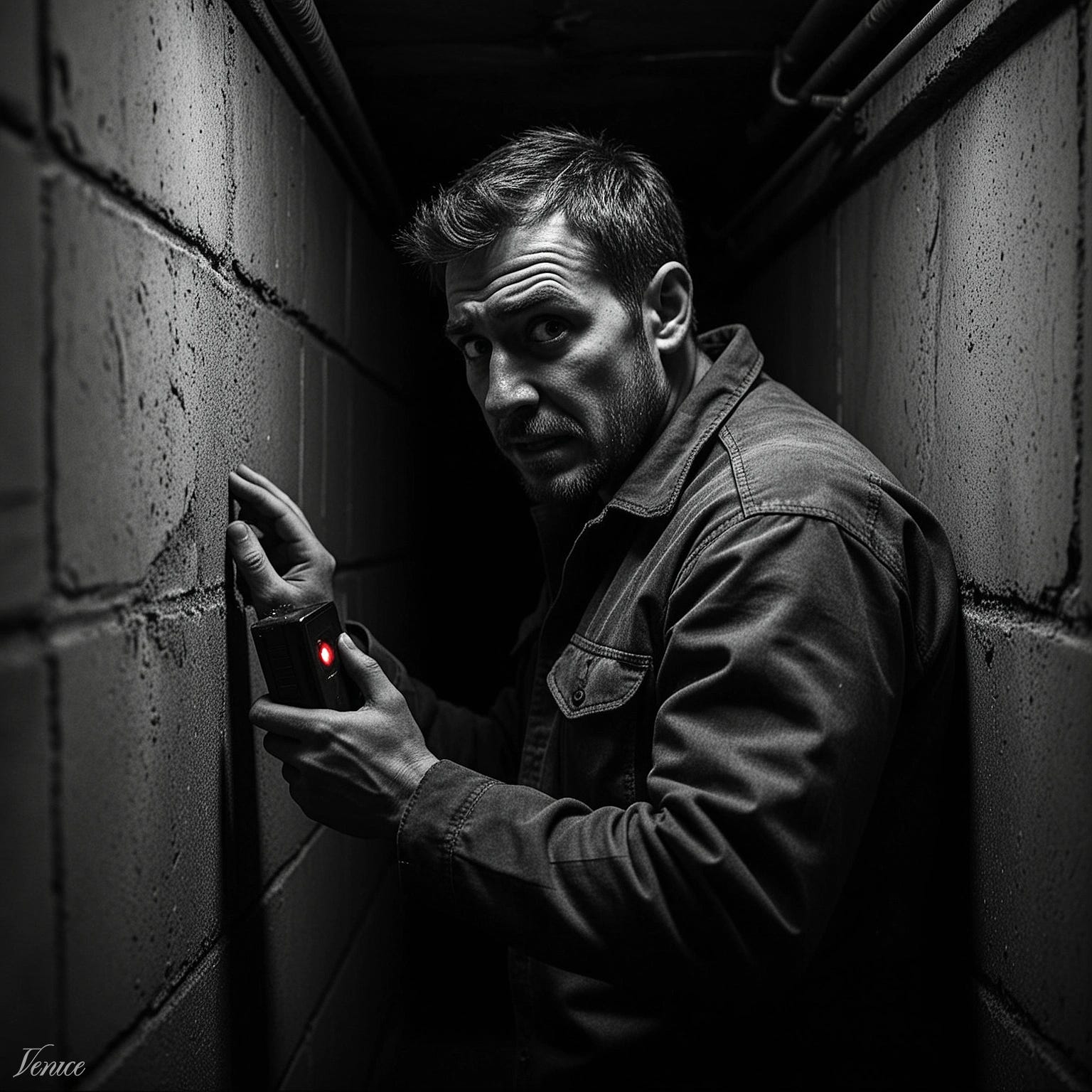
The man was stopped, his back against the wall, his chest heaving. He was holding something in his hand. A tool. A small, black device with a blinking red light.
“Don’t come closer,” the tech said.
“Put it down.”
“I can’t. It’s already activated.”
Declan’s blood went cold. “What is it?”
“A kill switch.” The tech’s voice was hollow. “Not for you. For the system. If I don’t complete the service window, the building locks down permanently. Emergency protocols. No one gets in or out until the board intervenes.”
“Then why are you running?”
“Because I wasn’t supposed to be seen.”
The tech’s hand trembled. The device in his palm pulsed, the red light blinking faster. Declan could hear Matthias approaching, his footsteps a steady rhythm in the corridor.
“Give me the device,” Declan said.
“I can’t.”
“You can. You just don’t want to.”
The tech’s eyes met his. There was something there. Fear, yes. But also something else. Resignation. The look of a man who knew he was already lost.
“They have my family,” the tech said. “I don’t have a choice.”
He pressed the button.
The building screamed.
It was a sound Declan had never heard before, a sound that didn’t belong in a place of glass and steel and fluorescent lights. A deep, mechanical roar that vibrated through the walls, through the floor, through his bones. The lights went out. The emergency systems kicked in, bathing everything in red.
The tech was gone.
Declan stood in the dark, his heart pounding, his hands shaking. Matthias found him a moment later, his face lit by the crimson glow, his expression unreadable.
“He triggered the lockdown,” Declan said.
“I know.”
“He said they have his family.”
“They always do.”
Matthias stepped closer. His hand found Declan’s arm, his grip firm, grounding. “We need to get back to your office. Now.”
“Why?”
“Because the device he used. It’s not a kill switch. It’s a beacon.”
Declan stared at him. “A beacon for what?”
Matthias’s face was hard, his jaw tight. “For whoever’s coming next.”
They ran.
The corridors were a nightmare of red light and shadows. Every door they passed was locked, every reader dark, every panel dead. The building had turned against them, its systems shutting down one by one, sealing them in.
They reached Declan’s office. The door was open, the lights still on. The folder was still on the desk, the routing sheet still open to the code BRC-SPON-07.
Matthias went to the window. He looked down at the street, then up at the sky. “They’re here.”
“Who?”
“The board. Or their representatives. Someone with authority.”
Declan joined him at the window. Below, a black car was pulling up to the building’s entrance. No logo, no markings. Just tinted windows and a driver in a dark suit.
“We have to move,” Matthias said.
“Where?”
“The sub-basement. There’s a service tunnel that leads to the old train station. It’s off the grid. No cameras, no sensors.”
“How do you know about it?”
Matthias’s smile was thin, bitter. “I told you. I’ve seen this before.”
Declan looked at the folder. The code. The routing sheet. The clean, damning paper trail that had started all of this.
He grabbed it.
“Let’s go.”
They moved through the building like ghosts. Down stairwells, through service corridors, past locked doors that Matthias opened with a tool from his pocket, a thin piece of metal that he worked into the locks with practiced ease. The building groaned around them, its systems fighting back, trying to hold them in.
The sub-basement was cold and damp. The air smelled of mold and rust. The service tunnel was a dark mouth in the wall, its entrance half-hidden behind a pile of old equipment.
Matthias stopped at the entrance. He looked back at Declan, his face half in shadow.
“Once we go in there, we can’t come back. Not the way we came. The building will know we left. They’ll seal this entrance behind us.”
“I know.”
“Are you sure?”
Declan looked at the folder in his hands. The code BRC-SPON-07. The name he still didn’t know, the name Matthias had recognized, the name they would have to drag into the light.
“I’m sure.”
They stepped into the tunnel and the darkness swallowed them.
The tunnel ran for what felt like miles. The floor was uneven, the walls slick with moisture. Water dripped from somewhere above, a steady, rhythmic sound that echoed in the silence. Declan’s phone was dead. Matthias’s was too. They walked by touch, one hand on the wall, the other reaching out into the void.
“How much further?” Declan asked.
“Another kilometer. Maybe less.”
“You’ve done this before.”
“I told you. I’ve seen this before.”
“That’s not what I mean.”
Matthias stopped. Declan nearly ran into him, his hands coming up to brace against the other man’s back. The contact was sudden, electric. He could feel the heat of Matthias’s body through his shirt, the tension in his muscles, the rapid beat of his heart.
“What do you mean?” Matthias asked.
“I mean you’ve done this before. Run through a tunnel in the dark. With someone else.”
A long silence. The water dripped. The darkness pressed in.
“Yes,” Matthias said. “I have.”
“What happened to them?”
“They didn’t make it.”
Declan’s hands were still on Matthias’s back. He could feel the other man’s breath, slow and steady, the rhythm of someone who had learned to control his fear.
“I’m not them,” Declan said.
“I know.”
“I’m not going to die in this tunnel.”
Matthias turned. In the dark, Declan could barely see his face. Just the outline of his jaw, the glint of his eyes, the shape of his mouth.
“No,” Matthias said. “You’re not.”
He reached out. His hand found Declan’s cheek, his thumb brushing across the line of his jaw. The touch was soft, tentative, a question asked in the dark.
Declan answered.
He leaned into the touch, his eyes closing, his breath catching. Matthias’s hand slid to the back of his neck, pulling him closer. Their foreheads touched. Their breath mingled.
“This is a bad idea,” Matthias whispered.
“I know.”
“We should keep moving.”
“I know.”
Neither of them moved.
The water dripped. The darkness held.
And then Matthias’s mouth was on his.
The kiss was hard, desperate, a collision of fear and want and the sharp, electric need of two people who had been running too long. Declan’s hands found Matthias’s waist, pulling him closer, feeling the hard line of his body against his own. Matthias’s fingers tangled in his hair, tugging, claiming.
They broke apart, gasping.
“We have to go,” Matthias said.
“I know.”
“But I needed to do that first.”
Declan’s heart was pounding. His lips were numb. “I needed it too.”
Matthias leaned close to Declan’s ear, “I love you.”
Declan looked up to what he assumed was Matthias’ face in the dark.
“I love you too.”
They moved on.
The tunnel opened into a wider space. A platform, old and crumbling, the remnants of a train station that had been abandoned decades ago. A single light bulb hung from the ceiling, casting a weak, yellow glow.
Matthias stopped at the edge of the platform. He looked back at the tunnel, then up at the light.
“We’re clear,” he said. “For now.”
Declan sat down on the edge of the platform. His legs were shaking. His hands were shaking. Everything was shaking.
He opened the folder.
The routing sheet was still there. The code BRC-SPON-07. The clean, damning paper trail that had started all of this.
He stared at the code.
“You recognized it,” he said. “In my office. You knew what it meant.”
Matthias sat down beside him. Their shoulders touched. Neither of them pulled away.
“BRC-SPON-07,” Matthias said. “It’s not just a code. It’s a person.”
“Who?”
“The head of the Board Risk Committee. The one who signs off on these exceptions.”
“You know their name.”
Matthias was quiet for a long moment. The light bulb flickered. The water dripped.
“I know their name,” he said. “But I’m not going to tell you.”
“Why?”
“Because once you know, you can’t unknow. And once you can’t unknow, you have to act. And once you act, there’s no going back.”
Declan looked at him. The yellow light cast shadows across Matthias’s face, making him look older, harder, more tired.
“I’m already past the point of no return,” Declan said. “Tell me.”
Matthias met his eyes.
“It’s Elara.”
The name hung in the air like a gunshot.
Declan’s mind went blank. Then it filled with images. Elara sliding the folder across her desk. Elara warning him about the elevator. Elara’s fingers lingering on the manila edge.
“No,” he said.
“Yes.”
“She gave us the folder. She helped us.”
“She gave us what she wanted us to see. She helped us get out. But she’s the one who signed the exception.”
Declan shook his head. His hands were shaking again. “She’s the COO. She’s not on the Board Risk Committee.”
“She is. It’s a secret appointment. Hidden in the bylaws. Only a handful of people know.”
“How do you know?”
Matthias’s face was unreadable. “Because I used to work for her.”
The words hit Declan like a physical blow. He stared at Matthias, seeing him for the first time. The hard edges. The careful silence. The way he moved through the building like he owned it.
“You were one of them,” Declan said.
“I was. I’m not anymore.”
“Why should I believe you?”
“Because I’m here. In this tunnel. With you. Running from the same people I used to work for.”
Declan wanted to argue. He wanted to push back, to find the lie, to prove that Matthias was wrong. But he couldn’t. Because he knew, deep down, that it was true.
He looked at the folder. The code. The name.
Elara.
“We have to go back,” he said.
“We can’t. Not yet.”
“We have to confront her.”
“We will. But first, we need proof. Real proof. Something she can’t explain away.”
Declan closed the folder. He stood up, his legs shaking, his heart pounding.
“Then let’s find it.”
Matthias stood beside him. The tunnel stretched out ahead of them, dark and unknown. The station was empty. The city was above them, waiting.
They walked out of the light and into the dark.
The old station was a skeleton of what it had once been. Tiles cracked and missing, benches rotted to splinters, a ticket booth with glass long since shattered. The air was cold and still, heavy with the weight of decades.
Declan’s footsteps echoed on the concrete. Matthias moved beside him, silent as a shadow.
“Where does this lead?” Declan asked.
“To the surface. About half a kilometer north of the building.”
“And then?”
“Then we find a place to think. Somewhere safe.”
“There’s nowhere safe.”
Matthias didn’t argue.
They reached the exit. A rusted door, half-hidden behind a collapsed wall. Matthias pushed it open, and daylight flooded in.
Declan blinked. The light was too bright, too sharp after the darkness of the tunnel. He stepped out into the alley, the gravel crunching under his feet.
The city was normal. Cars passed. People walked. The sun was high and pale, the sky a washed-out blue.
It felt like a lie.
Matthias closed the door behind them. He looked at Declan, and for a moment, something softened in his face.
“We’ll figure this out,” he said.
“Will we?”
“We have to.”
Declan looked at the folder in his hands. The code BRC-SPON-07. The name he couldn’t unhear.
Elara.
“I trusted her,” he said.
“I know.”
“She was the only one I trusted.”
Matthias was quiet. Then, softly: “Trust is a dangerous thing in this world.”
Declan looked at him. The man who had kissed him in the dark. The man who used to work for the enemy. The man who was standing beside him now, in the daylight, waiting.
“I don’t know if I can trust you,” Declan said.
“I know.”
“But I don’t have anyone else.”
Matthias’s hand found his. Their fingers intertwined, a quiet anchor in the noise of the city.
“Then let’s start there,” Matthias said.
They walked out of the alley together.
The city swallowed them.
The city didn’t care about them. Taxis honked. A delivery truck double-parked, its driver cursing at a cyclist. A woman with a stroller walked past without a glance. Declan felt invisible and exposed at the same time.
Matthias led them east, away from the building, away from the glass tower where Elara was probably already spinning her story. They walked through neighborhoods that shifted block by block. Glass and steel gave way to brick. Brick gave way to plywood and chain link. The air changed too. Cleaner somewhere. Dirtier here.
“Where are we going?”
“Somewhere I used to hide.”
“Before?”
“Before I left. Before I made my money. When I was still figuring out how to leave.”
Declan wanted to ask more. But the questions were piling up in his throat, too many to push past. He settled for following.
The building was a walk-up, five stories of faded brownstone with a fire escape that sagged like a tired spine. Matthias punched a code into a keypad by the door. The lock clicked. Inside, the hallway smelled of boiled cabbage and old carpet. The stairs creaked under their weight.
Third floor. Matthias stopped at a door at the end of the hall. He pulled a key from his pocket, one Declan hadn’t seen him take out. The key turned. The door swung open.
The apartment was small. A couch that had seen better decades. A kitchen table with one leg shorter than the others, propped up by a folded matchbook. A window that looked out at the brick wall of the building next door. Dust covered everything.
“Not much,” Matthias said. “But it’s off the books.”
Declan stood in the middle of the room. He felt the silence settle around him, thick and heavy. The folder was still in his hands. He hadn’t let go of it since the tunnel.
“She knew we’d find the code,” he said. “She put it in the folder on purpose.”
Matthias closed the door. He locked it, then slid a chain across. “Probably.”
“Why?”
“To see what you’d do with it. To see if you’d follow the trail or let it go.”
“I followed it.”
“And now she knows exactly where you are.” Matthias leaned against the door. His face was hard to read in the dim light. “Or she thinks she does.”
Declan set the folder on the table. He opened it. The routing sheet stared back at him, the code BRC-SPON-07, the clean lines of the paper trail. He traced his finger over the letters.
“There has to be more,” he said. “A paper trail this clean doesn’t exist without a digital one.”
“There is. But it’s locked behind layers of encryption. Firewalls. Protocols.”
“Then we break through them.”
Matthias laughed. It was a short sound, dry and bitter. “You’re not a hacker, Declan. Neither am I.”
“No. But we know someone who is.”
Matthias’s eyes narrowed. “Who?”
Declan thought about the tech. The one with the device. The one who had pressed the button and triggered the lockdown. The one who had said his family was being held.
“The tech,” Declan said. “The one who ran. He knew what he was doing. He knew the system.”
“He works for them.”
“He worked for them. Now he’s a liability. They’ll cut him loose if they haven’t already.”
Matthias shook his head. “You want to find a man who just locked us in a building and try to recruit him?”
“I want to find a man who has nothing left to lose. That’s the most dangerous kind of ally.”
The words hung in the air. Matthias stared at him. Then he pushed off from the door and walked to the window. He looked out at the brick wall, his back to Declan.
“He’ll be running too,” Matthias said. “If he’s smart.”
“He’s not smart. He’s scared. Scared people make mistakes.”
“And you’re going to find him before they do?”
“We have to try.”
Matthias turned. The light from the window caught his face, and Declan saw something there he hadn’t seen before. Something like respect.
Matthias crossed to the small, scarred table. “Alright. How do we find him?” His fingers brushed the folder’s edge, a gesture both possessive and hesitant. “He vanished into the building’s guts. No one gets out of there without a trace.”
“Not without a trace,” Declan countered, his mind racing, connecting the dots of the morning’s chaos. “The device. The beacon he activated. It wasn’t just a signal for them. It was a tracker. He was tagged the moment he accepted the job. They know where he is right now.”
Matthias’s gaze sharpened. “Then they’ll get to him first.”
“Only if they’re looking for a person,” Declan said, pulling his phone from his pocket. It was still dead. He tossed it onto the table with a clatter. “But they’re not. They’re looking for a loose end. A liability. They expect him to be hiding, running for his life. They’ll be checking known bolt-holes, cash points, his family’s address.”
He leaned forward, his knuckles white on the table. “They won’t be checking for a ghost in the machine. A digital phantom trying to erase himself.” He looked up at Matthias, a dangerous light in his eyes. “We don’t find the man. We find his digital shadow. We find the access point he used to trigger the lockdown. He had to have a terminal nearby. A maintenance hub. That’s where he’ll be, trying to wipe his existence from the system before they erase his physical one.”
A slow smile spread across Matthias’s face, thin and sharp as a razor. “The sub-basement service tunnel. There’s a network hub there. An old one, but it connects to the building’s core. It’s the only place he could have gotten a clean signal out during a lockdown.”
“Then that’s where we’re going,” Declan said, grabbing the folder.
“No,” Matthias said, his hand covering Declan’s, stopping him. “Not we. You stay here.”
“You’re the one they’re hunting, Matthias. I’ll go.”
“Like hell. I’m not letting you walk into that alone.”
“You won’t be alone,” a voice said from the doorway. “You’ll have me.”
They both turned. Standing in the open doorway, framed by the dim light of the hallway, was Elara. She wasn’t in her power suit. She wore dark trousers, a simple black turtleneck, and her expression was stripped of all corporate polish. It was raw, cold, and utterly unreadable. In her hand, she held a silenced pistol, and it was aimed squarely at Matthias’s chest.
“Put the folder down, Declan,” she said, her voice as calm as if she were asking for a coffee refill. “It’s time we all had a truly honest conversation.”

This is beyond unexpected and the plot just got serious!!
And the plot thickens!