


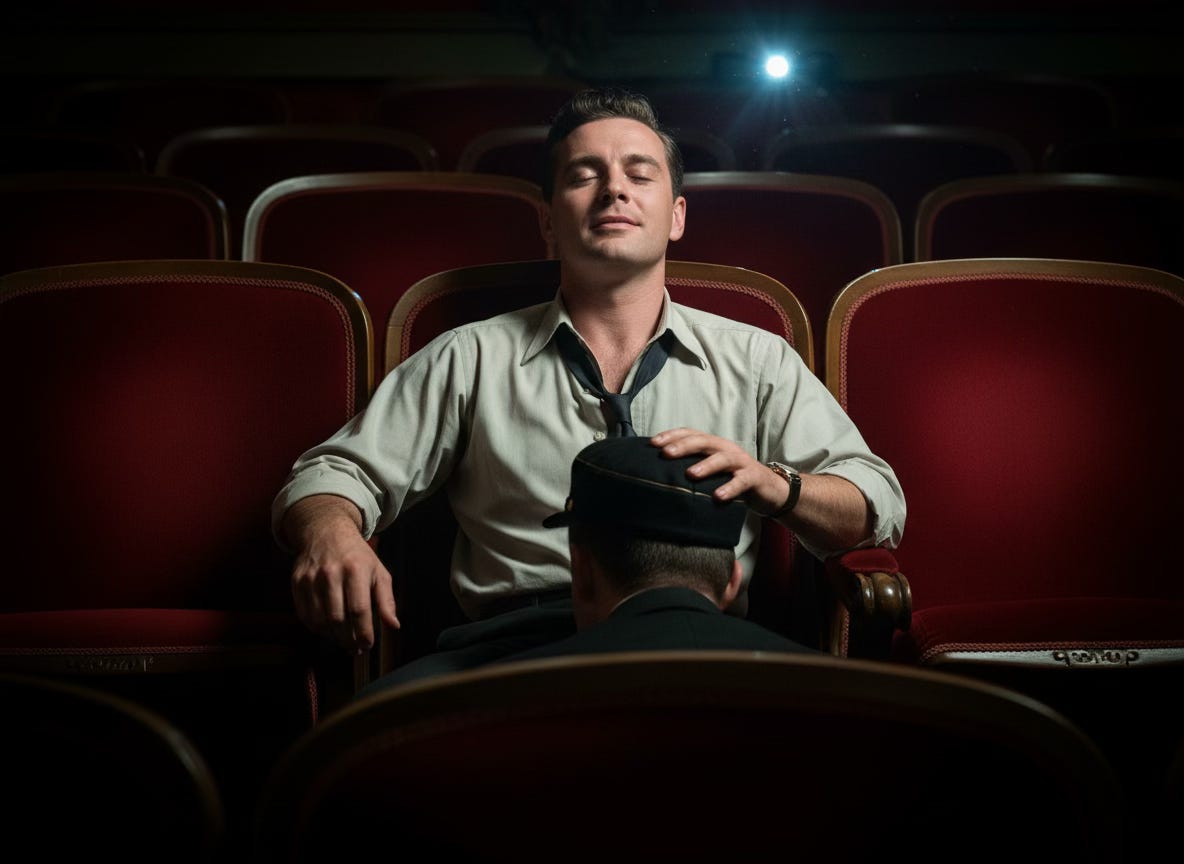
New York City, 1956
Rain drew lazy rivulets down the windows of the Regency Theatre, warping neon into liquid bruises on the sidewalk. The posters in their glass coffins promised Technicolor epics, but only a handful of yellowed bulbs lit the marquee. Adrian Cole paused outside the doors, counting the seconds before entering—an old trick for convincing himself of intent. It did nothing for his nerves. The ticket booth was a glass cube with a girl behind it who looked like she should’ve been home three hours ago. Her mascara was smudged and her boredom so absolute it felt strategic.
“Last show’s in ten,” she mumbled, voice filtered by the intercom grill. “Balcony’s closed. Five even.”
Adrian slid a bill under the glass. “That’s fine,” he said, careful to keep his voice level, deferential. He took the stub and the measured, suspicious glance she gave him, then passed through the turnstile, all careful shoulders and hands. His shirt was white, creased so sharply it felt like costume. The jeans were cuffed precisely, still blue-black at the seams, and his shoes—polished to an almost feminine gloss—clicked soft as moths against the faded carpet.
The lobby stank faintly of lemon oil and ghosts. Somewhere, a vacuum cleaner whined. The only other patrons—a couple in their forties, maybe, blurred by drink or inertia—were fused together near the concession counter, debating Milk Duds versus the more expensive fudge. Adrian kept his eyes ahead, past the pinched smile of the counter boy, into the cool arterial darkness of the theater itself.
Inside, the air was dense with the dry rot of velvet and the memory of cigarettes. The seats radiated a retrograde glamour—threadbare, but still noble, the armrests scratched with the hieroglyphics of a thousand nervous hands. In the front row, the couple had migrated, sinking into the expanse as if it were a love hotel suite. The woman draped her sweater across both their laps, the way wives did in movies when they were hiding something.
Adrian hovered in the back, mapping the theater by instinct. Second row from the back, aisle seat: easy to exit, easy to see. He took it, folded himself in, and exhaled through his teeth. The pulse of the projectors, the silver shimmer of dust in the beam—it all worked its anesthetic. For a while, that was enough.
He tried to watch the movie. Something Western, a double feature relic with six-shooters and painted mesas. His mind wandered, counting exits, tracking the footfalls that sometimes echoed from the lobby. He told himself he was here for the film, for the dark—never for the thing that sometimes happened in the dark, never for the rumor that had reached him through the grapevine of men who never met each other’s eyes.
Fifteen minutes in, the usher arrived.
He was tall, maybe six feet, with the bearing of someone who had learned to move without drawing focus. The uniform was regulation black, but the jacket was pressed so flat it seemed lacquered. Brass buttons caught the light in sharp little flashes. His hair—dark, parted with the precision of a razor—looked wet even when dry. He swept the beam of his flashlight with a casual authority, scanning the half-empty rows, pausing on Adrian with an intent that read less as curiosity and more as challenge.
“You’re fine. Don’t move.”
His voice was low, customer-service calm, with a vowel drag that placed him north of the city. He lingered for a heartbeat, then stepped down to the aisle, angling the flashlight into the well at Adrian’s feet.
“Just the three of you?” he asked, glancing toward the couple.
Adrian nodded, throat dry. “I guess so.”
The usher’s eyes darted up, assessing. “If they turn around, you’re leaving. Understood?”
Another nod, smaller. The man’s gaze lingered a moment too long—reading the lines of Adrian’s jaw, the starched collar, the way his hands gripped the seat arms like he was bracing for an impact that never came.
The usher’s expression softened—fractionally, but enough to be noticed. He clicked off the flashlight and leaned in, voice shearing lower.
“Move. Quietly. Two seats over, closer to the aisle.”
Adrian shifted, heat blooming behind his ears. The velvet creaked beneath him, a sound that felt as loud as a scream, but the couple up front didn’t stir. He moved as ordered, sliding across the row with minimal friction, his skin prickling with the awareness of being watched—not just by the usher, but by the whole dim apparatus of the theater itself.
The usher stood at the end of the row, hands behind his back. He nodded, once, then receded into the shadows, leaving Adrian with the drumbeat of his own pulse and a film he had already forgotten.
He tried to focus, to let the gunfire and the sun-bleached landscapes erase the encounter. But the memory of the usher’s gaze clung to him, as persistent as a fever. Adrian picked at a loose thread in his jeans, forcing his thoughts into orderly lines. He was here for the movie. The usher was just doing his rounds. The theater was nearly empty. Nothing would happen tonight.
He tried not to hope otherwise.
The reel changed, the interval announced by a brief stutter and the clack of gears. The couple at the front row whispered, one of them giggling too loudly. Adrian counted the rows between them and himself, the rows between him and the exit. He imagined the usher waiting in the lobby, hands in his pockets, running mental arithmetic on how long it took a normal person to finish a film.
He watched the beam of the flashlight trace the inner walls every fifteen minutes, always pausing on his position. After the fourth pass, Adrian looked back over his shoulder, feigning casual curiosity.
The usher was gone.
No: not gone, but standing in the main aisle, staring straight at him. The darkness warped his features, but the glint of his buttons was unmistakable.
Adrian returned to the screen, heart stuttering. He felt the pressure of the gaze, the mutual script of what might come next. He waited, barely breathing, until the next time the flashlight flickered.
It didn’t come.
Instead, the usher appeared at his row, gliding in with the ghost walk of someone well practiced at moving unseen.
He bent down, so close that Adrian felt the exhale of his breath on the back of his neck.
“In ten, the house lights come up for a reel change. That’s your window.”
A beat, then: “If you want it.”
Adrian didn’t answer. The usher was already gone, dissolving into the corridor with a movement so fluid it could have been an afterimage. The seconds until the lights rose stretched out into a cold infinity. The film’s violence blurred, then receded; only the cadence of the usher’s warning remained, etching itself into Adrian’s bones.
When the interval came, the couple up front lit a cigarette, huddling in the blue spill of the screen. Adrian stood, wiped his palms on his jeans, and drifted to the lobby, where a janitor mopped the tiles with one hand and cradled a radio in the other. No one looked up. The usher was waiting, just beyond the men’s room door, eyes steady.
“This way,” he said, a whisper built for acoustics and secrets.
He led Adrian through a utility corridor, silent except for the scuff of shoes and the heavy pulse of blood in his ears. There was a hush here, a waiting that pressed close, as if the walls themselves might confess. The usher stopped at a fire door, checked the handle, and ushered Adrian inside.
A storage room: stacked chairs, reels of film, the smell of disinfectant and old smoke. Here, the dark was more absolute.
“Five minutes,” said the usher, voice soft. “That’s all.”
Adrian nodded. He didn’t know if the shaking in his hands was anticipation or terror.
The usher stepped in, closing the door behind them with a hush that felt both final and merciful.
It was so easy to do what he did next.
He reached for Adrian, and Adrian let him.
The hush in the storage room was thicker than velvet, the only light seeping from the corridor’s transom—a wedge of white that cut a line across Adrian’s shoes and nothing else. The door shuddered shut. Airless, almost. Adrian felt the warmth of the usher pressed behind him, the certainty of hands trained for this particular darkness.
A gloved palm slid low around Adrian’s waist, a steadying counterbalance. It was clinical at first, more choreography than intimacy: a tug at his waistband, the slip of knuckles brushing beneath the hem of his shirt, fingers spreading to flatten over the pulse that beat against his hipbone. Then the expert flick of buttons—a practiced, unhurried invasion. Thomas’s breath ghosted against Adrian’s nape, impossibly steady. He must have done this before.
Adrian’s hands, clumsy with adrenaline, gripped the edge of a battered desk, the lacquer sticky under his fingertips. Thomas drew his body in closer, aligning his thighs with Adrian’s, knees bracketing him on either side so Adrian could not turn, only lean further into the safety of forward. The gloved hand slipped inside, found his cock already hard, and curled around it with an exquisite, measured pressure.


