


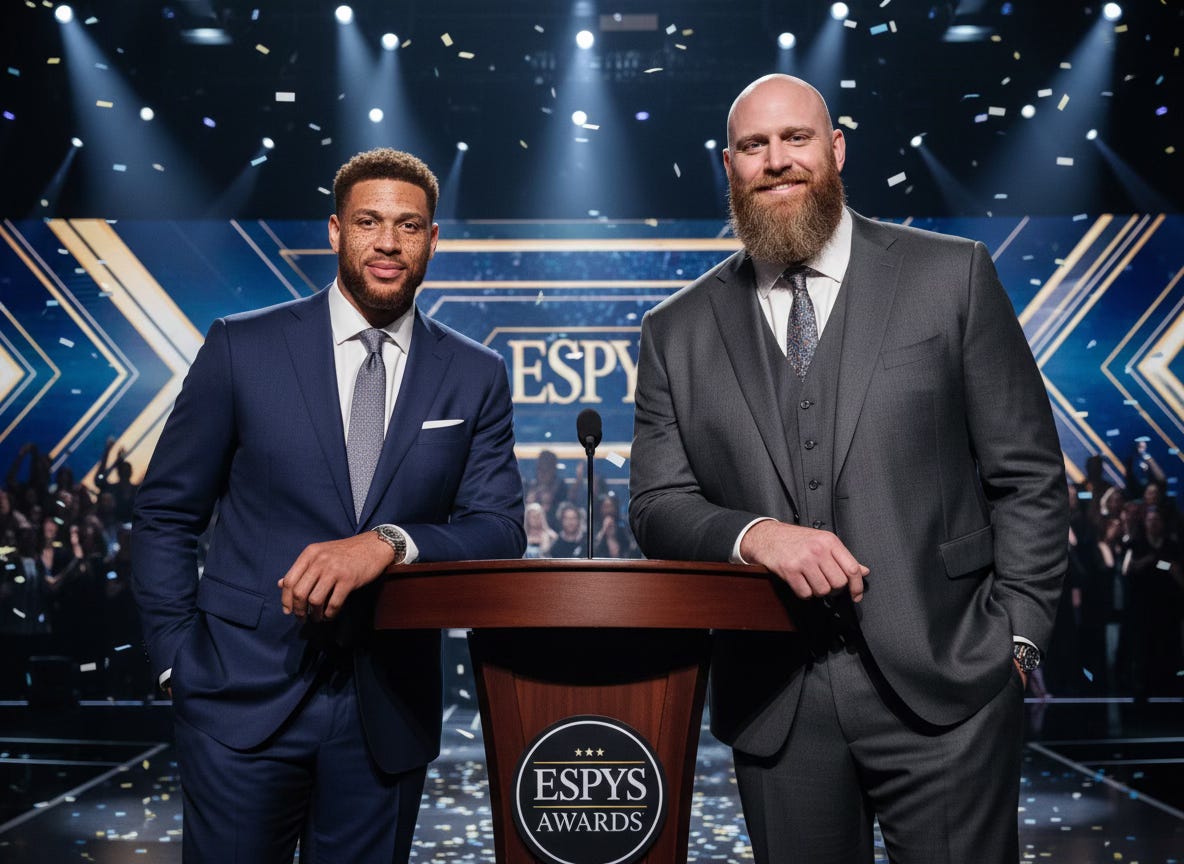
They say the lights are different at the ESPYs. Not the ordinary, mechanical glare of arena halogens or the flicker-hum of NBA courts, but a blinding, celestial array that spills from every angle, refracting in the thirty-foot projection of Drew Whitman’s teeth and Bryce Griffith’s deadpan squint. The crowd is a living organism tonight, pulsing in the dark with a thousand iPhones and the strobing tongues of press photographers.
Centerstage, Bryce stands a half step left of the teleprompter—his old point guard’s instinct. He doesn’t fidget. He holds himself with the static electricity of a man who has lived the bulk of his life under surveillance, a specimen polished until nothing but the glint remains. He’s smiling, not the default one but the real one, the upturned edge meant for unguarded moments. The suit is bespoke, midnight blue, lapels sharp enough to slice an offensive lineman. Beside him, Drew Whitman commands the room as if it were a defensive huddle and he the only man with the playbook. His suit gleams; the knot of his tie is a statement in asymmetry. Drew’s voice, when it lands, detonates from the diaphragm outwards. The first line of the night: “Give it up for every single one of you who had to sit through the NCAA eligibility meeting—twice!” A wave of laughter. The tension in the theater snaps, replaced by the loose confidence that only comes from knowing you’re in the hands of people who have sweat, bled, and caffeinated their way to this precise level of showmanship.
“Easy, Whitman,” Bryce says, mic cupped in palm. He pivots, posture a study in controlled relaxation. “If we’re already hitting the NCAA, what’s left for halftime?”
Drew grins. His canines gleam. “I was going to save the real roast for after the commercial, but let’s face it—some of us peaked in college. No need to name names. Looking at you, ‘Showstopper.’”
The audience eats it up. A camera finds a pair of collegiate athletes in the front row, one of them already mid-cringe. Bryce holds the beat, then leans in just enough for the shoulder of his jacket to brush the velvet of Drew’s, a glancing contact the cameras will probably miss but one the other man will not.
“Peaked in college,” Bryce repeats. He surveys the crowd, finds the red blinking dot of the main broadcast cam. “I’m sorry, Drew, didn’t you get drafted by the Browns?”
A groan-laugh, both self-effacing and savage. Drew bows, milkshake-thick arms stretching his sleeves. “True. But at least I have a sense of loyalty. Unlike some people who spent their last two seasons ring-chasing from city to city.”
“Ring-chasing is a sign of ambition,” Bryce retorts, now fully dialed in. “You’d know if you’d ever won one.”
The laughter is volcanic; it crests into applause, and the producers in the control booth are probably fist-pumping. The banter is on script, but the rhythm is jazz. Every punchline comes with a parry, every laugh line is spiked with something that will trend on X before midnight. Bryce can feel Drew watching him in profile, a sidelong glance meant for him alone.
The opening monologue barrels on, touching every landmine on the teleprompter—scandals, last season’s injuries, famous retirements. They riff off each other with the timing of a seasoned vaudeville act, tossing verbal grenades at the front row. At one point, Drew launches into a bit about a notorious hockey enforcer who once tried to fight a Zamboni. The camera finds the ex-enforcer, now balding and thick-necked in a rented tux, and he pantomimes a surrender, raising both hands. “Don’t worry,” Bryce says, “there’s a glass wall between us tonight.”
Drew cackles, the sound deep and spontaneous. It’s infectious. “Bryce, you should be careful. Rumor has it, he’s taken up competitive axe-throwing since retirement. That’s a real sport. Not like—what did you play again?”
“I played to win,” Bryce says. The crowd loves it. Every new volley is met with a spike in crowd noise, a sea of hands clapping, faces upturned to the hosts like worshippers at a very expensive, over-lit altar.
At one point they stand side by side, Drew’s knuckles grazing the curve of Bryce’s back as they gesture toward the jumbo screen. Neither acknowledges the touch, but neither recoils. The chemistry is atomic, as if all those years of strategic PR and coordinated rivalries had only sharpened their instincts for connection.
During a lull, Drew leans in, voice pitched for Bryce and Bryce alone. “You’re killing, man. The room’s yours.”
Bryce doesn’t look at him. He keeps his gaze on the audience, the full wattage of his smile pointed outward. But his left hand, at rest at his side, makes a barely perceptible fist. “We’re killing,” he murmurs, then snaps back to teleprompter clarity: “Tonight, we’re here to honor the best. The bravest. The slightly concussed.”
More laughter. A sports legend is called up for a lifetime achievement award, and the hosts retreat to the wings, microphones muted. As the winner shuffles onto the stage, Drew turns, quick and conspiratorial. “Seriously, you should’ve done stand-up.”
Bryce shrugs, unbuttoning his jacket for airflow. “I get the sense it’s a lot like basketball. You eat shit for the first few years and hope the crowd doesn’t eat you alive.”
Drew grins, a real one, looser than anything he offers to the crowd. “Couldn’t handle you on the court. Probably couldn’t handle you on tour either.”
“For what it’s worth, I wouldn’t trade you for a better co-host,” Bryce replies. The moment lingers longer than is strictly necessary, interrupted only by the showrunner hissing their names over headset.
Segment two begins. They’re back in front of the lights, reading nominations, launching into a medley of jokes that walk the line between roast and homage. They draw focus—Bryce’s dry wit, Drew’s physicality, their overlapping cadence. The teleprompter lags behind their improvisation, and the stage manager’s panic is barely concealed behind the upraised index finger signaling “stretch” from the front of the pit.
At the tail end of the segment, as a Paralympic swimmer limps up to accept an award, Drew leans over, lips near Bryce’s ear. “I’d give up both knees to see you bomb a joke, just once.”
Bryce deadpans, “You already gave up both knees.”
Drew laughs.
The stage manager gives the wrap signal. “That’s all for now, folks,” Bryce says into the camera, composure unbroken, “We’ll be back after a word from people who still think athletes can sell you a Chevy.”
Spotlights fade. The applause is tidal. Bryce and Drew exit stage left, trailing fragments of laughter and faint mist from the fog machines.
The moment they clear the main curtain, the air temperature drops five degrees. Technicians converge—an unassuming herd in headsets and black polos. A tiny woman yanks Bryce’s lapel microphone off, her fingers surprisingly gentle against his throat. Drew’s is ripped off with less ceremony.
The designated “VIP lounge” is a hasty pop-up: four walls of thick blackout drape and a ceiling just high enough to accommodate Drew’s wingspan if he cared to reach for it.
The couch is some executive’s wet dream, overstuffed leather that sighs obscenely when Drew drops his frame into it. He spreads out, legs splayed, tie yanked loose and collar popped open, like a thoroughbred huffing after a photo finish. Bryce stands for a moment, running his hand down the front of his jacket—autopilot habit—before methodically stripping it off and draping it over a padded hanger affixed to a mobile rack. He smooths it once, ensures the sleeves are perfectly aligned. Only then does he sit, perching at the edge of the couch, as if ready to be summoned for an encore.
The room is stocked: champagne in sweating silver buckets, plastic platters of sushi and cheese, and a tiered tray of macarons in tragic colors. Three glasses stand on the table, only one of them with actual liquid in it—Drew’s, already half-gone. He tilts it towards Bryce in mock salute, the rim catching a glimmer of ambient light.
“So, Showstopper,” Drew says, one arm draped along the couch back, “what’s the post-show plan? You strike me as a guy who schedules his sleep.”
Bryce’s laugh is controlled, close-mouthed, the kind designed not to ruffle bow ties or loosen ties of any sort. “I like to keep a schedule,” he admits, then studies Drew’s profile, the way his face softens in the absence of cameras. “Are you always on? Or is there an off switch somewhere I haven’t found yet?”
Drew’s reply is a shrug, followed by a slouch deeper into the cushions. “You never know when you’re being watched. At this point, even my toothbrush is probably recording analytics.”
He pivots, turning his entire body toward Bryce, leg folded up on the couch in a way that threatens to invade Bryce’s perfectly calibrated personal space. “You want to hear something dark? Last season, we lost a heartbreaker in overtime. Worst stadium in the league, acoustics like a wind tunnel, half the stands already empty. I’m walking off the field, helmet in hand, sweat dripping into my eyes, and this reporter—fresh out of college, braces and all—sticks a mic in my face. Asks if I think the loss is a reflection of my leadership skills or just a sign that I should retire.”
Bryce winces in sympathy. “Did you punch him?”
“I wish,” Drew grins. “No, I told him—on live TV—that my only regret was missing the early bird special at the team hotel buffet. They replayed it on SportsCenter for a week.”
Bryce laughs for real, the sound rawer than his on-camera persona allows. “I saw that clip,” he admits. “You looked like you were going to eat the microphone.”
“Probably should have. Better protein content than anything in that buffet.”
They lapse into silence, punctuated only by the distant, uneven rhythm of applause and laughter from the stage beyond the curtain. The couch’s surface warms under them; champagne beads slide down the bottle in slow motion, pooling on the black lacquer of the table.
Drew’s voice drops, the bravado blunted. “You ever miss it?”
Bryce considers the question, then traces the rim of his glass with a careful finger. “Not the games. Not the travel or the press. Sometimes, I miss the clarity. Knowing exactly what you’re supposed to do, every second of the play. Nothing ambiguous about a shot clock.”
Drew leans in, his forearm flexing on the couch back. “That’s the hardest part, right? Out here, nobody tells you what the next move is. It’s all—” He waves his hand, trying to encompass the absurdity of post-sports careers, talk shows and voiceovers and the endless hustle for relevancy.
Bryce smiles, but it’s bittersweet. “You do alright. If anyone’s built for the circus, it’s you.”
Drew accepts the compliment, though he doesn’t look entirely convinced. “Turns out catching footballs doesn’t prepare you for much else. Maybe that’s why I like this gig—” he gestures at the champagne, the velvet, the noise beyond the curtain. “It’s like the afterparty never ends. And hey, at least I get to hang out with the one guy who made my alma mater cry for four straight years.”
There it is again: the deliberate closeness, the invitation hanging in the air. Bryce feels himself drawn into the gravity of it, the old magnetism of a locker room moment extended into new, uncharted territory.
“You know,” Bryce says, voice low, “they still won’t let me back on campus. There’s a mural of my three-pointer in the student rec center, and every year somebody vandalizes it.”
Drew’s laugh is sudden and unfiltered. He takes a second to collect himself, then offers the bottle. “Toast to vandalism?”
Bryce raises his glass to meet Drew’s.
“You ever wonder if this is all there is?” Drew asks, not quite meeting Bryce’s gaze. “After the lights, the noise. If we’re just—” He shrugs, hands suddenly restless. “Props in somebody else’s highlight reel?”
Bryce studies him. The bravado is thinning; the golden boy mask slips, revealing something earnest, almost raw. “I think about it,” Bryce admits. “A lot more than I’d like to.”
Drew looks up, eyes sharp and suddenly searching. “So what do you do with that?”
Bryce considers. “You keep playing,” he says. “Even if it’s a new game.”
Drew smiles, this one softer, weightier. He shifts his leg, the new angle closing the space between them to almost nothing. Their knees touch, and neither man moves.
Bryce glances at his jacket, still perfectly hung, and then at Drew, sprawled and effortless. “You think we could get away with just not going back out?”
“Probably not,” Drew says. “But it’d be fun to try.”
Drew slides his empty glass onto the table with the kind of careful precision that says I need to move, or I’ll combust. The silence stretches, then Bryce breaks it, voice pitched soft and just for Drew:
“Do you ever feel like it’s all just a game? Not sports—this.” A flick of the hand, encompassing the gold-embossed show programs, the champagne, the entire charade of the night.
Drew nods, a slow-motion bob. “Yeah. Except the scoreboard’s broken and nobody told us.”
They both laugh, but the humor is threadbare. The moment lingers, and Drew’s knee, already touching Bryce’s, flexes slightly, the contact gentle but unmistakable.
Bryce inhales, the motion subtle but charged. “You know what’s funny? The first time I ever saw you, I thought, ‘That guy will never stop smiling.’ Like you were born with the helmet on, grinning through the facemask.”
Drew’s grin appears, but this time it flickers, falters, leaves something open. “It’s easier than telling people you don’t know what you’re doing,” he says, not quite joking. “Or that you wake up some mornings and forget who you’re supposed to be.”
There is a tremor of honesty in the space now, a vibration so pure it could break glass.
“Sometimes,” Bryce says, meeting Drew’s gaze, “I wake up and wonder if anyone will remember my name in five years.”
Drew’s eyes soften. He leans closer, not a lunge but an incremental surrender of territory. “You’re the only one they talk about in the green room,” he says. “Every highlight reel, every old-timer with a microphone. Even the stagehands remember your stats.”
Bryce flushes, a flicker of color at the edge of his cheekbone. He drops his gaze, but the gravitational pull between them only intensifies.
“You’re good at this,” Bryce says. “Being seen.”
Drew shrugs. “You make it easier. It’s a lot more fun than carrying a team of rookies through a playoff drought.”
Bryce laughs, low in his chest. “We make a good team.”
The hush holds as long as it can—seconds stretched, then wound tight. Neither man speaks, the only movement a pulse at Bryce’s throat and the nervous flex of Drew’s fingers against his palm.
Bryce finds he can’t look away from Drew. The armor is gone, and what’s left is raw: the slightly chapped line of his mouth, the way the last of his confidence clings to the tilt of his jaw, the tremor in his breath. The moment feels like standing at the edge of something infinite, toes curled on the lip, knowing that one step means nothing will ever be as safe or quiet again.
He moves first.
It’s nothing, at first—a tilt of the head, an almost-accidental collision of lips, more apology than intent. The touch is feather-soft, tentative, and when Drew doesn’t pull away, Bryce leans in harder, letting the world tip. He can taste the last sip of champagne on Drew’s tongue, the faint aftershock of citrus and something saltier, more dangerous underneath. Drew kisses back in a way that’s both cautious and desperate, as if he’s been waiting for this signal since the first handshake, the first cheap-shot insult traded on a television set.
There’s no choreography, no practiced rhythm; it’s all starts and stops, trial and error, years of denial dissolving in the heat of the first honest contact. Drew’s hand finds the back of Bryce’s neck, rough from old injuries, fingers splaying as if to anchor himself. The other hand lands on Bryce’s thigh, a measured squeeze, uncertain but unmistakable in intent.
Bryce exhales through his nose, the sound ragged, and lets himself fall forward, chest to chest, pinning Drew against the deep curve of the sofa. Their knees bump, awkward in the confined space, and Bryce’s arm tangles for a moment in the curtain of Drew’s loosened tie before he manages to get it off entirely and drop it behind the couch.
Somewhere in the auditorium, a laugh erupts—brilliant, too loud, like the world’s worst chaperone. It ricochets through the soundproofed walls and dies in the velvet folds of the curtain. Neither man pulls back, but the reminder is stark: the room is private only in theory, and the thinnest membrane separates them from exposure.
Drew breaks first, lips ghosting along Bryce’s jawline to his ear, voice so low it’s barely a vibration. “You know they’ll never let us live it down, right? If we get caught—”
Bryce silences him with another kiss, firmer now, almost punitive. “They can’t cancel us both,” he mutters against Drew’s lips, and Drew laughs into the kiss, a sound that’s all teeth and surrender.
The urgency grows, as if time has been rented by the minute. Bryce’s hands go to Drew’s suit jacket, fingertips skating the lapel before digging into the starched cotton beneath. He drags it off Drew’s shoulders in a single, impatient motion, hearing rather than seeing the way Drew’s body uncoils beneath.
Both of them are already sweating, shirts clinging in all the places the camera never sees. Bryce fumbles with the top button of his own shirt, hands shaking more than he’d like to admit. Drew helps, taking over with a surgeon’s precision, sliding each button through the hole, knuckles grazing the bare skin beneath with every inch of progress.
“You sure you want this?” Drew’s voice is hoarse, thick with uncertainty and need. His eyes search Bryce’s face for signs of retreat, but Bryce is already unbuttoning Drew’s shirt with hands that only tremble when they reach the last button.
“I’ve wanted this for awhile,” Bryce confesses, and the admission breaks the last of the tension between them.
The next kiss is not tentative. It’s greedy, clumsy, a collision of two men who have spent most of their adult lives refusing to admit what they want. Bryce straddles Drew, knees braced on either side of the ruined upholstery, and they crush together, hard enough to bruise.
Drew’s hands rove—first to Bryce’s waist, then up under the shirt, finding muscle and heat and the ridge of old scars. He pulls Bryce closer, impossibly close, until their chests are flush and the only thing separating them is a thin layer of overpriced cotton and decades of practiced restraint.
They kiss until their lips go numb, until the only air they breathe is the echo of each other’s lungs. The world beyond the curtain has gone liquid, the sounds of the award show now just a background thrum, a heartbeat in the walls. The lights seem to dim further, the frosted sconces a perimeter of safety—fragile, but for now, intact.
For a moment they stop, panting, foreheads pressed together, and the reality of where they are—the ESPYs, the velvet curtain, the table full of half-eaten food—crashes back in. Drew glances at the entry, eyes dilated, then returns to Bryce with a smile that’s half panic, half delight.
“I can’t believe we’re doing this,” he says, but makes no move to stop.
“Me neither,” Bryce replies, and unbuttons the last of Drew’s shirt. He lets his palm rest over Drew’s heart, feeling the staccato rhythm through sweat-dampened skin.
They don’t speak after that; there’s no need. Every touch is a question and an answer, a dare and a surrender. Bryce shrugs out of his shirt, tossing it onto the pile, then helps Drew do the same. Their torsos are mapped in muscle and memory, dotted with the small, secret scars of men who have spent their lives colliding with the world.
They kiss again, slower this time, savoring rather than conquering. Bryce can feel the heat from Drew’s body, the way their bodies align almost perfectly, like puzzle pieces engineered for a different game.
The applause outside swells, then recedes, a tide marking the passage of time. Bryce glances at the curtain, but it’s still drawn, their world reduced to this single couch, this single moment.
Drew’s hands never stop moving, memorizing every inch of Bryce’s skin, tracing the sharp angles of his shoulder blades, the curve of his ribs, the small hollow at the base of his spine. Bryce is less delicate, more direct—he wants, and so he takes, gripping Drew’s arms, his waist, pulling them closer until there’s nothing left to collapse.
They’re both panting now, skin flushed, hair tangled. Bryce is vaguely aware of the champagne bottle teetering on the edge of the table, the condensation pooling like a slow-motion hourglass. He doesn’t care if it falls.
The only thing that matters is Drew—his mouth, his hands, the look in his eyes that says, finally, finally, we’re here.
The moment stretches again, the hush more sacred than before. They hold it as long as they can, because soon the outside world will come for them, and the spell will break. But for now, they have this: two bodies, sweat and skin, heat and longing, the thin velvet curtain keeping everything else at bay.
Bryce grins, breathless, and kisses Drew one more time. “Let’s make it count.”
Bryce’s thighs lock tight around Drew’s waist, grinding their bodies together in a slow, delirious cadence. The air is humid with the friction of skin on skin, the vodka burn of Drew’s sweat mixing with citrus, starch, and the static tang of a thousand spotlights still simmering in their blood. The world outside shrinks to two heartbeats and the velvet afterimage of mutual need.
Drew’s bravado fractures at the seams. He’s supposed to be the one in control—he always is—but right now he looks almost frightened, lips swollen from kissing, pupils blown wide. His hands, so lethal in a huddle or at a broadcast table, tremble as they map the terrain of Bryce’s back, lingering at the ridges of vertebrae, the notched scar above his hip. He slides his hands lower, palms flattening at the waistband of Bryce’s tailored pants, and there he hesitates, every muscle in his arms straining to make the next move real.
Bryce leans in, hot breath against Drew’s cheek. “Don’t be gentle,” he whispers, the words barely a suggestion, more hunger than language.
Drew closes his eyes, swallows hard, and obeys. His fingers—those famous, surgeon-precise hands—work the belt, the buckle, the button, and then he’s inside, knuckles raw against cotton, the heat of Bryce’s ass like a live current. Bryce arches into him, head thrown back, and the low sound that escapes his throat is muffled by the curtain, but only just.
The first touch is a shock—a slick, perfect pressure, Drew’s fingers finding Bryce’s warm, tight hole, circling, then pushing in, gentle but insistent. Bryce’s whole body shudders, the muscles in his back taut as wire.
They kiss like they’re fighting for oxygen, each swallow of air laced with the taste of the other’s sweat and spit. Drew’s free hand roams Bryce’s chest, pinching a nipple through the fabric, feeling it harden and ripple beneath his palm. He’s shaking now, fully, the nerves in his hand shorting out as he works another finger inside. Bryce is so hot, so ready, it’s almost obscene; he grinds down, taking Drew’s fingers deeper, every motion deliberate and filthy.
Below, Drew’s cock strains at the front of his pants, so hard it hurts, the head leaking a stain that grows darker every time Bryce rolls his hips. The damp spot is visible now, spreading, and Bryce breaks their kiss just long enough to look down, smirk, and say, “I’m not the only one losing it.”
Drew laughs, but it’s not his usual cocksure bark. It’s softer, frayed at the edges, a sound that belongs to someone who has just lost a bet but secretly always wanted to. He glances at the curtain, then back up at Bryce, as if seeking permission to go further, to let go completely.
Bryce answers by rocking forward, sliding his own hand between their bodies, palming the length of Drew’s cock through the cloth, squeezing once, hard. The reaction is instantaneous—Drew’s hips jerk, his teeth clench, and his fingers slip deeper into Bryce, who almost whimpers before remembering where they are.


