
South Carolina State Affair

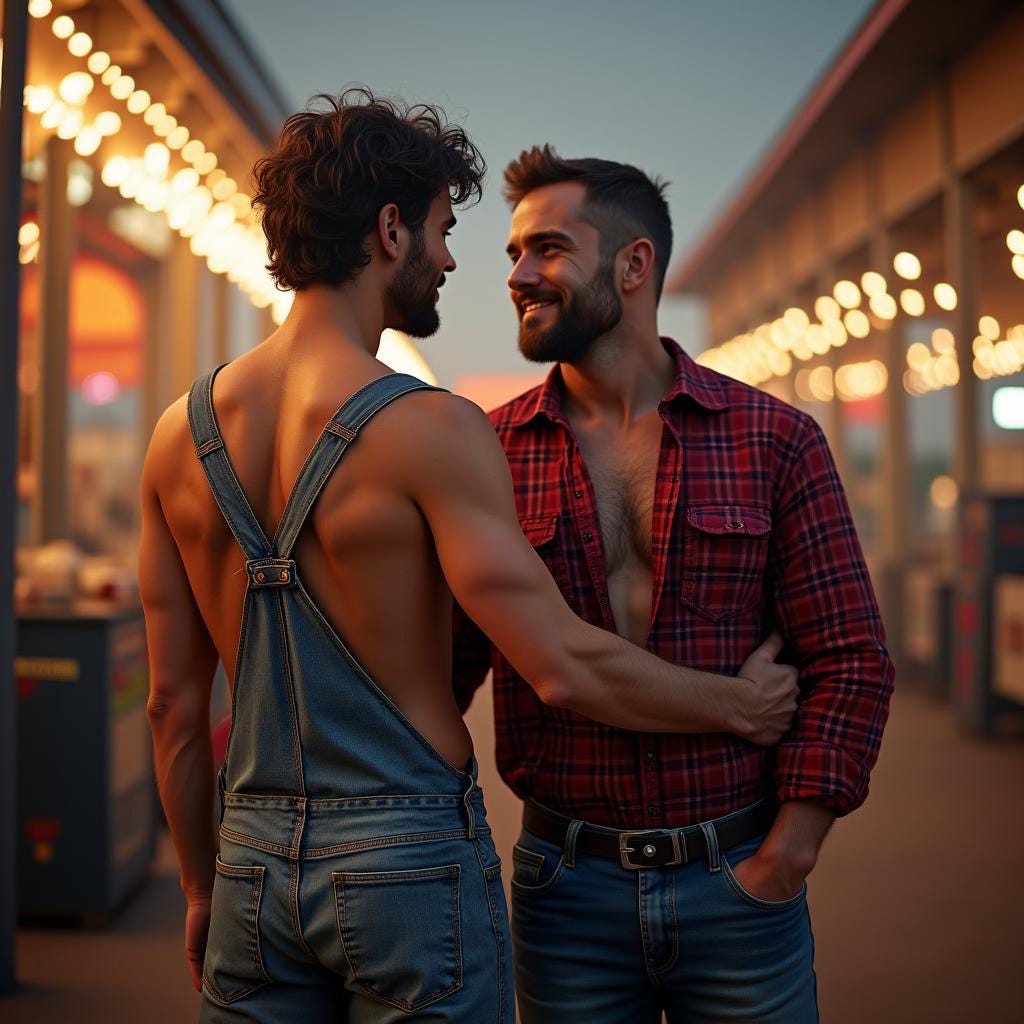
The midday sun crowns the top of the Ferris wheel, a molten disc shining down on the South Carolina State Fair. Heat smothers the parking lot and the battered grass beyond, extracting the metallic tang from aluminum rides and thickening the aroma of fried batter and caramelizing sugar until it is nearly viscous. Even from the ticket line, David Mitchell feels the air pressing into his collarbones, soaking the underarms of his button-down with the peculiar determination of a Southern October.
He blots his forehead on the back of his hand and glances at his wife, who is shading her face with the event flyer, tapping the heel of her flat against the baking concrete. His son—nine, thin, and restless—spins in loose orbits around his parents, orbiting closer with every surge of the crowd, then flinging himself to the gravitational limit of a father’s voice: “Easy, bud. The line’s not going anywhere.”
David’s hand flicks up to his hair, fingers snagging briefly on the tufts that have gone prematurely silver at the right temple. His green eyes sweep the dense, meandering line, then drift to the firetruck-red swings and the undulant crowd along the midway.
“I’m hot,” his son whines, tugging at David’s sleeve.
“I know, Grant. You’ll survive. See the lemonade stand?” He nods toward a plywood shack painted with enormous, dripping citrus slices. “We’ll hit that first, promise.”
His wife, Mara, lowers the flyer and aims a look at him—part commiseration, part “this was your idea.” The sharpness of her cheekbones is accentuated by the heat, and a thin bead of perspiration is already tracking a line beneath her sunglasses.
“Remind me why we’re doing this on a Saturday?” Mara says.
David shrugs, affecting a breezy humor he does not feel. “For the memories. For the deep-fried Oreos. For the photo of Grant puking off the Tilt-A-Whirl.”
Mara snorts. “You owe me a foot rub for every hour in this humidity.”
“Two hours and I’ll buy you a massage.” He grins, but even he can feel the smile floating above his face, not quite landing.
The line inches forward. He puts a hand on Grant’s head and guides him back into the orbit of family, the boy’s sweat-damp hair gritty with dust and sunscreen. The ticket attendant is a girl with braces and a complexion like a fresh peach, whose script is tattooed into her brainstem: “Wristbands or tickets, folks?” David requests the all-day band, rolling up his sleeve for her to affix it, and the attendant’s eyes skate over his forearm, lingering a microsecond too long on the pale skin beneath the tan line.
He imagines her thinking: Dad, and then: married. A calculus performed by every woman under 25, whether they admit it or not.
He thanks her, slides his credit card back into his wallet, and steers the family through the churning mouth of the entrance. The sound hits first—a wall of thumping pop, mechanical chimes, and the high-pitched shrieks of teenagers liquefied by adrenaline. There is a trampled sweetness to the air, like pink insulation cotton candy, but it cannot mask the acrid stench of sweat and diesel and the sharp, peppery undertone of animal cages. It is, David reflects, exactly as he remembers it from his own childhood: overwhelming, vaguely threatening, and the highlight of the suburban calendar.
Grant wants to see everything at once. He bolts from one attraction to the next, but always snaps back to his father, the way a dog tests the length of its leash. Mara follows, occasionally calling him by his first and middle name, a reliable warning shot. David plays the part of corral and cruise director, drawing the boundaries tighter with each pass.
They circle the livestock barns first. David notes the way Mara keeps a careful distance from the show cows, lips wrinkled in disgust. Grant, by contrast, presses his nose to the pens, exclaiming over the size of the Herefords and the cartoonishness of the chickens. “They look like they’re wearing pants,” Grant announces. David stifles a laugh, and for a moment, his chest tightens with pride and something like fear. He is, by all visible evidence, a good father. This should satisfy him. It doesn’t.
The heat leeches into his skin, and every few minutes David catches himself daydreaming: the snap of a cold beer against his palm, the quiet of his empty office late at night, the brief, unnameable thrill when a stranger’s gaze lingers. These thoughts come and go, like a fish flicking in the reeds, impossible to pin down and equally impossible to exorcise.
Mara snaps a picture of Grant climbing onto the hay bale throne, then gestures for David to join. “Come on,” she says, “so I don’t look like a single mom in all these.” Her voice is soft, teasing, but there’s an undercurrent that he recognizes: she is keeping score, and he has been racking up little debts for years.
He squeezes onto the bale beside Grant, who is already squirming away. Mara frames the photo. David looks into the lens and tries to commit to the moment, to be the husband Mara wants and the father Grant deserves. It works for exactly the length of the shutter sound.
They zigzag toward the rides, and the crowd thickens—teenagers in cutoffs and crop tops, clusters of retirees, church youth groups in matching t-shirts. David scans the faces with automatic precision, a habit from his brief, unsuccessful college baseball career: know your field, anticipate the movement, always be two steps ahead.
A teenage couple is making out in front of the ring toss, hands roving freely. Two middle-aged men in camo are debating the merits of elephant ears versus funnel cake. Behind the Tilt-A-Whirl, a boy with blue hair is peeling off his shirt, tattoos on full display. The chaos is both comforting and agitating. David’s hand moves to his hair again, tamping down the unruly silver, as if that could bring order to his thoughts.
Grant bounces in place, counting the tickets and mapping his next move. “Dad, can I do the bumper cars first? Pleeeease?”
“Sure, but remember, you have to let the smaller kids have a turn too.”
“I’m not that big.”
“You’re big enough,” David says, and Grant beams with an authority he has not earned but already wears comfortably.
At the bumper cars, Grant clambers into a neon-green car, buckling the belt with serious concentration. David watches him for a moment, then feels Mara’s gaze prick at his shoulder.
“You’re doing that thing,” she says quietly.
“What thing?”
“Staring off into space. Like you’re somewhere else.”
He considers denying it, but he’s always been a bad liar. “Just a lot on my mind, that’s all. Work’s been—“
“Work is always ‘a lot’ for you. Don’t you ever just… enjoy it?” Mara’s lips press together, not angry, but exhausted. “Enjoy us?”
“I do,” he says. “Of course I do.”
She studies him, her expression unreadable behind the sunglasses. “You’re the one who wanted this,” she repeats.
He wants to tell her: I wanted you, once, with a desperation that scared me. I wanted a family. I wanted a life that felt like it belonged to me. He wants to say: It’s not your fault I’m restless. But instead, he offers a smile, the same one he gives his regional sales team when he needs them to overperform: convincing, noncommittal, harmless.
They watch Grant swerve and collide, shrieking with delight as he slams into a pair of shrimpy twins. David’s mind wanders, counting the number of times the cars collide per minute, how long before the ride attendant gets bored enough to let the kids run amok. He times it almost perfectly. Six minutes, fourteen seconds.
Afterward, Grant is radiant and sweating, cheeks flushed with exertion. “Next?” he says, and David points him toward the Gravitron, then walks Mara over to a shaded bench while their son waits in line. The wood of the bench is blistering, but Mara sits anyway, stretching her legs with a dancer’s self-consciousness.
She fans herself with the event flyer, watching the crowd. “You ever think about what it’d be like if we hadn’t left New Jersey?” she says after a minute.
“Sure. We’d both be working sixty hours a week, and Grant would be cussing in two languages by now.”
She laughs, but not with her mouth. “You’d like that, though. The city.”
“Maybe. Maybe not.” He studies his hands, the thick knuckles and squared-off nails, and wonders when they started to look so much like his father’s.
Mara touches his thigh with the tips of her fingers, a signal so small it could be missed if you weren’t watching for it. “Just… be here, okay? For today?”
He nods, unable to promise. But he tries, in that moment, to focus on her—the way her skirt is sticking to the back of her legs, the fine beads of sweat at her temple, the faint citrus of her perfume barely holding its own against the oppressive air. He tries, and for a second it almost feels like enough.
The Gravitron spins up, rattling like a jet engine, and Grant disappears inside with a crowd of hollering kids. Mara leans her head on David’s shoulder, letting out a tiny, defeated sigh. David puts his arm around her, squeezing gently, but his eyes drift to the horizon of the midway, scanning for something he can’t name. He feels both contained and unmoored, as if the fair itself is a diorama and he is the only conscious figure inside.
The ride ends, the exit gate opens, and a tide of children floods the platform. Grant emerges, dizzy and elated, weaving toward his parents with exaggerated, staggering steps.
“Where to next?” David asks.
Grant wants to see the pigs, then try the strongman hammer, then “maybe throw up.” Mara wants shade and a place to sit. David wants… he’s not sure. The day is half-over already, and his skin hums with the friction of all he has not said.
They weave through the carnival, navigating the unpredictable currents of people and noise. At the edge of the midway, a shriek of excitement catches David’s attention: a child, maybe six, has just won an enormous plush dinosaur, her father hefting it over his shoulder like a sack of flour. The girl’s laughter is clear and wild, a pure note in the din. David watches them for a moment, something like envy blooming in his chest. The simplicity of it. The singularity.
They follow the route toward the games section, the avenue lined with plywood booths and barkers, the air thick with the promise of impossible prizes. Grant is nearly vibrating with anticipation, already plotting which stuffed animal he’ll target, which ring or ball or dart he’ll wield. Mara slows her pace, lagging behind as David leads Grant into the throng.
For a second, David catches his own reflection in the mirrored wall of the Funhouse: broad-shouldered, neat-casual, the lines at his eyes deeper than he remembers. He recognizes the figure, but barely. He runs a hand through his hair and keeps walking.
Ahead, the ring-toss booth is crowded, but David registers, in a flicker, the presence of the attendant—a young man in a blue tank top, posture casual and inviting, skin tanned to a shade that suggests he lives outdoors. There is something magnetic about the set of his shoulders, the easy way he banters with customers. David files this detail away without examining it too closely.
He gestures Grant toward the balloon darts, but Grant, predictably, wants the ring toss. “Please, Dad?”
David relents, rolling up his sleeves and guiding his son to the front of the line. He senses Mara watching him, perhaps wondering what motivates his sudden indulgence. He isn’t sure himself. But as he hands the attendant a bill and accepts the rings, David feels the smallest flicker of anticipation, the sense that, beneath all the domestic noise and duty, something is about to happen.
The ring-toss booth glows with an unearthly blue, the prizes like neon fruit suspended behind wire mesh: oversized stuffed pandas, fake goldfish in plastic bags, lurid rainbow snakes looped on dowels. Even at a distance, the attendant is impossible to miss. He’s early twenties, maybe younger, but there’s an ease to the way he moves that transcends his years. His tank top is faded Carolina blue, stretched thin over shoulders broad enough to advertise themselves. The sweat dapples his sternum in dark ovals and makes the fine blonde hair of his arms gleam with a faint, animal gloss.
“Step right up, gentlemen, test your skill—” the attendant calls, voice syrupy and unselfconscious, but he catches David’s gaze for a microsecond, and the smile he gives is not the cheap kind tossed to every passing customer. There’s a flicker of challenge in it, or maybe recognition, like two members of a secret society crossing paths in open daylight.
David slows. The crowd seems to melt around him. He studies the attendant—how he dips his torso low to retrieve fallen rings, the slight arch of his back, the languid way his hips follow his hands. It is a performance of unconcern, but every gesture is calibrated for effect. David feels the first flush of awareness pool at the base of his neck, followed by the involuntary tightening in his stomach.
“Grant, you want to try the ring toss?” David’s voice comes out rougher than intended.
Mara wrinkles her nose. “Those are a scam,” she says, but she’s already sizing up the prizes. “Try that one instead—look, the darts are only a buck for three throws.”
“Aw, Mom,” Grant whines, “the ring-toss is cooler.”
“We’ll do both,” David says, and steers them toward the booth. He keeps his eyes on the attendant, as if the magnetic field of their earlier glance is still pulling him forward.
When they reach the counter, the attendant stands up straighter, towering a good inch or two over David. Up close, his features are more striking: long, almost feminine eyelashes, a nose straight as a knife-blade, lips so pink they look artificial. A single earring—cheap silver hoop—catches the sunlight, and David’s attention is drawn to the pulse throbbing just beneath it.
“First-timers?” the attendant says, and the way he says it makes David’s cheeks flare with heat.
“Not really,” David says, “but it’s been a while.” He can’t remember ever hearing his own voice sound so uncertain.
The attendant laughs, low and genuine. “It’s all in the wrist, man. Gotta let the ring do the work. Three for five,” the attendant says, holding out the rings. His hand is tanned and nicked, the nails bit short. As David reaches for the rings, their fingers brush—just a ghost of contact, but the current it sends through David’s body is almost ridiculous.
He tosses the first ring. It arcs high, landing squarely on the bottleneck, then ricochets off and skitters to the ground. “Nice try,” the attendant says, “but you gotta have a lighter touch.”
David tries again. Same result. He can feel Mara watching, waiting to pounce, and he forces himself to focus, if only to erase the smug tilt of the attendant’s lips.
Third try: the ring clatters, but this time it hesitates, teetering on the rim. The attendant leans forward, face inches from David’s. “Almost,” he murmurs, voice pitched for David’s ears alone. “You’re getting there.”
Grant groans. “Aw, Dad! That was so close.”
David shrugs, embarrassed by how invested he is. “We’ll get ‘em next time, bud.”
“Want a tip?” the attendant asks, already picking up the rings for round two.
David nods, and the attendant gestures him in closer. Mara is half-distracted by her phone, and Grant has drifted to the edge of the booth, eyes glued to the mechanical fortune teller in the next stall. David leans in, not sure what to expect.
“Loosen your grip,” the attendant says, voice dropping. “Let your hand relax. Then flick, just at the last second.” He demonstrates, fingers curled gently around the plastic ring, wrist flexing with almost obscene fluidity.
David follows suit. The attendant watches his hand as he does, then looks up, green eyes meeting brown, the contact almost too direct to withstand. David’s pulse slams in his throat.
He throws. The ring lands, wobbling, and for a second it seems to hang in time before dropping squarely over the bottleneck. A rush of childish victory surges up in David, completely out of proportion to the prize.
Grant returns to see the aftermath, and whoops, “He did it! Dad, you actually did it!”
The attendant claps, slow and ironic, but the smile he gives David is softer now, less mocking. “Pick your poison,” he says, gesturing to the rows of prizes.
Grant chooses the rainbow snake, of course. The attendant lifts it from the hook, letting the plush coil dangle provocatively before handing it over.
David lets Grant lead the way, but he lingers at the counter, waiting for Mara to catch up. She is busy taking a photo of Grant, who is brandishing the snake like a trophy.
“Nice work,” David says to the attendant, “you could sell ice to Eskimos.”
The attendant shrugs. “Comes with the job. Besides, I like helping people win.”
He doesn’t look away, and David feels the stare settle into his bones.
“Name’s Ethan,” the attendant says, sticking out his hand. “You ever need another shot, come see me.”
David takes the handshake. Ethan’s palm is warm, dry, and lingers just a moment longer than necessary.
“David,” he replies.
Ethan grins, cocky and open. “See you around, David.”
David rejoins his family, hyper-aware of the set of his shoulders, the roll of his gait. Grant is already begging to do the funhouse next, but David’s attention drifts back to the ring-toss, where Ethan is leaning against the counter, arms crossed, watching David walk away with a faint, private smile.
The midway opens up onto the main artery of the fair, a processional of turkey legs and livestock posters, but David keeps glancing back, catching glimpses of Ethan as the crowd parts and reforms.
David watches his family fade into the blur of humanity. Mara steers Grant toward a picnic table painted with sticky orange stripes, the boy’s rainbow snake slithering over his shoulder, a triumph already forgotten in the pursuit of curly fries. David stands for a moment at the fork in the path, then turns and moves with measured purpose toward the nearest vendor. He buys a trio of water bottles, still cold enough to bead sweat in the dense dusk, and uses the transaction as a shield: a father’s errand, unimpeachable, ordinary.
The fair around him is a blur, the screams from the Tilt-A-Whirl, the insistent bark of the dart game guy, the greasy hands of children pawing at cotton candy. But through it all, David is fixed on the image of Ethan, the sweat on his temple, the curve of his smile, the way he looked at David like an equation he was itching to solve.
At the picnic table, Mara is texting someone—probably her mother, maybe a friend from New Jersey who still wonders how she puts up with the South. David sits, hands the water bottles around, but his own thirst is gnawing, unquenched.
He tries to focus on Grant, but the inside of his skull is a slow-motion replay of the booth, the way time seemed to dilate, the sounds growing muffled, everything narrowed to the shape of a body and the possibility of touch.
Mara looks up. “You okay?” she asks, her voice half-concern, half-boredom.
“Fine,” David says. “Just tired. Forgot how exhausting these things are.”
“Tomorrow we’re sleeping in,” Mara says, as if she’s decided it for both of them.
David nods. He drinks his water, but it tastes like nothing.
As they stand to leave, David glances once more toward the ring-toss. Ethan is serving a group of frat boys, laughing with his head thrown back, but as if on cue, he looks up, sees David, and gives the smallest, most deliberate nod.
David feels it land inside him, a spark, a dare, a promise of more.
He tells Mara he’s going to check the lost and found for Grant’s water bottle—an object Grant has not lost, but which Mara will not bother to verify, her focus absorbed by a pop-up jewelry tent. He pockets his phone, checks for the text that does not come, and sets out with the pace of someone running late for an appointment.
The ring-toss is between rounds, no customers lined up, and Ethan stands with one arm over the back of a folding chair, eyes scanning the crowd. The instant he sees David, something about his posture sharpens—a dog’s ears pricking at the scent of something new.
“Hey, stranger,” Ethan calls, voice lower and smoother than before, stripped of any barker’s bravado. “Missed your shot at the grand prize?”
David can feel the heat rising in his chest. He glances over his shoulder—the jewelry tent is visible, Mara half-lit by fairy lights, Grant slumped against her, fighting sleep.
“Want to practice?” Ethan says.
Ethan leans in so his lips are nearly brushing David’s ear. “I only give private lessons to the ones who want them.” His breath is warm, stirring the fine hair on David’s neck.
David’s heart pounds, and he swears he can feel each pulse in his fingertips.
David hesitates. He feels the pressure of his phone in his pocket, the clock ticking forward, Mara’s possible questions stacking up like overdue bills. But the lure in Ethan’s eyes is stronger.
David glances at the midway: the crowds are distant now, the only witnesses the few remaining carnies and a handful of stragglers. He feels the smallness of the world in this moment, a stage with only two players.
There’s a moment of standoff: Ethan with his arms folded, David with his hands jammed in his pockets, both of them caught between motion and inertia. The silence isn’t comfortable, exactly, but it’s charged. They listen to the wind scrape over the bottle racks, the distant mechanical groan of a service cart, the thump of some unseen generator.
Ethan is the one who breaks. He walks to the side of the booth and jerks his head, a wordless summons. David follows, ducking beneath the half-lowered canvas tarp, and emerges behind the maintenance tents, into the narrow space where the rides sleep and the ground is muddy with trampled grass.
This time, they don’t waste time with small talk or preamble. The instant they’re out of sight, Ethan presses David against a tent pole, mouth urgent and open, hands already at the buttons of David’s shirt. The kiss is greedy, Ethan biting at David’s lip, dragging teeth along the stubble of his jaw. David growls, low and involuntary, and yanks Ethan’s tee over his head, the fabric catching on the earring and making it tug at his lobe.
The contact is electric. David’s palms are rough from years of gym and yard work, and Ethan’s skin is baby-smooth, warm and yielding. David drags his nails down Ethan’s back, leaving pale tracks, then grabs his ass with both hands, lifting him so their bodies align.
Ethan breaks the kiss, panting. “Fuck, you’re strong.”
David grins, teeth bared, and walks them backward until they collapse onto the soft, wet grass. He lands on top, pinning Ethan’s wrists above his head. For a second, they just stare at each other, both surprised by the sudden reversal of control.
Then Ethan laughs, wriggles one hand free, and pushes David upright. “Shirt off,” he commands.
David obeys, stripping down in three quick motions. He pauses at the belt, fingers hooking under the leather, and with a deft flick, undoes it. The clink of the buckle is louder than it should be, echoing off the empty tents.
Ethan grins, eyes flashing. “I’ve been waiting to hear that all day.”
He sinks to his knees, the grass soaking the denim at his knees, and looks up at David with something like reverence. He works the fly, slow at first, then with a sudden urgency. David’s cock is already half-hard, but the cool air makes him gasp as Ethan frees it, letting it fall heavy against his thigh.
