


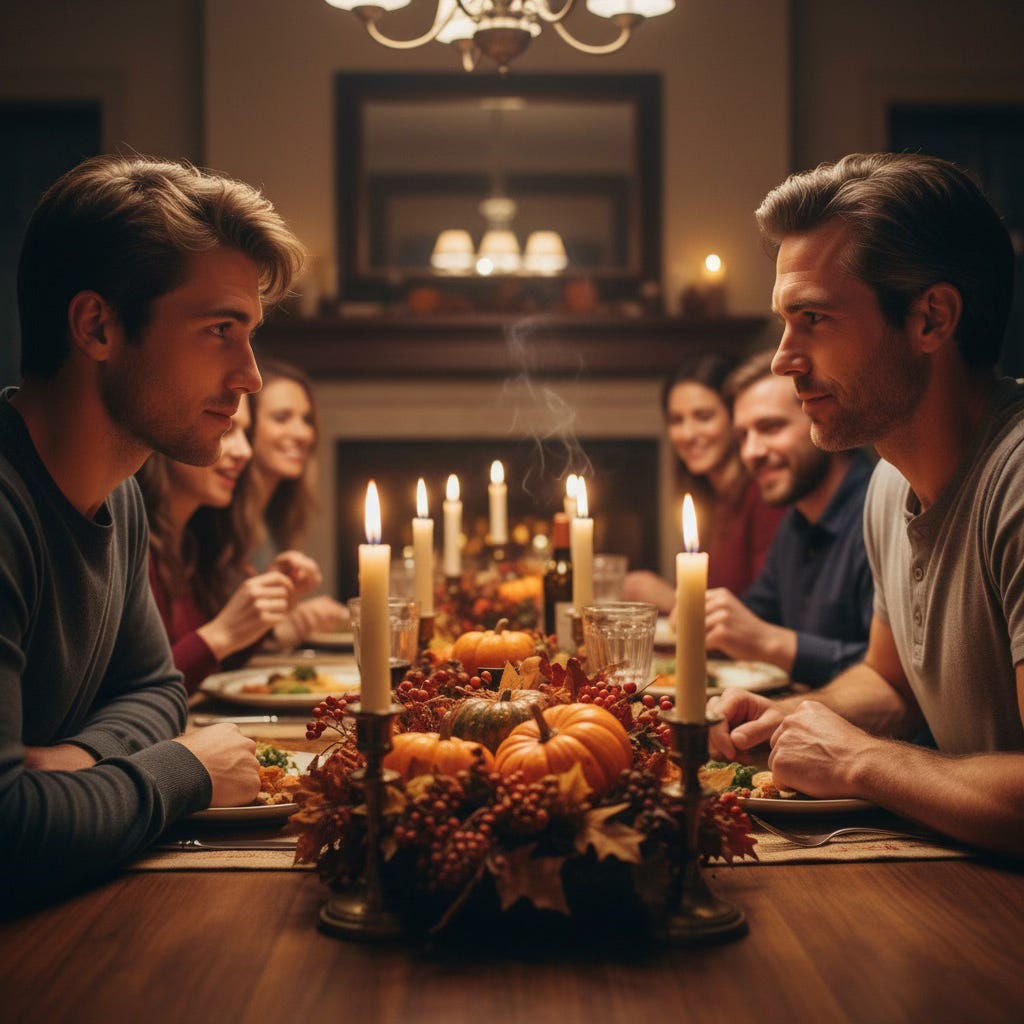
I am the first to hear the door knocker—a polite double-tap muffled by the last moans of November wind. Mom, as if summoned by a sixth sense, abandons her watch over the roasting pan and emerges from the kitchen, apron already untied, hands still glistening with a faint lacquer of olive oil. I shift my weight toward the foyer, positioning myself just left of the fireplace so the new arrivals will see me but not feel inspected. Years of these entries and exits have taught me the choreography of family greetings.
The door swings open and Samantha steps inside, shoulders squared in that way she does when she’s trying not to betray her nerves. She’s bundled in a rusty orange scarf, hair tucked behind both ears. She tugs her boyfriend along—Jake, his name is—by the hand, the gesture more checkpoint than rescue, a silent query: Ready?
I watch the way Jake’s eyes flick past the threshold, scanning the ceramic bowl of pinecones, the Persian runner, then upward, meeting my gaze and quickly dropping again. He’s taller than I expected, perhaps a full head over Sam, but leans into himself as though reluctant to claim the space.
“Happy Thanksgiving!” Mom trills, pulling Sam in for a squeeze that leaves a faint lip-gloss sheen on her temple. Her eyes dart to Jake, cataloguing everything from his artfully disheveled haircut to the neatly wrapped hostess gift—a bottle of Malbec—to the hand Sam keeps curled around his wrist.
“Hi, Mrs. Williams,” Jake says, voice unexpectedly deep but tempered with practiced humility. “Thank you for having me.”
“Oh, please. You can call me Laura. No formality in this house, not today.” She removes his coat herself—he tries to help, but she steamrolls through—and gestures toward the interior. “Come in, get out of the cold. Was the drive okay?”
Sam launches into familiar territory, detailing the traffic bottleneck and how they nearly missed the turn because Jake gets lost in podcasts. The lines of tension dissolve from her face as she narrates. She’s always been good at this: the easing of atmospheres, the deft adjustment of familial pressure.
Dad appears from the garage, a faint smell of turpentine trailing in his wake. He sizes up Jake with a squint. “You must be the fellow we’ve heard so much about.” The handshake is inevitable: Dad’s grip a vise, testing, while Jake’s is cool and measured.
“Mike Williams,” Dad says. “You’re the designer?”
“Graphic design, yeah. I work for a small studio, mostly freelance.” Jake gives a self-deprecating laugh. “Sometimes I think my mom’s the only one who understands what I do.”
Dad’s eyebrows arch. “Freelance. That’s the dream, huh?” He claps Jake on the back, just a little too hard. “Come meet the rest of the crew.”
Emily perches on the green velvet loveseat, legs folded under her. She removes one earbud as Jake enters, studying him with the critical, unblinking gaze she’s been perfecting since sixteen. Her only greeting is a nod—not hostile, more an invitation to try and impress her.
Lisa emerges from the kitchen, cheeks flushed from the oven’s blast, lipstick perfect. She gives Sam a side hug—Lisa does not do full embraces—then aims her gaze at Jake. “And you must be the infamous Jake. I’m Lisa. I sell real estate, but my real job is keeping this lot out of trouble.”
“I’ve heard a lot about you,” Jake says.
“All lies, I’m sure,” Lisa fires back. “Hope you brought your appetite. We do Thanksgiving right around here.”
I remain at the mantle, watching Jake take in the architecture of our old house: the not-quite-white walls, the driftwood frames, the faint smoke stain above the fireplace. His eyes keep returning to the family portrait in the hall. I can almost see the gears working: Where do I fit in this tableau?
Sam answers for him. “Everyone, this is Jake. Jake, this is my family.” There’s no hesitation in the way she says it. For a moment, even Lisa goes still.
The next few minutes are rapid-fire interrogations. Mom asks about allergies, Lisa wants to know if Jake’s parents are local, Dad discusses property taxes, and Emily asks which podcast derailed their arrival, as though the answer will reveal some core truth.
Jake handles it all with nimble deference. He never brags, but doesn’t deflect either. When he tells the story about the lost turnoff, he credits Sam; when asked about his job, he shrugs, says, “I’m lucky. I get to do what I love, and sometimes people even pay me for it.”
I find myself studying the way he stands—feet close together, hands clasped behind his back or tucked in his jeans pockets. There’s nervous energy, but also something else. An animal awareness of his own body in space, a readiness to spring or retreat.
“Oh, and Jake’s run a half-marathon,” Sam says. “He’s thinking of doing the full in April.”
Dad grunts. “I tried running once. Didn’t like the way my knees sounded afterward.”
“Dad, your knees sound like Rice Krispies when you stand up,” Emily says with pure mischief.
Everyone laughs, including Jake, whose smile seems to soften, as though the force field between us all has been temporarily lowered.
I realize I’m still standing apart, the observer. But now I feel the heat of the fireplace against my back, the rising swirl of cinnamon and woodsmoke, and decide to step forward.
“Sam, are you going to introduce me, or do I have to file an official request?”
Sam’s eyes light up. “Oh! This is my Uncle Rob. He’s the cool one. Also the only one who can beat me at Settlers of Catan. He lives in the city, but comes up for every holiday. Literally every holiday. Even Arbor Day.”
Jake extends his hand without hesitation. “Nice to meet you, sir.”
“Rob’s fine,” I say, letting my handshake linger a moment longer than strictly necessary. Jake’s palm is warm, dry, his grip precise. There’s a brief current of challenge in his eyes, quickly hidden behind practiced geniality.
I lean in, lowering my voice so only he can hear. “So you’re the man who’s stolen our Sammy’s heart.”
He holds my gaze for a beat, then answers, “I’m hoping to keep it,” with a smile that’s almost conspiratorial.
Sam drags him off to see the family photo wall, her arm around his waist, narrating each image with stories that grow more exaggerated the further back in time they go. I watch them disappear down the hallway, her laughter ricocheting off the picture frames.
Mom sidles up beside me, glass of wine in hand. “He seems nice,” she murmurs.
“He seems something,” I say, swirling my glass. “We’ll see if he survives the stuffing.”
Mom laughs, and we stand in companionable silence.
In the next room, voices overlap and tumble. I listen to the orchestrated chaos and realize that the stranger among us is no longer quite so strange.
The room is crowded with the ordinary stuff of family, but charged now with an electric, shifting expectation.
I raise my glass silently, and prepare to watch what happens next.
I make a proper entrance this time, crossing the carpeted boundary between observer and participant. The living room is pulsing now, all body heat and pre-dinner chatter, with Sam and Jake seated together at one end of the low coffee table, Emily prowling for snacks, and Mom prepping canapés with Lisa at the kitchen pass-through. The air is dense with scents—yeasty bread rolls, Mom’s signature mulled wine, the faint echo of woodsmoke from the just-extinguished fire.
I’m in a fitted blue oxford, sleeves rolled past my elbows. Sam clocks me first, her face lighting with that mixture of nostalgia and mild embarrassment reserved for uncles who insist on reciting childhood nicknames at public events.
“There he is,” she says. “Jake, Uncle Rob teaches history and queer studies at the university.”
Jake stands, and up close I catch the things you only get in proximity: the faint smudge of cologne on his throat, the perfect line of his jaw, the way his hair—messy on top but sculpted at the sides—invites fingers to explore the difference.
“Adjunct faculty,” I say. “History and, when they let me, a dash of queer studies. Which means I’m almost as poor as Sam’s boyfriend.”
The joke lands; Jake laughs, easy and deep, and Sam gives me a look that says: behave.
“We actually met at a gallery opening,” Sam says, dropping onto the sofa and patting the seat for Jake to join. “Rob, you’d have loved it—modern stuff, all neon and steel and, what was the term you used?”
“Post-industrial absurdism,” Jake says, “which is probably pretentious but… accurate?”
“It’s only pretentious if you’re wrong,” I say, catching the quick flash of a smile in his eyes.
The next few minutes are conversational chess. I volley stories about Sam’s undergrad misadventures, her infamous mac-and-cheese binge, her high school feminist zine that Dad still pretends not to understand. Sam endures it with good humor, eyes rolling but lips tight against laughter. Jake listens with an attentiveness I’ve seen in men trying to impress or to camouflage. I suspect, with him, it’s both.
Every so often, when the rest of the room gets louder, I turn to Jake and pitch my voice just for him. “So, you’re a runner. Half-marathons, right? That’s a particular brand of masochism.”
He grins, shoulders relaxing. “It keeps me sane. Or at least makes the insanity productive.”
“I get it,” I reply. “I used to run, until my knees started filing complaints with HR.” I lean in, lowering my voice. “Now I just take long, punishing walks. Preferably with someone who doesn’t mind losing sight of the trail.”
His eyes flick to me, assessing. “I like getting lost. You see things you’d never notice otherwise.”
It’s the sort of exchange that would pass for harmless to anyone else. But we both know, don’t we?
From the kitchen, Lisa’s voice cuts through: “Rob, can you help me open this wine, or are you too busy corrupting the youth?”
I excuse myself with a mock bow and head for the kitchen, where Lisa is waiting, bottle in hand, eyes sharp.
She lowers her voice. “He’s cute, but if you scare him off before dinner, Sam will kill you.”
I flash her a grin, expertly uncork the Malbec, and pour a glass. “She likes him.”
“She does. He’s a good one.” Lisa tilts her head. “Are you being good?”
I shrug, savoring the taste of the wine. “Depends on your definition.”
Back in the living room, the conversation has shifted to Emily’s poetry club—she’s explaining, with surgical precision, why the latest issue of the school lit mag is “aesthetic violence.” Jake seems genuinely engaged, even makes a self-deprecating joke about his own failed attempts at haiku.
“Let’s see,” he says, “what rhymes with existential dread?”
“Bread,” Emily deadpans, and everyone laughs.
I settle onto the arm of the chair nearest Jake, crossing my legs and letting my knee brush his for just a moment. He tenses, then relaxes, the way a dog does when deciding if a stranger is friend or threat.
“Jake, you have to ask Rob about his ghost stories,” Sam says. “He’s got all the haunted hallways on campus mapped.”
“I can believe it,” Jake says, glancing up at me. “You look like someone who collects secrets.”
I smile, slow and deliberate. “Only the interesting ones.”
At one point, the others are distracted by Mom’s call for hors d’oeuvres, and it’s just Jake and me. The room is dim, dusk pressing against the windows.
“You doing okay?” I ask, voice pitched low.
He nods, lips parting as though to say more, then thinks better of it. “Yeah. Everyone’s been really… welcoming.”
I let the silence stretch, then say, “It’s not always easy, is it?”
He holds my gaze. “It’s easier when you know there’s someone who gets it.”
I don’t move, don’t touch him, but I let my eyes do all the talking: You’re not alone. You’re seen. And maybe, if you want, you’re wanted.
He blinks, then looks away, a smile ghosting across his lips. “Thanks,” he says, barely audible.
The rest of the family floods back in, oblivious to the undercurrent, and the moment passes, tucked away for later.
There’s a choreography to these evenings, a kind of physics that governs the movement of bodies through wine-warmed air. I drift through the rooms, glass in hand, observing the current of Sam’s new orbit.
Jake is a quick study. He floats from group to group, never anchoring too long, always leaving a piece of himself—an anecdote, a glinting aside, a laugh—before moving on. Yet, every time I enter his radius, he recalibrates, eyes locking with mine as though we’re the only two in the room not following the script.
The first real collision is at the appetizer tray. I reach for the spinach-artichoke dip just as he does, and our hands bump, knuckles grazing. Instead of the reflexive retreat, Jake holds his position, meets my eyes, and says, “Go ahead,” voice low and even.
“After you,” I reply, gesturing with the carrot stick I’ve just commandeered.
We stand side by side, chewing in the hush between the noisy kitchen and the low static of the TV. I glance down and catch the flicker of a smile at the corner of his mouth.
“Sam tells me you’re a legend at family game nights,” he says, not quite a challenge, but enough to stake a flag.
“Only if you like losing,” I volley, then lean in. “But I’m always happy to teach.”
He turns toward me, face open, expression unreadable. “I’m a quick learner.”
Our elbows brush, and I watch the way the veins stand out on his wrist, the way his pulse jumps under the skin. I want, very badly, to press my thumb there, to see if he’d flinch or lean in.
At one point, Sam is pulled into the kitchen to help Lisa with the cranberry sauce, and Jake finds himself marooned at the bar cart. I join him, close enough to smell the sharp, citrusy scent of his shampoo beneath the layer of musk and starch.
“Need a refill?” I ask.
He looks at his glass, then at me. “Not unless you’re drinking with me.”
I oblige, pouring a healthy splash of Malbec into each of our glasses. He watches the gesture, tongue flicking over his teeth, just once.
“Sam tells me you went backpacking through Europe in college,” he says. “Where was your favorite place?”
“Berlin,” I say, without hesitation. “Back then it was this raw, unvarnished city. You could feel history under your feet. Every bar, every alleyway, had a story.”
He nods, considering. “I’d like to go, someday.”
“Take Sam,” I suggest, then add, “or go alone. Some things are better solo.”
There’s a silence, not uncomfortable. I let it stretch, watching the way the candlelight shadows his features, the play of nerves and desire and calculation in the tilt of his jaw.
“I’m glad you’re here,” I say, not meaning the house, or the holiday, but him.
He meets my eyes. “Me too,” he says, soft but unambiguous.
I lift my glass, offer a silent toast, and he clinks his against mine, the sound sharp and secret.
Sam returns, cheeks flushed, eyes bright, and loops her arm through Jake’s. “We’re on appetizer duty,” she says, and her happiness is so transparent it’s almost blinding.
Through it all, Jake and I keep up the dance: a glance here, a shared smirk there, the brush of hands as we both reach for the last olive.
Mom appears in the doorway, hands on hips. “Dinner will be ready in fifteen! Wash up, and no more snacking or there won’t be anything left!”
The room stirs, everyone moving at once. I watch as Jake and Sam drift toward the bathroom, fingers interlaced. I linger, savoring the quiet left behind, the aftertaste of something unspoken hanging in the air.
As everyone begins to assemble, filing in with the clatter of utensils and the low hum of excitement, I feel Jake’s eyes on me from across the room. I hold his gaze, let it linger, then break it with a slow, deliberate smile.
The meal hasn’t even started, but I already feel full. Sated, almost.
Still, the promise of the evening, the possibility of more, crackles in the background—a slow-burn conflagration, waiting for the right moment to leap.
I take my seat, ready for the next course.
The house is never more itself than at Thanksgiving: lamps dialed low, candles guttering in the antique silver holders, the chandelier’s fractured light painting everything in strokes of honey and shadow. The dining table is stretched to its full extension, leaf after leaf fitted into place, the lacy runner centered and recentered until Mom is satisfied. Every seat is assigned with the same rigor as a military operation, names inked on cardstock tent cards in Emily’s curlicued handwriting.
I am across from Jake—of course I am, the universe wouldn’t miss this joke—but tonight it feels less like fate and more like an open dare.
He sits at Sam’s right, spine straight, tie loosened just enough to pass as relaxed. The color suits him: deep wine red, matched to his shirt in a way that looks accidental but, I suspect, is anything but. Sam glances at him often, pride and a hint of nervousness in her eyes, as if she’s afraid the spell might break if she looks away too long.
Mom takes her usual post at the head, carving fork in hand. She’s in hostess mode: crisp blouse, pearls, hair swept up and anchored with what I know is at least four pins and three blasts of spray. Even Lisa, who loves to perform indifference, gives her sister-in-law a nod of respect before plucking a roll from the basket.
Max, impossibly tall and already stretching the sleeves of his shirt, slouches between Emily and Lisa. He’s texting under the table until Lisa slaps his wrist, then he retaliates by making a show of loading his plate with obscene quantities of mashed potatoes and gravy, rolling his eyes at Emily’s pointed sigh.
The meal is a performance, each course its own act. First, the salad: endive, pomegranate, blue cheese, arranged in a spiral that says “I spent all afternoon on this, so act impressed.” Then, the parade of side dishes—each introduced by Mom as if it’s a debutante at court—followed by the turkey, its skin lacquered and gleaming under the main chandelier.
“This looks amazing, Mrs.—I mean, Laura,” Jake says, catching himself mid-sentence, earning a flash of approval from Mom and a slow, sly smile from Sam.
“Thank you, Jake. I hope you like dark meat,” she replies, carving off a slice and plating it with ceremonial care.
I watch the knife work, the way her hands never shake, the precise pressure of each cut. Jake watches too, and when he looks up, our eyes snag across the centerpiece—an autumnal explosion of gourds and dried berries, so over-the-top it borders on parody. He smirks, just for me, and there’s a heat in it, a private joke no one else at the table is invited to.
The food makes its rounds, everyone taking more than they need, filling plates and then scraping them clean before seconds, thirds. Conversation collides and overlaps: Lisa talking real estate bubbles, Dad reminiscing about the Thanksgiving they deep-fried the turkey and nearly torched the garage, Emily reciting lines from a poem she claims is about gratitude but sounds more like an elegy.
“’We fill the hollows of our hunger with rituals of remembering,’” Emily says, chin propped on her palm. “That’s Louise Glück, by the way, not me. I wish I wrote like that.”
“Still sounds depressing,” Max mutters, then stuffs a crescent roll in his mouth whole.
“It’s more about the persistence of memory,” Emily retorts. “How even joy has an aftertaste of loss.”
Jake, in the act of spooning stuffing onto his plate, glances at me, eyebrow raised. “Is that a family thing?”
I lean forward, elbow on the table. “Only since Emily discovered existentialism last year. Before that it was all Sylvia Plath, all the time.”
Emily glares, but the effect is ruined by the ghost of a smile. “Plath is a gateway drug. You’re welcome.”
Sam laughs, the sound bright and genuine, and for a moment the table relaxes, the usual crosscurrents of competition and one-upmanship subsiding into a quiet, shared pleasure. Jake’s eyes linger on me a beat too long before he turns back to Sam, squeezing her hand under the table.
I wouldn’t notice—shouldn’t notice—but the way his hand moves, the way his wrist dips and his fingers flex, draws my attention. I shift in my seat, suddenly aware of the heat rising up from my chest, the flush prickling just under my collar.
Mom refills my wineglass—she never asks, just pours, because she knows I’ll never refuse it—and the warm, silken swirl of Cabernet makes everything brighter, louder, less defensible. I catch Jake’s gaze again over the rim, and this time his eyes don’t flinch. He drinks, slow and deliberate, the movement of his throat drawing my focus like a magnet.
“Rob,” Mom says, “how’s the university? Still fighting the good fight?”
I clear my throat, willing my voice not to crack. “Always. They’re threatening to cut our funding again, so I’m prepping for open rebellion. History department will be the last to fall.”
Dad, never one to miss an opening, chimes in: “You should teach something profitable, like accounting. Or at least something useful.”
“Accounting is the history of numbers, Dad,” I volley back, and everyone except Dad laughs.
Jake surprises me by leaning in, voice pitched just for me: “I always hated math, but I’d take a class if you taught it.”
There’s a beat where I don’t know how to respond, where the line hangs in the air—ambiguous, playful, but with an undertow that threatens to drag me under. I opt for a noncommittal smile, then return my focus to the sweet potatoes, which seem safer.
The conversation spins out: travel stories, mutual complaints about airline food, a running debate about whether marshmallows belong on yams (they do not, but Sam is outnumbered). The banter is sharp, affectionate, occasionally biting, but always edged with the knowledge that we’ll all be back here next year, same faces, same food, same ritual.
Under the table, something brushes against my ankle. At first, I think it’s the dog—Mom’s golden retriever, banished for bad behavior but known to sneak underfoot when no one’s watching—but then it happens again, a gentle press, deliberate, unmistakable. I glance up; Jake is spooning cranberry relish onto his plate, attention apparently on Lisa’s story about a botched home inspection, but the set of his mouth, the tilt of his head, tells a different story.
I angle my foot, just enough to confirm: yes, that’s him. The pressure increases, slides up the hem of my pants, pauses at the bone of my ankle. It’s not a slip, not a mistake. He wants me to know.
The family talk crescendos—Emily reading a second poem, Max chiming in with a parody, Dad launching into a complaint about the neighbors’ Christmas lights going up before Black Friday. But I am floating somewhere outside the conversation, tuned to the wavelength of Jake’s foot against mine, the growing insistence of contact.
Sam leans across him to refill her own glass, and Jake takes the opportunity to look at me, really look: eyes steady, unblinking, a challenge issued and already accepted. I feel my pulse in my ears, in my wrists, in the tight knot of heat blooming at the base of my spine.
Another push under the table. This time, it’s higher, calf to calf, a slow press and then a release, as if daring me to reciprocate. I flex my foot in return, slide it up his leg, the motion hidden by the cloth but electric all the same.
Jake takes a long sip of wine, the movement practiced, but when he sets the glass down his tongue flicks out to catch the last drop at the corner of his mouth. My hand tightens around my own glass, the pressure of the stem grounding me just enough to keep my composure.
The meal slows, courses tapering off, plates scraped clean. There’s a lull as Mom announces the desserts—two kinds of pie, three if you count Lisa’s “experimental” bourbon-pecan—and everyone groans in mock protest, as if they won’t all eat two slices apiece.
Max pushes back from the table, rubbing his stomach. “I’m tapping out. If I eat any more, I’ll need to roll myself home.”
“You can sleep on the couch,” Mom says, barely missing a beat.
Jake’s foot finds mine one more time, the pressure now gentle, almost a caress. I look up, and for a split second—just before the room’s attention is elsewhere—he gives me a smile, barely-there, a secret passed under the noise.
There’s a current between us now, undeniable, as thick as the gravy still pooling on the serving platter. I want to taste him. I want to see if his mouth is as warm as the flush in his cheeks, if his hands are as sure as they look wrapped around a wineglass.
I stand, aware of the way my knees tremble, of the sweat starting at the small of my back. Jake stands, too, and for a second we are side by side, the length of his arm brushing against mine.
“Excuse me,” I murmur, and slip away toward the hallway.
In the mirror by the entryway, I catch my reflection: face flushed, hair slightly askew, lips parted. I straighten my collar, run a hand through my hair, and wait. The anticipation is a physical thing, alive in my veins, loud as a drum.
He will follow. We both know it.
The phone vibrates in my pocket, a pulse so perfectly timed it might as well be a stage cue. I recognize the number—campus security, probably another false alarm—but I let the call ring out, then hold the screen to my ear as I step from the dining room. No one really notices my exit; the tide of dessert and small talk has reached its flood, and even Mom has let her vigilance slip in the warm current of family and pie.
The hallway is narrow, the air dense with the perfume of wood polish and chrysanthemums. Family photos march down the paneled wall in unbroken columns: Sam and Emily in a leaf pile, Max in a Halloween cape, a younger, beardless version of myself grinning beside my sister at some long-ago Fourth of July. I pace the length of the rug, pretending to talk, my own voice low and meaningless against the silence. Every sense is tuned backward, toward the dining room, toward the sound of chairs scraping, the hope or terror of approaching footsteps.
I keep up the charade: “Yes, I’ll send you the form tomorrow… Uh-huh. No, it shouldn’t be a problem. Thanks.” I could do this all night, fill the hallway with safe, empty words, but the point isn’t escape. It’s waiting. It’s the anticipation, the not-knowing.
The first time I hear him, it’s a stutter in the conversation behind the kitchen door, then the deliberate hush of steps on the hardwood. I slow my breathing, try for nonchalance, but my hands won’t stop shaking, the old, adolescent thrill of getting away with something outrageous, something forbidden.
Jake’s shadow moves across the doorway, then his body follows, lean and lit from behind by the spill of dining room gold. He pauses, one hand on the frame, as if debating whether to continue, but then Sam’s laugh erupts from the far side of the house, and I see the moment of decision lock into place.
He turns back—leans in, plants a casual, practiced kiss on Sam’s cheek, says something I can’t hear—and then he’s coming down the hallway, the smile gone, face set with a tension I recognize instantly. The air changes. Even the flowers seem to hush, petals shivering in the draft of his arrival.
We stop, two feet apart, neither of us speaking. He’s close enough now that I can see the pulse at his throat, the flush still high on his cheeks, the blue of his eyes made sharp and strange by the dim hallway light.
He breaks the silence, voice barely above a whisper. “I saw you watching me.”
I lower the phone, thumb the screen off, let the lie dissolve in my hand. “I couldn’t help myself,” I say, and it’s truer than anything else I’ve said tonight.
He steps closer. The distance disappears. I don’t know who moves first—maybe we both do—but suddenly our chests are touching, breath shared in the thin air between our faces. His hand rises, fingers slipping under my shirt collar, tugging me forward, and the wall is suddenly at my back, cold and solid.
For a second I’m aware of everything: the faint echo of laughter from the dining room, the creak of the floorboards, the heady rush of my own heartbeat. I glance over his shoulder, toward the spill of light from the kitchen, the reality of Mom and Dad and Sam and everyone else just a dozen feet away. The risk is almost enough to make me pull back, but then Jake’s hands are on my chest, fingers splayed, and his mouth crashes into mine with a ferocity that burns out every doubt.
I respond—God, do I respond—my own hands gripping the hard muscle of his shoulders, pulling him closer, greedy for the heat and the taste and the raw want in every motion. His tongue is in my mouth, exploring, demanding, and I give it all to him, losing the careful choreography of the evening in the pure, blind need of now.
He breaks the kiss first, lips trailing down my jaw, hot breath fanning across my skin. “Not here,” he whispers against my throat. “Too close.”
He takes my hand and pulls me deeper into the house, past the bathroom, past the linen closet, into the shadowed corridor that leads to the guest room. It’s darker here, quieter, the sounds of the family muffled by distance and walls. Safer. Or at least safer enough.
The moment we’re out of sight, I spin him against the wall, reversing our positions, and drop to my knees. His eyes widen—surprise, then hunger—and I see his chest rise and fall with rapid breaths.
“Rob—” he starts, but I’m already working his belt open, fingers fumbling with the button and zipper of his slacks. He doesn’t stop me. Instead, his hands come to rest on my shoulders, steadying himself, giving permission.


