

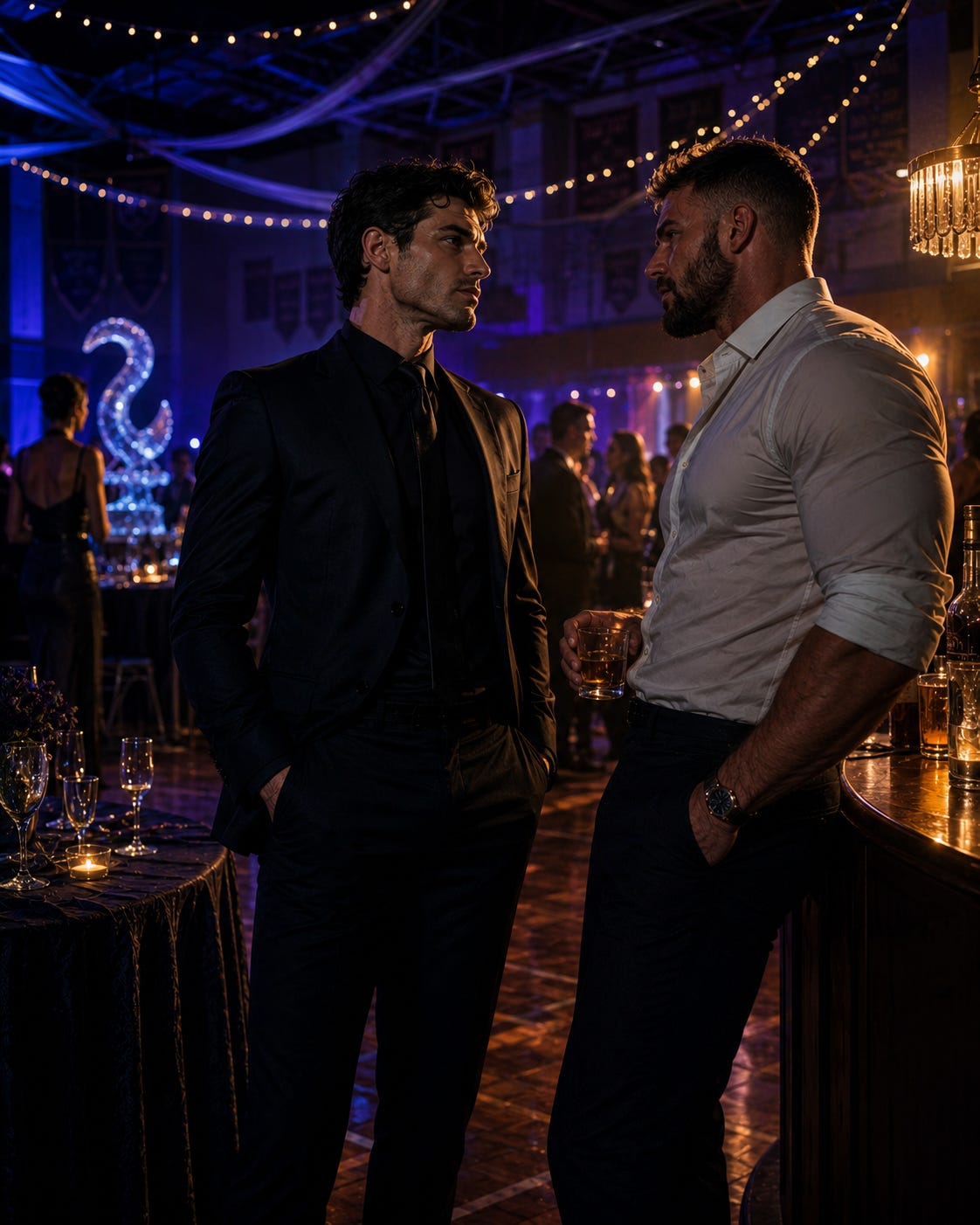
Eric Caldwell stands just beyond the spill of light from the foyer, blinking away the last of the rain as his reflection stares back at him in the high school’s glass vestibule. Ten years dissolved in a blink; the same scuffed linoleum, the same industrial-orange airlock doors, only now the trophy cases on either side are swollen with relics that, at seventeen, he would have given bone marrow to ignore. The security guard at the main desk looks up, fails to recognize him, and goes back to scrolling through his phone. Eric’s lips twist at that—a familiar aftertaste of erasure, delicious in its own way tonight.
He lets the moment ripen, drawing a breath so deep it fills not just his lungs but the hollowed-out vault where his old self once nested. He straightens the cuffs of his midnight suit—Armani, fitted within a micron by a Milanese tailor who’d confessed an urge to lick the finished seams. The memory flushes a low current up Eric’s spine as he pushes the door open, the hydraulic sigh of it collapsing behind him like the final exhale of adolescence.
Inside, the gymnasium is no longer a gymnasium. Someone has torched the budget on atmospheric uplighting: gold and ultraviolet striping the rafters, chasing shadows through the lattice of crepe paper and twinkling fairy lights. The battered parquet floor is consumed by an army of round tables, each one dressed to the teeth in navy damask, crystal flutes budding from their centers like orchids. A string quartet—no, a quartet of sophomores in rented tuxedos, their faces anxious and acne-pocked—summons the ghost of Outkast’s “Hey Ya!” in a key so minor it might be mistaken for grief.
Eric glides over the threshold and into the charged liminality of memory rendered theater. It’s impossible to miss the way heads pivot: the double-takes, the triangulation of glances, the hurried recalibration as eyes scavenge his face for the pixelated nerd of the past. He sees the audit running behind their pupils: Is that Caldwell? Holy shit, it is. The reactions travel like ripples in a stock market panic. He’s never been religious, but the sensation feels Biblical. Resurrection with a side of high-end grooming.
Someone has left name tags at the entrance, arrayed alphabetically, first names in Helvetica, last names in lurid all-caps. He locates his: ERIC. The adhesive back peels with a static pop, and he’s acutely aware of the small ceremonial violence in pinning it to his lapel—a badge, a brand, a claim staked on the man he has constructed since leaving this town’s gravitational pull.
He pauses, just enough to savor it.
A couple of the early arrivals are already huddled near the open bar, white-knuckling cheap stemware. He recognizes none of them immediately, but their faces reconstruct themselves as they pass through the filtering algorithm of memory. There is an ex-wrestler, hairline retreating but shoulders still bullish under a discount blazer; a girl who used to weep over the fates of guinea pigs in Bio, now apparently on her fourth baby, the evidence inscribed in the way she pats her midsection as she laughs. He registers their whispered saccades and lets them roll off him like rain on a hydrophobic screen.
At the heart of the gym, an ice sculpture lists precariously—a swan or maybe a question mark, backlit with shifting LEDs. He sidesteps it, scanning the perimeter for old nemeses, ghosts in the machine of his adolescence. Sean Harrington is not here yet; the air doesn’t crackle with his brand of performative masculinity, but Eric senses the inevitability of his arrival like a pressure drop before a summer storm.
He is aware of his effect on the crowd—the tightening around mouths, the tilt of shoulders, the whisper networks lighting up as he makes his orbit. He accepts the offered smiles with perfect, soulless symmetry, replying to compliments about his company, “Yes, the IPO did surprise us too, but cybersecurity is a growth vertical” and his body, “You know, most of it is just protein powder and regret” with precisely measured doses of self-deprecation, never letting sincerity breach the membrane.
When someone—an ex-class president, if his internal rolodex is to be trusted—leans in for a hug, Eric reciprocates, careful not to let his fingers linger on the silk of her dress. She smells like coconut and ambition; she tells him he looks “ridiculous”, and he thanks her for her candor. He’s unsure if she means it as a compliment, but he files it away regardless.
The music staggers into a cello-murdered version of “Mr. Brightside.” Eric’s lip twitches. He circles the edge of the dance floor, never committing, always at the event horizon, content to let the desperate gravity of the social nebula pull others toward him. He finds a table at the margin, chooses a seat with a clear sightline of the doors, and pours himself a slug of still water from the sweating pitcher. He toys with the glass, twirling it by the stem, watching droplets condense and run in slow motion.
The room is a diorama of nostalgia in panic: people clinging to their glory, or failing to camouflage how far they have tumbled since. Eric finds the spectacle anthropological, a study in self-mythology. He wonders how many have rehearsed their personal elevator pitches on the drive over, how many have rehearsed apologies for things they no longer even remember doing.
He checks his phone—an excuse, a shield—scrolling through push notifications from Tokyo, Berlin, São Paulo. Each one a bead on the abacus of his worth. He lets his gaze drift, lets the envy and awe percolate around him, but keeps his own vulnerabilities hermetically sealed.
As he raises the glass for another sip, Eric catches his own reflection in the polished steel of the basketball hoop’s upright. For a split second, he is the boy he once was: pale, brittle, half-submerged by ill-fitting clothes and social camouflage. Then the illusion breaks, and he is left with the man he built, the man whose name circulates on tongues tonight as both question and answer.
Somewhere across the gym, the doors admit another gust of wind and rain, and the night’s next surprise enters on the heels of damp applause. Eric sets his glass down, spine straightening, pulse alive in his neck.
Natalie Kim spots him before he can even decide whether to feign indifference or feign recognition. She materializes with the precision of a predator in sensible heels, clipboard against her chest, her black hair framing a face engineered for sympathy and focus. The signature burgundy lipstick, the tasteful monochrome dress—he clocked her brand of presentation years ago on the senior yearbook committee. The only thing that’s changed is how seamlessly she’s merged into adulthood, the way her presence blends into the background while never quite ceding control.
“Eric! There you are—I was hoping you’d make it early.” Her voice is warm, practiced, and, he notes with a private smile, pitched exactly one notch above the ambient noise of the gym.
He stands, offering a handshake. She accepts, but converts it into a brief, light grasp on his forearm. “I’ll never get used to this,” she laughs, gesturing at the gymnasium’s chrysalis of fabric and LEDs. “You should see the budget breakdown for all this. Corporate sponsorships, can you believe it?”
He glances at the printed lanyard half-obscured under her hair: “Event Director.” Of course. “Only if you show me the pie chart,” he says, and lets his mouth curve into something approximating warmth.
She leans in. “I could give you the whole PowerPoint if you want. You probably love spreadsheets, right?” There’s a sharpness behind her joke—a surgical flick, not meant to wound but to remind him she remembers things. The National Mathlete trophies, the years when his science project ran unchallenged. She’s inviting him to laugh at himself, to re-enter the social contract with its little humiliations.
He nods at the challenge, but stays on script. “Spreadsheets are a growth industry, or so I hear.” He watches as she notes this, mentally adjusting her next move.
“I have to tell you, everyone’s already talking about your company. There was some debate about whether you’d even show.” Natalie moves around the table to his side, the clipboard sliding effortlessly under her arm. “I think you just scared people with your RSVP. They didn’t know how to brace for the genius coming home.”
Eric blinks. The word is still a razor, even after all these years. But Natalie is already half-pivoted toward the arrivals table, her attention fractalized across the room, never fully on him for more than two contiguous seconds.
A burst of perfume—vanilla and ambition—heralds Leah Thompson, who wedges herself between Eric and the buffet line as if invited to a private audience. “E.C.!” she yelps, eyes wide as showroom halogens. “Look at you. It’s like, is this even allowed?” She touches his jacket, pinches the fabric between two manicured fingers as if to verify its reality.
“It’s bespoke,” he says. He could say more, but why. Her face is animated, running several scripts at once, none of which seem to have been debugged since high school. “You look—” He gestures at her glossy curls, her sculpted dress. “Very Lee.”
She snorts, delighted, and slaps his chest, leaving a fleeting dusting of powder. “Did you see the ice swan? Natalie said the artist drove in from Minneapolis. Apparently, it’s, like, really symbolic.”
Eric raises an eyebrow. “Of?”
“Oh my God, right? Like, what isn’t? I told her you’d appreciate the irony, but you probably have a patent on irony by now.” Leah orbits closer, setting her wine glass directly next to his untouched water. Her voice, always pitched for the bleachers, starts pulling in nearby ears.
“Can I just say,” she continues, “I googled you. All those zeroes, and I thought—damn, Caldwell’s living the dream. I bet you don’t even remember us little people, huh?”
There’s a familiar bite under the sugar, a test for weakness. Eric glances sideways at Natalie, who’s busied herself with aligning a napkin display but is eavesdropping, antennae tuned.
“Only the people who made it interesting,” he says. It’s smooth, but the undertow of something darker is there if you know where to look.
Leah’s mouth opens to volley back, but Natalie cuts in, tone conciliatory. “Sean’s not here yet, if you’re wondering,” she says to Eric, as if reading the unspoken. “He always shows late, if at all.”
Eric sets his fingers against the rim of the water glass, turning it like a dial. “I’m not expecting a trophy ceremony.”
“Oh, but you should,” Leah says. “Half the class would vote you prom king if we re-ran the ballot.” She pronounces this with absolute confidence, then, as if suddenly unsure, asks: “Are you…seeing anyone? I mean, you always seemed so busy even back then, it’s hard to imagine you, like, with a person. I mean, not that you couldn’t—”
Natalie bails her out. “Sorry, Lee’s on her third glass and she always does this,” she says. But the eyes remain fixed on Eric, searching for cracks.
He lets them look. He has no intention of revealing the actual truth (which is complicated, empty, and worth precisely nothing on a high school scoreboard), so he leans back, considers the overhead lights as if the question itself is a passing cloud.
“I keep busy,” he says. It’s nothing, it’s everything.
Leah laughs, clearly delighted by the ambiguity. She covers her mouth, fingers splayed, her rings catching the light. “You haven’t changed at all, Eric. Just…more. Intensified.” She catches his eye and holds it, as if expecting him to break first. He doesn’t.
Natalie steps closer, shifting the clipboard to her other side, and for a moment the noise of the room recedes. “If you need a break from the crowd, I reserved a little green room by the art wing. Some people are already hiding there. I thought you’d like to know.”
He reads her—an offering, or a test, or both. He nods his thanks. “Appreciated.”
There’s a blare of music, a drunken cheer from the far side of the gym, and the air rearranges itself as a fresh wave of alumni floods in. Leah drains her wine, already eyeing the next, and Natalie straightens her lanyard, smoothing invisible wrinkles from her dress.
“Well,” Leah says, “time to make the rounds. I’m leading the photo booth charge, if you want in. Or are you saving your face for Forbes?”
He smiles, a razor-edge smile that’s become almost muscle memory. “We all start somewhere.”
They drift off, dissolving into the social tide, but not without a last, hungry glance backward from both of them. Eric watches them go, then refocuses on his reflection in the metallic glint of a folding chair.
There is a kind of music to the way Sean Harrington enters a room, even now, ten years after the last snap of a varsity whistle. The gym’s chatter skids, stutters, and then crescendos as Sean shoulders through the double doors, his presence inflating the oxygen level by at least a third. He’s heavier than memory, all meat and denim, but the old symmetry of his frame is still there: the quarterback’s architecture, just slightly overbuilt from years of compensating at the bench. His hair, bleached and tamed into a style that refuses to acknowledge recession, glows under the harsh ceiling lights. He’s loud even when silent, the kind of man whose cologne enters five seconds before the rest of him does.
Eric watches it all from his perch by the water pitcher, every nerve ending tuned to the change in gravity. Sean’s arrival is a meteor strike—backs slapped, names barked across the gym, former linemen locking him in hugs that teeter on the edge of violence. The air around Sean warps, bending faces and laughter toward him like sunflowers to a heat lamp.
Eric feels his own posture shift, spine lengthening, chin angling a fraction higher. The old reflex, never truly extinct, simply buried under layers of cultivated ice. He can see Sean’s eyes scanning, checking the leaderboard of the room—who’s won, who’s lost, who even matters. When those eyes hit Eric’s, the moment is a double pulse: a flicker of non-recognition, then a flash of something primal, alive.
For a second, Eric expects Sean to look away, to reboot his memory and pretend. But he doesn’t. Instead, Sean holds the gaze, and in that span of seconds something untranslatable passes between them. A jolt, an old circuit gone hot again.
Sean’s face reconstructs itself as he approaches, the old confidence soldered to new ambiguity. The lines at the edge of his mouth are deeper, the set of his jaw still granite but less certain of its right to dominance. As the gap closes, Eric registers the details: the telltale scarring on the knee visible just above the boot, the dent in Sean’s brow from a freshman year helmet-to-helmet, the faintest touch of grey shading the sideburns. These are the new data points. He processes them ruthlessly.
Sean slows at the edge of Eric’s orbit. There is no handshake, no gesture; only the tilt of Sean’s head, the full-frontal confrontation that always preceded his worst taunts. But the playbook is gone, replaced by something rawer.
“Caldwell,” Sean says. He doesn’t bother with the first name. The sound is a question and a verdict.
Eric allows himself a slow blink, then lifts his glass in a gesture of toast or truce. “Harrington. Surprised to see you upright. Thought they’d have you in traction by now.”
Sean laughs, low and sharp, and for an instant the mask drops. There is fatigue in it, and maybe—if you know what to look for—a kind of battered admiration. “Takes more than a knee to keep me down.” He lets his eyes sweep Eric’s suit, the whole vector of his transformation, and nods as if signing off on it.
A new voice interrupts—the ex-president from earlier, her cheeks blotchy with two wines and nostalgia. “Oh my God, is this the famous showdown? Someone get the yearbooks out, it’s 2008 all over again.” The comment is met with scattered laughter, but Eric and Sean barely flinch.
There is a perimeter now, an invisible ring of attention, people waiting for the old drama to replay itself. Leah is back, sidling up with the practiced nonchalance of someone who’s never missed a gossip thread in her life. She positions herself equidistant between the two men, eyes ping-ponging as if anticipating the first volley.
But Eric has already made his move. He steps forward, not aggressive, but with enough force to shatter the tableau. “You look good, Sean. Marriage treating you well?” He lets the word hang, knowing it’s an open wound. The rumors were always ahead of the facts.
Sean’s jaw flexes, and Eric can see the internal calculus as Sean decides whether to lie. “Divorced,” Sean says, eventually. “Two years now. Guess that’s a trend around here.” He shrugs, but the motion doesn’t land.
Leah’s hand shoots out, clasping Sean’s bicep, her voice a giddy shriek: “You have to tell Eric about the time you almost drowned at senior lake day. He’s probably the only one who doesn’t know.”
Eric smiles, but doesn’t let his eyes leave Sean’s. “I can imagine it. You always had trouble with depth.”
Sean’s lips quirk, half-amused. “And you never liked getting wet.” He says it quietly, for Eric alone, and the echo of it vibrates beneath the level of hearing. Eric feels heat rising behind his ears, a chemical memory of shame, defiance, and the sharp possibility of something neither of them will name.
The quartet’s rendition of “Clocks” stumbles in the background, slow and glassy. The people around them have started talking again, but the pressure bubble at the core persists. Natalie watches from a distance, her gaze curious but not invasive, as if cataloging every micro-movement for future reference.
For the next several seconds, Eric and Sean exist in a closed loop. No one else in the room matters; the world could collapse to a singularity and they would still be locked here, sizing up the new battlefield.
Sean’s throat works as he swallows, and Eric is startled to realize that he is the source of that discomfort, the cause of that heat. It’s not victory he feels, but something crueler: mutual vulnerability, suspended in amber.
Then, as quickly as it began, the spell breaks. A stray body—one of Sean’s former teammates, now more gut than man—staggers into Sean from behind, sending a splash of beer onto the gym floor. Sean claps the man on the shoulder, laughing too loud, the old script reasserting itself. But even as the group regathers and the noise blurs, Eric sees Sean’s eyes flick back to him. One last charge across the gap, a silent promise that this is not over.
Eric feels his own heart drum against his ribs, a tempo faster than it should be. He drains his water, then allows himself a real, unscripted smile.
The night accumulates stories the way static builds in a wool carpet—unnoticed until the spark leaps. By now the gym is swelling with noise and ex-colleagues, and Eric is considering the merits of escaping to the designated “quiet room” Natalie mentioned earlier. He calculates the social risk: too soon and he’ll be marked as snob, too late and he might miss the one worthwhile scene.
Before he can execute, a familiar shape interrupts his vector—tweed jacket, wire-rim glasses, and the perma-smudge of chalk at the hem. Mr. Mitchell, one-time AP English legend, approaches with the awkward alacrity of a man convinced he’s still relevant to the adult lives of his students.
“Eric!” Mitchell says, his voice still carrying that kindly condescension. “Was hoping to catch you before you got too famous for the likes of us.”
Eric glances at the table for allies, but Daniel is occupied with a debate over mortgage rates. He gives Mr. Mitchell a smile, minimalist but not unfriendly. “Never too famous for you, sir. I’d be writing spam emails for a living if not for your senior thesis death march.”
Mitchell’s face folds into a delighted, almost childlike grin. “You always had a way with words, my boy. But I suspect it was your persistence, not the curriculum, that got you where you are.” He adjusts his tie—a wide, regrettable paisley—and looks over Eric’s shoulder at the crowd. “I have to say, I never imagined you’d come back. The whole class is abuzz.”
Eric tilts his head. “You mean, ‘is it Caldwell or a deepfake?’”
Mitchell laughs, wheezing a little. “Let’s call it healthy skepticism. You know, it’s funny—I always thought you and Harrington would go the farthest, but in such... divergent directions.” He lowers his voice, faux conspiratorial. “Between you and me, some of the faculty had a betting pool. I think Mrs. Monroe owes me a lunch.”
Eric is about to reply when Mitchell’s eyes light up—target acquired. “And there he is!” Mitchell pivots, drawing Sean into the tableau like an errant planet.
“Sean, over here!” The teacher’s hand lands on Sean’s bicep, and for a moment it’s unclear whether it’s meant as a greeting or a restraint.
Sean, mid-laugh with someone else, startles at his name. He recovers in a single, muscle-controlled blink, and then he’s next to Eric and Mr. Mitchell, looming with a presence that’s more physical than cordial.
“Mr. Mitchell,” Sean says, and the greeting is almost tender. “You still running the sophomore boys’ locker room like a boot camp?”
Mitchell beams. “Retired, finally! Now I only torture the grandkids. But I couldn’t miss this—my two most memorable students, in one place! For different reasons, of course.” His eyes twinkle, and Eric reads it instantly: the impulse to play peacekeeper, the teacherly urge to fix what’s broken, to summon catharsis before the last bell.
“Always the overachiever,” Sean mutters, a crooked smile shifting onto Eric. The old rivalry, dulled by time but never neutralized.
Eric gives Sean a nod. “Good to see you. Didn’t expect you’d make it through the gauntlet of—” he gestures at the gym, “—overfed nostalgia.”
Sean shrugs, but there’s something tense in the set of his jaw. “I came for the open bar. But I’m guessing you’re here for the, what, research? Or are you mining us for a new social network?”
Mitchell senses the tension, moves to dilute it with a teacher’s anecdote. “You know, I remember the day you two got into it over The Odyssey,” he says, voice slipping into lecture mode. “Eric argued Odysseus was a manipulator, Sean said he was a hero. The whole class took sides—had to break it up with a pop quiz.”
Eric lets the memory roll over him. “I stand by it. Heroism is just manipulation with better PR.”
Sean snorts. “You never change.”
“Neither do you,” Eric says, soft enough to almost be a compliment.
Mitchell claps his hands together. “See! Still sparring. If only my current classes had half the fire. Sometimes I wonder if you two might have gotten along better in another timeline.” He leans in, confidential. “Or, at least, driven each other less insane.”
There is a pause, the kind that’s supposed to land as a punchline but instead just hangs, a slowly descending curtain.
“I’m glad you’re both doing well,” Mitchell says, fidgeting with his glasses. “Truly. I tell stories about you every year—well, appropriate ones. Sean, you still coaching Little League? And Eric, I heard you sponsor scholarships for STEM kids now. Full circles, right?”
Eric shrugs, the gesture modest but not fake. “It seemed efficient to automate philanthropy.”
Sean looks away, suddenly interested in the ice sculpture. “I had to quit the coaching. Scheduling.”
Mitchell’s face drops, just a touch. “That’s a shame. You were always good with the underdogs. Even if you didn’t realize it.” He turns, shifting his full attention to Eric. “And you. Still running at full speed?”
“Momentum is hard to unlearn,” Eric says.
Mitchell looks from one to the other, as if hoping for a sign, a handshake, some evidence that old wounds can cauterize into something gentler. When it’s clear that won’t happen, he fills the silence with a story about a substitute teacher mistaking him for the janitor, which draws a polite chuckle from Eric and a louder, slightly desperate one from Sean.
“Anyway,” Mitchell says, “I’ll let you two catch up. Maybe don’t argue about the Greeks this time, hmm?” He gives them both a parting pat, as if blessing a marriage, and then he’s gone, swallowed by the gym’s shifting tides.
Sean’s bravado collapses a little in the absence of a witness. He stands rigid, hands in pockets, rocking forward on his toes. For a moment, Eric almost wants to say something, to cut the tension with something real. Instead, he waits.
Sean breaks first. “He’s the only teacher I ever liked,” he says, almost sheepish.
“I’m surprised you remember any of them,” Eric says.
Sean’s voice is low. “You’re the only reason I passed his class.”
Eric’s mouth opens, then closes. He studies Sean, the way his body telegraphs both apology and challenge, and for an instant all the old equations seem solvable.
But before either can speak, Daniel swoops in, fresh Scotch in hand, full of excuse-me’s and forced urgency. “Eric, sorry to be a homewrecker, but they need you at the front for some kind of alumni photo op. Something about ‘faces of the future’.”
Eric glances at Sean, measuring, but Sean is already pulling back, folding himself behind a new mask. “Don’t let the fans wait,” Sean says, smile back at full wattage.
Daniel steers Eric away, muttering under his breath about the absurdity of staged photo shoots, but Eric is barely listening. He risks a look over his shoulder, and sees Sean still standing there, eyes locked on Eric’s back, the expression unreadable: angry, lost, or—maybe—a little bit hopeful.
Eric squares his shoulders and walks into the light, the afterimage of Sean’s gaze lingering longer than the flash of any camera.
The reunion splinters as the night ages, clots of old friends coagulating at the corners of the gym, ex-lovers magnetizing then repelling, nostalgia becoming fuel and then ash. The bar—once merely functional—is now the center of gravity for the class of ’08, which makes sense, since all the best mistakes in life start here.
Eric prefers gin, neat, but tonight he orders bourbon to match the mood. He claims a barstool at the farthest reach, under a canopy of battered championship pennants. The lighting here is dim, honeyed, and more forgiving than anything out on the floor. It’s the kind of shadow where secrets feel plausible and words mean more than they should.
He’s halfway through the glass when he feels the air around him shift: denser, warmer, carrying a blast of Sean’s cologne and the ozone of recent rainfall. Sean leans against the bar, just close enough for their arms to share the polished plane of oak, just far enough that plausible deniability is preserved.
Eric doesn’t look up. He knows who it is by the rhythm of the breathing, the faint tick of metal against wood as Sean spins his own glass with restless precision.
“You planning to nurse that all night?” Sean’s voice, lower than before, a rougher version of the old drawl. The words slant out sideways, defensive before there’s even an attack.
Eric finishes his sip, measures the afterburn. “Trying to avoid regret. I hear it’s high in sugar.”
Sean laughs, then falls silent. The amber light knifes across his jaw, accentuates the tension there. He stares straight ahead, pretending to watch the bartender, but his energy boomerangs.
For a long, fractional minute, neither of them speak. They just exist: old enemies, old somethings, sharing the breathing room.
Then Sean says, “I’ve been meaning to ask—” but stops, starts over. “I should have said this a long time ago.” His right hand knots into a fist on the bar, knuckles blanching. “About high school. The shit I pulled. I was—” He breathes out hard, as if the word hurts. “I’m sorry.”
Eric turns, at last, to look at him. Sean’s eyes are glassy but not unfocused. If anything, he’s more present now than he’s ever been.
“Which part?” Eric asks, soft.
Sean manages a wry half-smile. “All of it. Some days I don’t know why you didn’t deck me.”
“I did. Twice. You just didn’t feel it.”
Sean laughs again, but quieter, more brittle. “That’s fair.”
Eric lets the silence stretch, plucks at it like a string. “What’s really eating you, Harrington?”
Sean shifts his weight, one foot planted as if to sprint. “You know, everyone says ‘it gets better’ after high school. But what if you peaked back then?” He shrugs, muscles rippling under the shirt. “I come here, see you—Mr. Future, Mr. Genius—and I wonder if I was just the world’s biggest placeholder.” He drains the last of his drink, slams the glass down. “So, yeah. I’m sorry.”
Eric studies him: the shadows under his eyes, the small tremor in his hand. He’s not looking for victory, not tonight.
“Don’t flatter yourself,” Eric says. “You weren’t even the biggest placeholder in the district.” He offers it deadpan, and Sean cracks a genuine smile.
There’s an opening now, thin but electric. Eric leans a fraction closer, feeling the shift in the molecules between them. “You’re not drunk enough for this kind of honesty,” he says.
Sean grins, and the bravado returns in a rush. “Bet I can catch up.”
Eric signals the bartender. Two bourbons appear, twin embers in the gloom. Sean raises his, but instead of clinking, he just holds it between thumb and forefinger, looking at the condensation bead and run down the glass.
“I always figured you’d hate me,” Sean says, voice so low it’s nearly lost in the murmur of the gym.
“Some days I do,” Eric admits. “But mostly, I just don’t have the time.”
“Bullshit.” Sean says it softly, like a compliment.
Eric takes a drink, and when he sets the glass down, his fingers brush Sean’s. The touch is accidental, then not. They both notice; neither acknowledges.
Sean’s breath is shallower now. “You never used to be at a loss for words,” Eric observes, gaze fixed on Sean’s mouth.
“Maybe I’m just out of practice,” Sean says.
“Try harder,” Eric says, and it comes out as an invitation, as a dare.
Sean does. He shifts his body so their knees align, thighs nearly touching. He looks at Eric, then away, then back. “You really never forgave me, did you?”
“Depends what you’re asking forgiveness for.”
Sean hesitates. His hand moves, almost unconsciously, toward Eric’s, then stops, fingers drumming the bar instead. “You know what I mean,” he says.
Eric considers this. His own pulse is a slow sizzle in his wrists, a drag of heat up his chest. He thinks about the years of absence, of wanting not revenge but acknowledgement, not apology but a rewrite of memory. He thinks about the gap between their bodies, narrowing now with each unguarded second.
“I know what you mean,” Eric says, and leans in. The world shrinks to the square of bar, the bourbon, the brush of fabric against skin. “But I also know you. You’re not sorry.”
Sean’s voice is a whisper: “I could be.”
“Could be, or want to be?”
Sean’s hand finally lands, palm down, covering Eric’s knuckles. There’s a tremor in it, but the grip is strong.
“I want to be,” Sean says, and there is something breaking in his voice, some piece of the old armor finally shearing off.
Eric smiles, slow and hungry. “That’s a start.”
He turns his hand over, lacing their fingers, and squeezes once. Sean’s pupils dilate, the air between them vibrating with unsaid things. The moment stretches, snaps, and then Eric is standing, pulling Sean with him by the hand, not giving a damn about who sees.
They leave the bar behind, walking in lockstep toward the shadowed edge of the gym. The bourbon is gone, the old grievances eclipsed by the possibility of something new—an opening, a risk, a chemical surrender.
At the farthest reach of the corridor, where the light fades into nothing, Eric stops. He tugs Sean closer until there’s no space at all, breath mingling, hearts hammering out synchronized staccato.
He leans in, lips nearly to Sean’s ear, and whispers: “You always did talk too much.”
Sean’s response is wordless, a groan swallowed by the dark as Eric claims his mouth in a kiss that is not gentle, not forgiving, but absolutely, finally honest.
When they break, Sean is breathless, glassy-eyed, his composure collapsed. “Fuck,” he says, a confession and a plea.
Eric smiles, presses their foreheads together. “Next time, try an actual apology.”
Sean laughs, and it’s the first sound all night that feels real.
The collision is inevitable: two bodies, two pasts, one mutual dare. They don’t pause to check the corridor, don’t look back to see if the world is following. The reunion’s pulse is a muffled threat behind them, but Eric and Sean are already halfway down the cinderblock hall, hands clenched so tight there are half-moons in Sean’s palm where his nails dig flesh.
The door is unmarked—probably once a science room, repurposed, then left to gather dust after the last teacher retirement. The knob gives under Sean’s grip, and suddenly the world is all linoleum, resin desks, and the stuttering blue-white of a single overhead fluorescent bulb, shuddering in sympathy with the violence to come. The smell is a perfect trap: chalk, old sweat, and the faint ozone tang of electronics from a forgotten projector overhead.
Sean slams the door behind them with his heel, then shoves Eric backward, hard enough that his suit shoulder blades clack against the cinderblock with a sound like a snapped ruler. Sean’s forearm is a bar across Eric’s chest—pinning, not gentle, not even a question. For a second the air freezes, and in that second Eric sees it: the old Sean, locker-room alpha, untouchable, not yet aware the empire of his high school dominion is sand in the bottom of an hourglass.
Eric waits, lets the pressure build, lets Sean’s weight tell the old story—and then, with one clean motion, shifts his hips, breaks the fulcrum, and reverses. Sean’s body spins on its axis, and now Eric is the one with leverage, one hand on the thick column of Sean’s neck, the other braced against his sternum. It’s over in less than a breath. Sean’s back hits the wall so hard the poster beside his head shivers loose from the tack.
For the first time in memory, Sean looks shocked. It hangs between them: an electric, dumbfounded silence, punctured only by the hum of the light above and their own wrecked breathing.
“Didn’t think you had it in you,” Sean says, voice rough, not quite a taunt. His hands hover at Eric’s ribs, unsure whether to push, pull, or tear.
Eric tightens his grip, just enough to remind. “You never really knew me, Harrington.”
The next kiss is an act of war.
They crash together, teeth and tongue, bruising and blood in the seam of it. Sean’s hands go for the lapels, fisting the fabric with a desperation that’s part rage, part terror. Eric’s own hands move north—one twisting in the blond hair at Sean’s scalp, pulling until Sean’s head tilts just so, the angle perfect for a deeper assault. Sean gasps, the sound raw and high, but it’s not surrender; it’s a dare for more.
Years of memory, humiliation, and unspent want detonate in every motion. Eric tastes sweat, cologne, the coppery edge of Sean’s bitten lip. His thigh slides between Sean’s, pinning him harder against the wall, and Sean lets it happen—no, Sean thrusts back, grinding for friction, for a win.
The fluorescent flicker makes a strobe of the moment: Sean’s face, wild and hungry; the tight set of his jaw; the pulse in his neck. Eric bites there, not hard enough to mark but hard enough to mean. Sean shudders, then retaliates—hand at the back of Eric’s head, wrenching him forward for another violent kiss, teeth clacking, spit stringing between them when they break.
“Thought you’d be more of a talker,” Sean growls, breathing like he’s just sprinted a mile. “Always figured you’d—”
Eric shuts him up with another kiss, this one slower but no less consuming. He tastes Sean’s words, swallows them, makes them irrelevant.
Their bodies remember: the old calculus of dominance, the yearbook photo hierarchies, who sat where at lunch. But here, with no one watching, Eric writes his own equation. He bends Sean’s arms up, pins them to the cold cinderblock with one wrist, using just enough pressure to draw a choked sound from Sean’s throat. The other hand works the buttons of Sean’s shirt, popping them one by one, exposing the heat of his skin to the cold, dead air of the classroom.
Sean strains, but the struggle is token. He could break this hold if he wanted—Eric knows it, Sean knows it—but neither of them really want that. Not anymore. The point is the tension, the thrill of the reversal. Eric’s lips travel down, biting at Sean’s clavicle, tongue tracing the ridge of muscle until Sean can’t keep still. The shirt is open now, Sean’s chest as perfect as always but more real, the tan line at his collarbone a dirty secret. Eric presses his mouth to it, teeth scraping, and Sean’s hands finally break free, only to drag Eric closer, demanding more.
The desks rattle as Sean’s legs hit the nearest row, knocking plastic chairs askew. The noise is amplified, cartoonish, but neither notices or cares. Eric pulls back for a fraction, just enough to see Sean’s face—flushed, lips swollen, eyes dark with something close to awe.
“This what you wanted?” Eric asks, voice frayed, barely above a whisper.
Sean doesn’t answer with words. He pulls Eric back, crushes their mouths together, and lets the answer be in the way he yields, the way his hands roam, reckless, over the planes of Eric’s back, tracing the line of the suit until his fingers find bare skin beneath. The suit jacket is pushed off, then dropped to the floor, puddling like spilt ink. The tie goes next, Sean yanking it loose and tossing it over his shoulder.
They stumble together, neither willing to break contact, until Sean’s back hits the edge of the teacher’s desk. The impact knocks over a stack of blank grade sheets, which fan out in slow motion, a flurry of paper snow in the fluorescent gloom. Eric hoists Sean onto the desk, forcing his knees apart, stepping into the V and using his height to keep Sean pinned. This time, Sean doesn’t fight—he leans back, palms braced on the wood, head thrown back, throat bared.
The surrender is almost obscene.
Eric takes it, mouth at the hollow of Sean’s neck, biting a mark that will bloom blue-purple by morning. Sean’s body arches, desperate for friction, for contact, and Eric gives it to him—grinding, rutting, until their breathless gasps drown out even the buzzing of the overhead light.
“Jesus,” Sean pants, fingers digging into the desk. “You—fuck—you’re not at all how I thought.”
Eric laughs, low and dangerous, lips still pressed to Sean’s skin. “I’m exactly what you made me.”
