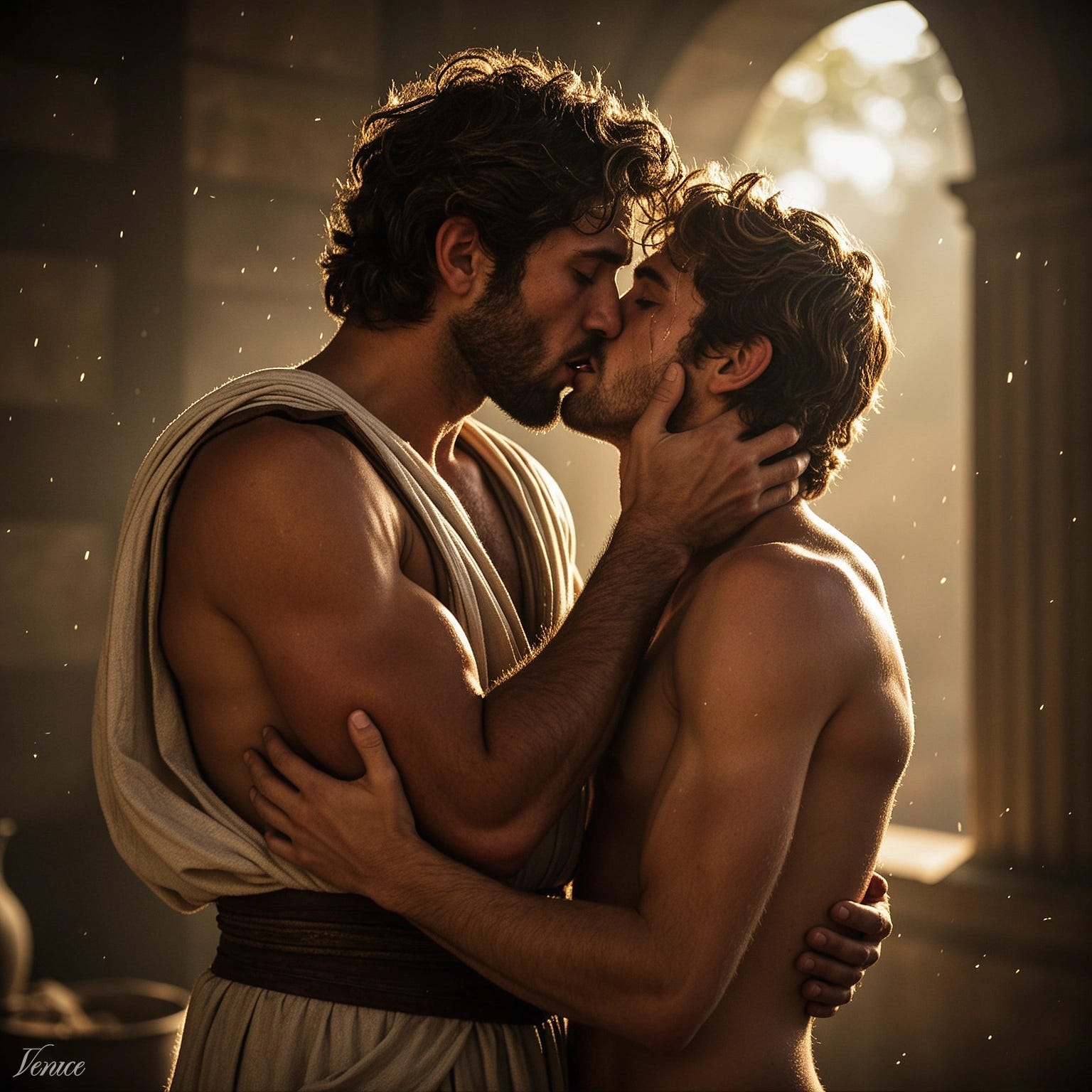
The palace of King Alcinous smelled of wine and roasted meat, of salt air drifting through marble columns, of men who had bathed in olive oil and rosewater. Odysseus sat in the place of honor, a cup of wine untouched in his hand, and watched the firelight play across the faces of strangers who had saved his life.
He had washed ashore on their beach three days ago, more corpse than man. Naked, salt-crusted, half-drowned. The prince—Nausicaa, barely twenty and beautiful in the way of young men who have never known war—had found him tangled in seaweed and thought him a god. Odysseus had laughed at that, a sound like breaking glass, and said: “No god. Just a man trying to get home.”
Now, clean and fed and clothed in borrowed finery, he still felt like a drowned thing. Twenty years since he’d left Ithaca. Ten years of war, ten years of wandering. The man who had sailed away was dead. What sat in this chair, drinking Phaeacian wine, was something else entirely.
“You have not told us your name,” King Alcinous said. He was older, silver-bearded, with kind eyes that had seen enough of the world to recognize suffering. “Nor where you come from. Nor how you came to be alone on a raft in Poseidon’s waters.”
Odysseus set down his cup. Around the hall, conversation dimmed. Even the servants paused in their work. They had been waiting for this—the stranger’s story. In his silence over the past three days, he had become a mystery, and men loved mysteries almost as much as they loved wine.
“My name,” he said, and his voice sounded strange to his own ears, “is Odysseus. Son of Laertes. King of Ithaca.” He paused. “Or I was, once. I don’t know what I am now.”
A murmur rippled through the hall. They knew the name. Everyone knew the name. Odysseus of the Trojan Horse. Odysseus of many wiles. Odysseus who had helped end the war that had consumed a generation.
“Ithaca,” Nausicaa breathed. “But that’s—the war ended ten years ago. Where have you been?”
Odysseus looked at the young prince and saw himself at that age: bright-eyed, unmarked by loss, still believing the world made sense. “Trying to get home,” he said simply. “The gods had other plans.”
King Alcinous leaned forward. “Tell us. We Phaeacians honor the sacred law of hospitality. You are safe here, and your story—whatever it is—will be heard without judgment.”
Without judgment. Odysseus almost laughed again. How do you tell a story like his without judgment? How do you explain the things you’ve done, the men you’ve lost, the promises you’ve broken? How do you say: I have been faithful and unfaithful, loyal and treacherous, desperate and cowardly and brave, and I no longer know which of these is the truth?
But they were waiting. And he was so tired of carrying it alone.
“Very well,” Odysseus said. He picked up his wine, drank deep, and began. “I will tell you how I left Troy victorious and arrived here, twenty years later, with nothing but the clothes you’ve given me and a heart full of ghosts.”
TWENTY YEARS EARLIER
The night before he sailed for Troy, Odysseus made love to Patroclus like a man trying to memorize a prayer.
They had been together since they were young—since Odysseus was eighteen and Patroclus sixteen, both of them fumbling and fierce and certain they had invented desire. Fifteen years of shared beds and shared secrets, of building a life in the rocky soil of Ithaca, of learning each other’s bodies the way sailors learn the stars.
Patroclus was beautiful. Not in the way that stopped conversation—not like Helen, whose face had launched this damned war—but in the way that made you want to look again, and then again. Auburn hair that caught fire in sunlight. A mouth made for smiling, though it smiled less these days. Eyes the color of the sea in winter: gray-green and full of storms.
“Don’t go,” Patroclus whispered against Odysseus’s throat.
They were tangled together in their bed, the one they had shared for fifteen years, in the room that overlooked the olive groves. Outside, the cicadas sang their endless summer song. Inside, there was only the sound of their breathing, the rustle of linen sheets, the beating of two hearts that had learned to move in rhythm.
The room was warm despite the hour—that thick Mediterranean heat that clung to skin like honey. A single oil lamp burned on the table, casting shadows that danced across the whitewashed walls, across the curve of Patroclus’s shoulder, across the desperate tangle of their limbs.
Odysseus wanted to stay. Gods, he wanted to. But he had sworn an oath—all of Helen’s suitors had sworn it, years ago when she chose Menelaus—to defend her marriage. And oaths mattered. Honor mattered. Or so he had believed, once.
“I have to,” he said, hating the words even as he spoke them. “The oath—”
“Damn the oath.” Patroclus pulled back to look at him, and there were tears on his face, silver in the lamplight. “Damn Helen. Damn Menelaus and Agamemnon and all of them. What about your oath to me?”
They had never spoken vows in a temple. There was no priest who would bless what they were, no ceremony that would make them legitimate in the eyes of the law. But they had made promises anyway, in this bed, in the dark, with their bodies pressed together and their souls laid bare: I am yours. You are mine. Until death or the gods themselves part us.
Odysseus cupped Patroclus’s face in his hands, thumbs brushing away tears. The gesture was so familiar it hurt—how many times had he done this over fifteen years? How many tears had he kissed away, how many smiles had he coaxed from that beautiful mouth?
“I will come back to you,” he said. “I swear it. On my life, on my kingdom, on everything I am—I will come back.”
“How long?” Patroclus’s voice broke. “How long will you be gone?”
“A year. Maybe two. It’s just one city. How long can it take?”
Patroclus laughed, bitter and wet. “You don’t know that. You don’t know anything. You could die there. You could—” He couldn’t finish.
“I won’t die.” Odysseus kissed him, tasting salt and desperation. “I’m too clever to die. You know that.”
“Clever men die too.”
“Not this one.” Another kiss, deeper. “I will come home to you. And when I do, I’ll never leave again. I swear it.”
Patroclus searched his face in the lamplight, looking for the lie, the doubt. Finding none—or choosing not to see it—he pulled Odysseus closer, their bodies pressing together from chest to hip. Odysseus could feel Patroclus’s heart racing against his own, could feel the heat of his skin, the tremor in his hands.
“Then make love to me like you mean it,” Patroclus whispered. “Make love to me so I remember what I’m waiting for.”
Odysseus did.
He kissed Patroclus slowly, thoroughly, the way he’d learned to over fifteen years of practice. He knew every place that made Patroclus gasp—the hollow of his throat, the inside of his wrist, the sensitive skin just below his ear. He mapped them all again now, committing them to memory, building a catalog of sighs and shivers to carry with him across the wine-dark sea.
His mouth moved down Patroclus’s neck, tasting the salt of his skin, feeling the pulse point flutter beneath his lips. Patroclus’s hands tangled in his hair, holding him close, and the small sound he made—half-moan, half-plea—went straight to Odysseus’s cock.
They were both already hard, had been since they’d climbed into bed an hour ago. This whole night had been foreplay—every touch weighted with goodbye, every kiss edged with desperation.
Odysseus’s hands moved over Patroclus’s body with the familiarity of long intimacy. The freckles scattered across his shoulders like constellations. The scar on his hip from a childhood fall from an olive tree. The way his stomach muscles jumped when Odysseus’s fingers traced lower, following the line of dark hair that led down to where Patroclus was hard and wanting.
“Odysseus—” Patroclus’s voice was already wrecked, and they’d barely begun.
“I’m here,” Odysseus murmured against his skin. “I’m here, love.”
He wrapped his hand around Patroclus’s cock, and Patroclus arched off the bed with a gasp. Odysseus knew exactly how to touch him—the pressure he liked, the rhythm that drove him mad. He stroked slowly, deliberately, watching Patroclus’s face in the lamplight. Watching the way his eyes fluttered closed, the way his lips parted, the way pleasure softened the lines of worry that had been etched there for weeks.
This was what Odysseus wanted to remember: Patroclus lost in sensation, beautiful and unguarded, his.
“Need you,” Patroclus gasped. His hands clutched at Odysseus’s shoulders, pulling him closer, nails digging into skin. “Need to feel you. Need—”
“I know.” Odysseus released his grip on Patroclus’s cock—ignoring the whimper of protest—and reached for the small clay jar they kept beside the bed. The one filled with olive oil scented with lavender and rosemary. His hands were shaking slightly as he pulled out the stopper. “I know what you need.”
He slicked his fingers, taking his time, letting Patroclus watch. They’d done this a thousand times, but tonight felt different. Tonight felt like the first time and the last time all at once.
Odysseus kissed him again as his hand moved between Patroclus’s legs, as his fingers found the tight heat of his entrance. Patroclus opened his legs wider, offering himself completely, and Odysseus felt his chest constrict with love so fierce it was almost painful.
He worked one finger inside slowly, carefully, watching Patroclus’s face for any sign of discomfort. Found only desire—eyes dark with want, mouth open on a silent moan.
“More,” Patroclus whispered. “Please. I need more.”
Odysseus added a second finger, then a third, stretching him open with patient thoroughness. Patroclus was tight and hot around his fingers, his body clenching and releasing in rhythm with his breathing. Odysseus crooked his fingers, finding that spot inside that made Patroclus cry out and arch his back.
“There,” Patroclus gasped. “Gods, there—”
Odysseus worked him open until Patroclus was trembling, until he was begging, until his cock was leaking steadily against his stomach and his hands were fisted in the sheets.
“Ready?” Odysseus asked, though he could see the answer written in every line of Patroclus’s body.
“Yes. Gods, yes. Need you inside me. Need to feel you.”
Odysseus withdrew his fingers—earning another whimper—and slicked his own cock with oil. He was achingly hard, had been for what felt like hours, and the first touch of his own hand made him groan.
He positioned himself between Patroclus’s legs, the head of his cock pressing against Patroclus’s entrance. Their eyes met, and for a moment neither of them moved. This was the threshold. Once they crossed it, the night would truly begin its countdown to dawn.
“I love you,” Odysseus said. “Whatever happens. Whatever comes. I love you.”
“I love you,” Patroclus replied. “Now stop talking and fuck me.”
Odysseus pushed inside.
They both gasped at the sensation—the tight heat, the perfect resistance, the way Patroclus’s body opened for him inch by inch. Odysseus went slowly, giving Patroclus time to adjust, watching his face for any sign of pain. But there was only pleasure—eyes rolling back, mouth falling open, a low moan building in his throat.
When Odysseus was fully seated, buried to the hilt inside his lover’s body, he paused. Let them both feel it. The connection. The completeness. The way they fit together like they’d been made for this, for each other.
“Fuck me,” Patroclus demanded. His legs wrapped around Odysseus’s waist, heels digging into his ass. “Please fuck me.”
Odysseus did.
He pulled out slowly, almost all the way, then thrust back in. Set a rhythm that was deep and deliberate and designed to drive them both mad. Each thrust pulled sounds from Patroclus—moans and gasps and broken syllables that might have been Odysseus’s name.
Odysseus braced himself on his forearms, hovering over Patroclus, close enough to kiss him between thrusts. Close enough to see every flicker of pleasure across his face. Close enough to feel Patroclus’s breath against his lips, to taste the wine they’d drunk earlier, to drown in the gray-green of his eyes.
“Harder,” Patroclus panted. “I need—harder—”
Odysseus shifted his angle and drove in deeper, faster. The sound of skin against skin filled the room, punctuated by their breathing, their moans, the creak of the bed frame. Patroclus’s cock was trapped between their bodies, rubbing against Odysseus’s stomach with each thrust, and the friction was driving him wild.
“Touch yourself,” Odysseus commanded, his voice rough. “I want to watch you.”
Patroclus obeyed immediately, his hand wrapping around his own cock, stroking in rhythm with Odysseus’s thrusts. The sight of it—Patroclus spread open beneath him, taking his cock, pleasuring himself, lost in sensation—nearly undid Odysseus completely.
“So beautiful,” Odysseus gasped. “You’re so beautiful. I’ll never forget this. Never forget you like this.”
“Don’t want you to forget,” Patroclus managed. His hand moved faster on his cock, his body tightening around Odysseus. “Want you to remember. Want you to think of this—of me—every night you’re gone.”
“I will. Gods, I will.”
Odysseus could feel his orgasm building at the base of his spine, could feel the tension coiling tighter with each thrust. But he wanted Patroclus to come first. Wanted to feel him fall apart, wanted to watch it, wanted to memorize every second.
He adjusted his angle again, hitting that spot inside Patroclus with every thrust. Patroclus’s hand moved frantically on his cock, his other hand clutching at Odysseus’s shoulder hard enough to bruise.
“Close,” Patroclus gasped. “So close—don’t stop—”
“Never,” Odysseus promised. “I’ll never stop. I’ll never stop loving you.”
Patroclus came with a cry that was half-sob, his body clenching tight around Odysseus’s cock, his release spilling hot and wet between them. The sight of it, the sound of it, the feeling of Patroclus’s body pulsing around him—it pushed Odysseus over the edge.
He buried himself deep one final time and came, gasping Patroclus’s name like a prayer, like an oath, like the only truth he knew. His release poured into Patroclus’s body in waves, marking him, claiming him, binding them together in the most primal way possible.
For a long moment, they stayed locked together, trembling, breathing hard. Odysseus’s arms shook with the effort of holding himself up. Patroclus’s legs were still wrapped around his waist, holding him close, holding him inside.
“Don’t pull out yet,” Patroclus whispered. “Stay. Just for a moment.”
Odysseus lowered himself carefully, letting his weight settle onto Patroclus, their sweat-slicked bodies pressing together. He could feel Patroclus’s heart racing against his chest, could feel the flutter of his breath against his neck, could feel his own release slowly leaking out around his softening cock.
“I love you,” Patroclus said again. His voice was small, broken. “I love you so much it terrifies me.”
“I love you too.” Odysseus pressed his face into the curve of Patroclus’s neck, breathing him in—olive oil and sweat and sex and something that was uniquely, perfectly him. “I will come back to you. I swear it on everything sacred.”
They lay like that until their breathing slowed, until the sweat cooled on their skin, until Odysseus finally, reluctantly, withdrew. Patroclus made a small sound of loss, and Odysseus felt it echo in his own chest.
He rolled onto his side and gathered Patroclus into his arms, pulling him close. Patroclus came willingly, tucking his head under Odysseus’s chin, one leg thrown over Odysseus’s hip. They fit together perfectly, the way they always had—two pieces of the same whole.
Odysseus could feel the evidence of their lovemaking between them—the cooling sweat, the stickiness of release on their skin, the slight tremor in Patroclus’s limbs. He reached for the cloth they kept beside the bed and cleaned them both gently, tenderly, taking care with Patroclus’s oversensitive flesh.
“You’ll be sore tomorrow,” Odysseus murmured.
“Good.” Patroclus’s voice was drowsy but fierce. “I want to feel it. Want to remember.”
Odysseus tossed the cloth aside and pulled Patroclus close again. Outside, the cicadas had finally quieted. The night was at its deepest point—that still, dark hour before dawn when the world held its breath.
“Tell me again,” Patroclus whispered. “Tell me you’ll come back.”
“I’ll come back.” Odysseus pressed a kiss to his forehead. “I’ll sail through storms and fight through armies and bargain with the gods themselves if I have to. But I will come back to you.”
“Promise me something else.”
“Anything.”
“Promise me that no matter what happens, no matter how long it takes, you’ll remember this. Remember us. Remember who you are.” Patroclus pulled back just enough to look at him, and his eyes were serious, almost prophetic. “War changes men. I’ve seen it. Promise me you won’t let it change you so much that you forget your way home.”
Odysseus felt a chill run down his spine despite the warmth of the room. “I promise. You are my home, Patroclus. As long as I remember you, I’ll know my way back.”
Patroclus studied his face for a long moment, then nodded. He settled back against Odysseus’s chest, his breathing gradually evening out.
Odysseus stayed awake, holding him, memorizing the weight of him, the warmth of him, the way he fit perfectly in the curve of Odysseus’s body. He memorized the sound of his breathing, the smell of his hair, the feeling of his heartbeat against Odysseus’s ribs.
He memorized everything, because some part of him—some deep, prophetic part that he would later wish he’d listened to—knew that this moment was precious beyond measure. Knew that the man holding Patroclus in this bed would not be the same man who returned to it.
But he pushed that thought away. Told himself he was being maudlin, superstitious. It was just a war. Just a year or two. He would fight, he would win, he would come home. Simple.
The sky outside began to lighten—that first pale hint of dawn creeping over the horizon. Odysseus felt it like a physical pain, like a blade sliding between his ribs.
Patroclus stirred in his arms. “Is it morning?”
“Not yet. Soon.”
“Then we have a little more time.” Patroclus’s hand slid down Odysseus’s chest, over his stomach, lower. Found him already half-hard again despite having just come. “Make love to me again. One more time before you go.”
And Odysseus did.
This time was different—slower, quieter, tinged with grief. Odysseus took his time preparing Patroclus again, stretching him open with patient fingers, kissing him until they were both breathless. When he finally pushed inside, they both made sounds that were closer to sobs than moans.
They moved together in the growing light, unhurried, savoring every moment. Odysseus memorized the way Patroclus felt around him, the sounds he made, the way his body responded to every touch. He made it last as long as he could, drawing out their pleasure until they were both shaking with need.
When they finally came—Patroclus first, then Odysseus moments later—it felt less like pleasure and more like breaking. Like something essential tearing apart.
They lay tangled together afterward, neither speaking, both knowing that words would shatter whatever fragile thing they were trying to preserve.
The sun rose. Golden light spilled through the window, painting the room in shades of amber and honey. It was beautiful. It was terrible. It meant their time was up.
“I have to go,” Odysseus whispered.
“I know.”
Neither of them moved.
Finally, Odysseus forced himself to sit up. His body protested—muscles sore from lovemaking, heart sore from something deeper. He found his clothes scattered across the floor where they’d been discarded the night before and began to dress.
Patroclus watched him from the bed, the sheet pooled around his waist, his hair mussed, his skin marked with the evidence of Odysseus’s mouth and hands. He looked like a painting. Like something too beautiful for this world.
“Don’t watch me leave,” Odysseus said as he fastened his sandals. “I don’t think I can bear it if you watch me leave.”
“Then I’ll wait here.” Patroclus’s voice was steady, but his eyes were bright with unshed tears. “I’ll wait in this bed until you come back to it.”
Odysseus crossed to him one last time. Cupped his face in his hands one last time. Kissed him one last time—deep and desperate and full of all the things he couldn’t say.
“I love you,” he whispered against Patroclus’s lips. “I will love you until the day I die and beyond. You are everything to me. Everything.”
“I love you.” Patroclus’s tears finally spilled over, tracking down his cheeks. “Come back to me. Please. Just come back.”
“I will. I swear it.”
Odysseus forced himself to let go. Forced himself to turn away. Forced himself to walk to the door.
He paused at the threshold, his hand on the frame, every instinct screaming at him to turn back. To stay. To damn the oath and the war and everything else.
But he didn’t.
He walked out of the room, down the stairs, out of the palace. He walked down to the harbor where his ships waited, where his men were already preparing to sail. He walked away from everything he loved, everything that mattered, because he had made a promise to men he barely knew for a cause he didn’t believe in.
He did not look back.
If he had looked back, he would have seen Patroclus standing at the window, watching him go, one hand pressed against the glass.
If he had looked back, he might have changed his mind.
If he had looked back, the next twenty years might have been different.
But he didn’t look back.
And that, perhaps, was his first mistake.
THE PALACE OF ALCINOUS
“The war took ten years,” Odysseus said.
His voice was flat, emotionless, but his hands trembled as he lifted his wine cup. The hall was utterly silent. Even the servants had stopped moving, transfixed by the stranger’s story.
“Ten years of blood and fire and men dying for a woman who didn’t want to be rescued. Ten years of watching boys become soldiers and soldiers become corpses. Ten years of doing things I told myself were necessary, were strategic, were justified by the cause.”
He drank deeply, draining the cup. A servant hurried to refill it.
“I designed the horse. The great wooden horse we left at Troy’s gates. They dragged it inside their walls, thinking it a gift from the gods, a sign of our surrender. That night, we poured out of its belly like a plague and opened the gates for our army.” His jaw tightened. “By dawn, Troy was ash and screams and the smell of burning flesh. Women wailing over their dead. Children crying for fathers who would never answer. Blood running in the streets like rivers.”
Nausicaa looked pale. “But you won.”
“We won.” Odysseus’s laugh was bitter. “We took Helen back. We avenged Menelaus’s honor. We did what we came to do. And all I could think was: I can go home now. I can see him again. I can keep my promise. I can go back to that bed, that room, that man, and pretend the last ten years never happened.“
“But you didn’t go home,” King Alcinous said quietly.
“No.” Odysseus stared into his wine. “No, I didn’t. Because the gods—or fate, or my own hubris—had other plans.”
He set down his cup with deliberate care, as if afraid he might shatter it.
“We set sail from Troy with twelve ships. Twelve ships full of men who had survived ten years of war and just wanted to see their families again. The journey should have taken two weeks. Fair winds, calm seas, straight to Ithaca.” He looked up, and his eyes were haunted. “I would have been home before the blood dried under my fingernails. I would have walked back into that room, climbed back into that bed, and held him again. I was so close.”
“What happened?” Nausicaa asked, though his voice suggested he already knew the answer wouldn’t be simple.
“Poseidon happened. Or perhaps it was Zeus. Or perhaps it was simply that the universe demands payment for hubris, and I had been too confident, too proud, too certain that I could control my own fate.” Odysseus’s hands clenched into fists. “A storm hit us three days out from Troy. Sudden, savage, unlike anything I’d ever seen. It tore our sails to shreds, snapped our masts like kindling, scattered the fleet. Lightning struck so close I could taste copper. Waves tall as mountains. Men screaming prayers to gods who weren’t listening.”
He could still feel it—the terror of the deck pitching beneath his feet, of not knowing which way was up, of being utterly at the mercy of forces beyond his control.
“When it finally cleared, we had no idea where we were. The stars were wrong. The currents were wrong. Everything was wrong. We’d been blown so far off course that even I—and I knew these waters better than most—couldn’t find our position.”
King Alcinous leaned forward. “How long were you lost?”
“Ten years.” The words fell like stones. “Ten years of trying to find my way home. Ten years of islands and monsters and gods playing with us like toys. Ten years of watching my men die one by one. Ten years of choices that seemed necessary at the time but that I will carry like scars for the rest of my life.”
He picked up his wine again, but didn’t drink. Just held it, staring at the dark liquid as if it held answers.
“The first island we found seemed like salvation. Beautiful. Peaceful. The people there welcomed us, fed us, gave us shelter. They offered us lotus flowers—said they would ease our weariness, help us rest.” His voice went soft, almost wistful. “Do you know what lotus does, Your Majesty?”
“I’ve heard tales,” King Alcinous said. “It makes men forget.”
“Forget everything. Their homes, their families, their purpose, their pain. My men ate those flowers and didn’t want to leave. They said: ‘Why go back? Why suffer? We can stay here forever, in paradise, and never hurt again.’” Odysseus’s jaw worked. “I had to drag them back to the ships. Some of them fought me. Begged me to let them stay. And I understood—gods, I understood. The war had broken something in all of us. The idea of just stopping, of letting go, of never having to face what we’d done or what we’d become... it was seductive.”
“But you resisted,” Nausicaa said softly.
“I had a reason to resist.” Odysseus looked at the young prince, and something raw and desperate flickered across his face. “I had someone waiting for me. Someone I loved more than peace, more than forgetting, more than paradise itself. Someone I had promised to return to.”
The words hung in the air. In the firelight, Odysseus looked like a man carved from grief.
“His name was Patroclus,” he said quietly. “Is Patroclus. I don’t know if he’s still alive. I don’t know if he’s still waiting. Twenty years is a long time. He could be dead. He could have moved on, found someone else, built a life without me. He could hate me for leaving, for being gone so long, for breaking my promise.” His voice cracked. “But twenty years ago, I promised him I would come home. And that promise is the only thing that’s kept me alive through everything that came after.”
King Alcinous’s expression softened with understanding. “You loved him.”
“I love him.” Present tense. Deliberate. Defiant. “I have loved him since I was eighteen years old. He is... he was... everything. My heart. My home. The reason I wake up in the morning and the last thought in my head before I sleep.”
Odysseus’s hands were shaking now, and he didn’t bother to hide it.
“The last time I saw him, I made love to him twice. Once at sunset, once at dawn. I memorized every inch of his body, every sound he made, every way he responded to my touch. I thought I was being thorough. I thought I was being romantic.” He laughed, and it was a broken sound. “I didn’t know I was saying goodbye for twenty years. I didn’t know that the man who left that bed would not be the same man who returned to it—if he returned at all.”
The hall was so quiet that the sound of the sea could be heard through the columns—waves against stone, eternal and indifferent.
“And I have betrayed him,” Odysseus said, his voice barely above a whisper. “In ways I can barely speak aloud. In ways that will haunt me until I die. I have been unfaithful. I have been weak. I have done things to survive that I cannot undo, cannot take back, cannot justify no matter how hard I try.”
He looked around the hall, meeting the eyes of the Phaeacians watching him with a mixture of pity and fascination.
“So I will tell you my story,” he said. “All of it. The glory and the shame. The monsters and the gods. The men I lost and the men I loved and the man I betrayed most of all. I will tell you how I spent ten years trying to sail home, and how every choice I made took me further from the person I was trying to return to.”
He raised his cup, and his hand was steady now—the steadiness of a man who had made a decision, who had chosen to confess.
“And when I’m done, you can judge whether I deserve to go home at all. Whether I deserve to see him again. Whether love can survive what I’ve done to it.”
King Alcinous raised his own cup in response. “We will listen,” he said gently. “And then we will help you finish your journey. The gods brought you to our shore for a reason, Odysseus of Ithaca. Perhaps that reason is redemption.”
Odysseus drank. The wine tasted like ash and salt and regret.
“The second island,” he began, his voice steadying as he slipped into the role of storyteller, “was where I learned that survival has a price. And that sometimes, the price is yourself.”
He set down his cup and looked into the fire, seeing not flames but memories—a cave, a monster, a choice that would mark him forever.
“We landed seeking supplies. Food, water, anything to keep us alive. We found a cave—massive, filled with stores of cheese and grain. We thought it was abandoned. We were wrong.”
The fire crackled. The sea whispered against the shore.
“The cave belonged to a warlord named Polyphemus. They called him the Cyclops—not because he had one eye, but because he ruled that island alone, answering to no one, taking what he wanted and killing what he didn’t want. He found us in his cave and sealed the entrance with a boulder too massive for twenty men to move. We were trapped.”
Nausicaa leaned forward, transfixed.
“He was enormous. Nearly seven feet of scarred muscle and casual cruelty. And he was hungry.” Odysseus’s voice went flat. “He ate two of my men that first night. Cracked their bones like kindling. Laughed while he did it.”
Someone in the hall made a sound of horror.
“For three days, we were his prisoners. For three days, I watched him and waited and planned. And on the fourth day, I saw my opening.” Odysseus’s jaw tightened. “He wanted me. Not to eat. To fuck.”
The word fell like a stone into the silence.
“So I made him a bargain. Wine for time. Pleasure for mercy.” Odysseus met King Alcinous’s eyes. “I whored myself to a monster to save my men. And when he was drunk and sated and unconscious, we drove a sharpened stake through his eye and escaped while he screamed.”
The hall was utterly silent.
“That was the first time I betrayed Patroclus,” Odysseus said quietly. “The first time I let another man inside my body. The first time I used sex as a weapon, as a strategy, as a means to an end.” He paused. “It would not be the last.”
King Alcinous’s expression was grave but not judgmental. “You did what you had to do to survive. To save your men.”
“Did I?” Odysseus’s laugh was hollow. “Or did I simply make the choice that let me live with myself? There might have been another way. A better way. But I didn’t look for it hard enough because the path I chose was... easier. Clearer.” He shook his head. “I told myself it was strategy. I told myself it was sacrifice. I told myself it meant nothing—that my body was just a tool, a weapon, no different than a sword or a shield.”
He fell silent for a moment, staring into his wine.
“But it did mean something. Because when it was over, when we were safe on the ship and sailing away, I couldn’t stop shaking. Couldn’t stop feeling his hands on me, inside me. Couldn’t stop feeling... marked.” His voice dropped to barely a whisper. “And I couldn’t stop thinking about Patroclus. About the last time someone had touched me that way—with tenderness, with love, with reverence. About how I’d let a monster defile something that was supposed to be sacred between us.”
Nausicaa’s eyes were bright with unshed tears. “But you survived. You saved your men.”
“I survived.” Odysseus nodded slowly. “And that became my justification for everything that came after. Every choice, every betrayal, every compromise. I survived. I kept going. I kept trying to get home.” He looked up, and his eyes were haunted. “But the question I’ve been asking myself for ten years is: what’s the point of surviving if you lose yourself in the process? What’s the point of getting home if you’re not the person who left?”
King Alcinous was quiet for a long moment. Then he said, “Perhaps the point is that you kept trying. That even broken, even changed, you never stopped wanting to return to him.”
“Perhaps.” Odysseus didn’t sound convinced. “Or perhaps I’m just a coward who couldn’t face the alternative. Who couldn’t admit that I’d already lost what I was fighting for.”
He picked up his wine and drained it in one long swallow. When he set the cup down, his expression had shifted—less raw, more controlled. The mask of the storyteller sliding back into place.
“That was the first island,” he said. “The first test. There would be many more. Some I passed. Some I failed. Some I’m still not sure which they were.”
“How many islands?” Nausicaa asked.
“Too many to count. Some we stayed on for days. Some for months. One for seven years.” Odysseus’s jaw tightened. “Each one had its own temptation, its own price. The lotus eaters offered forgetfulness. Polyphemus took by force what I gave to survive. But there were others—gods and mortals and everything in between—who offered pleasure, comfort, love. Who made me want to stay. Who made me forget, for a while, what I was trying to get back to.”
“Did you?” King Alcinous asked gently. “Forget?”
“Sometimes.” The admission seemed to cost him. “Not always. Not at first. But as the years passed, as the journey stretched on and on with no end in sight, as I watched my men die one by one until I was the only one left... yes. Sometimes I forgot. Sometimes I let myself pretend that home was a dream, that Patroclus was a memory, that I could start over and be someone new.”
He looked down at his hands—scarred, weathered, the hands of a man who had seen too much.
“But I always remembered again. Always. Because no matter how far I ran, no matter how many beds I climbed into, no matter how many times I told myself it didn’t matter—I could still feel him. Still smell the rosemary in his hair. Still hear the way he said my name when we made love. Still remember the promise I made in that bed twenty years ago.”
Odysseus’s voice broke on the last word, and he stopped, pressing his fist against his mouth as if to hold back a sob.
The hall waited. No one moved. No one spoke.
Finally, Odysseus lowered his hand and continued, his voice rough but steady.
“After Polyphemus, we sailed for weeks. Lost more ships to storms, to monsters, to our own mistakes. We reached the island of Aeolus—the god of winds. He was... kind. Generous. He offered to help us. He had a bag of winds that could blow us straight home to Ithaca. One day’s journey, he said. One day and I could see Patroclus again.”
“But?” Nausicaa prompted when Odysseus fell silent.
“But there was a price. There’s always a price.” Odysseus’s smile was bitter. “One night in his bed. That was all he asked. One night, and he’d give me the winds that would take me home.”
“And you agreed,” King Alcinous said. It wasn’t a question.
“I agreed.” Odysseus’s voice was flat. “I told myself it was the same as Polyphemus. A transaction. A strategy. Meaningless.” He laughed, and it was a terrible sound. “But it wasn’t the same. Polyphemus took by force. Aeolus asked. And I said yes. I chose it. I climbed into his bed willingly, let him touch me, let him inside me, let him make me feel things I didn’t want to feel. And the whole time, I thought of Patroclus. Wondered if he could feel it somehow, across all those miles of sea. Wondered if he knew I was betraying him. Wondered if he’d forgive me.”
He paused, swallowing hard.
“In the morning, Aeolus gave me the bag of winds. Told me not to open it until we reached Ithaca. We set sail, and for one perfect day, I believed I was going home. I could see it in my mind—the harbor, the palace, the room, the bed. Him. I was one day away from keeping my promise.”
“What happened?” Nausicaa whispered, though the grief in Odysseus’s voice already told the story.
“My men didn’t trust me. They thought I was keeping treasure in the bag, hoarding it for myself. While I slept—exhausted from sailing, from hoping, from daring to believe—they opened it.” Odysseus’s hands clenched into fists. “All the winds escaped at once. Blew us back to where we’d started. Back to Aeolus’s island. And when I begged him to help us again, he refused. Said I was cursed. Said the gods clearly didn’t want me to go home.”
His voice cracked. “I was one day away. One day. And I lost it because my own men didn’t trust me. Because I’d been gone so long, sacrificed so much, that even they could see I wasn’t the man I used to be.”
Tears slid down Odysseus’s face now, and he didn’t bother to wipe them away.
“That’s when I started to break. That’s when I started to wonder if the gods were right. If I was cursed. If I was being punished for something—for the war, for the lives I’d taken, for the promises I’d broken. That’s when I started to think that maybe I didn’t deserve to go home. That maybe Patroclus was better off without me.”
King Alcinous rose from his throne and crossed to Odysseus. He placed a hand on the broken man’s shoulder—a gesture of comfort, of solidarity.
“But you kept going,” the king said quietly. “You didn’t give up.”
“I kept going.” Odysseus nodded, wiping at his eyes with the back of his hand. “Because I’m either the most loyal man alive or the most stubborn fool. I’m still not sure which.”
He took a shaky breath and looked around the hall. Every eye was on him—some wet with tears, some wide with shock, all of them transfixed.
“There’s more,” Odysseus said. “So much more. Islands where I stayed too long. Gods who kept me captive. Men I loved who weren’t him. Choices I made that I can never unmake. A decade of wandering, of losing myself piece by piece, of becoming someone I don’t recognize when I look in a mirror.”
He stood, swaying slightly, exhausted by confession.
“But I’m tired. And you’ve heard enough for one night. The rest... the rest can wait until tomorrow. If you still want to hear it. If you haven’t already decided I’m not worth helping.”
“We want to hear it,” King Alcinous said firmly. “All of it. And when you’re done, we will help you finish your journey. You have my word.”
Odysseus looked at him for a long moment, searching for the lie, the judgment. Finding none.
“Thank you,” he whispered. “For listening. For not turning me away. For... for not hating me.”
“We don’t hate you,” Nausicaa said, his young voice thick with emotion. “We pity you. And we admire you. Because you’re still here. Still fighting. Still trying to get home.”
Odysseus smiled, and it was sad and small and genuine. “I don’t know if that makes me brave or just too stupid to know when to quit.”
“Perhaps it makes you human,” King Alcinous said. “And perhaps that’s enough.”
A servant appeared at Odysseus’s elbow, ready to guide him to his chambers. Odysseus nodded his thanks and turned to follow, but paused at the threshold of the hall.
He looked back at the Phaeacians—at their kind faces, their open hearts, their willingness to hear his story without judgment.
“I haven’t said his name aloud in years,” Odysseus said quietly. “Patroclus. I was afraid that if I spoke it, I’d summon him somehow. That he’d see what I’ve become and turn away in disgust.” He swallowed hard. “But tonight, I said it. And the world didn’t end. And maybe... maybe that means there’s still hope. Maybe it means I can still go home. Maybe it means he’ll still want me when I get there.”
“He will,” Nausicaa said with the certainty of youth, of someone who still believed in happy endings. “If he loved you the way you loved him, he’ll want you. No matter what. No matter how long it’s been.”
Odysseus wanted to believe him. Gods, he wanted to believe him.
“Tomorrow,” he said, “I’ll tell you about Circe. About the year I spent in his bed, forgetting everything. About how pleasure can be its own kind of prison. About how I almost didn’t leave.”
He looked at each of them in turn—these strangers who had become his confessors, his witnesses, his last hope.
“And then I’ll tell you about Calypso. About the seven years I spent on his island, in his arms, wanting to die because I couldn’t go home and couldn’t forget why I needed to.” His voice dropped to a whisper. “About how I begged the gods to let me drown. About how I’m only here because they finally took pity on me.”
The hall was silent.
“Sleep well,” King Alcinous said gently. “Tomorrow, we’ll hear the rest. And then we’ll take you home.”
Odysseus nodded. He didn’t trust himself to speak.
He followed the servant out of the hall, through marble corridors, to a room that was comfortable and clean and utterly foreign. The servant left him alone, and Odysseus stood in the center of the room, suddenly aware of how exhausted he was. How heavy his bones felt. How much it had cost to tell even this much of his story.
He stripped off his borrowed clothes and climbed into the bed. The sheets were soft, the mattress comfortable, but it wasn’t his bed. Wasn’t the bed he’d left twenty years ago. Wasn’t the bed where Patroclus had begged him not to go.
Odysseus closed his eyes and tried to remember what Patroclus looked like. But twenty years was a long time, and memory was a traitor. He could remember pieces—auburn hair, gray-green eyes, a smile that lit up the room. But he couldn’t quite assemble them into a whole. Couldn’t quite see his face clearly anymore.
The realization made him want to weep.
“I’m coming home,” he whispered into the darkness. “I’m still coming home. Please still be there. Please still want me. Please...”
But the darkness had no answers.
And so Odysseus lay awake in a stranger’s bed, in a stranger’s palace, on a strange island, and counted the days until he could finish his journey.
Twenty years gone. Ten years of war. Ten years of wandering.
And still, somehow, he hadn’t given up.
Still, somehow, he believed he could make it home.
Still, somehow, he loved a man he might not even recognize anymore.
Outside, the sea whispered against the shore. The same sea that had carried him away from Ithaca twenty years ago. The same sea that would, gods willing, carry him back.
Odysseus closed his eyes and dreamed of olive groves and cicadas and a bed that smelled like rosemary.
He dreamed of home.