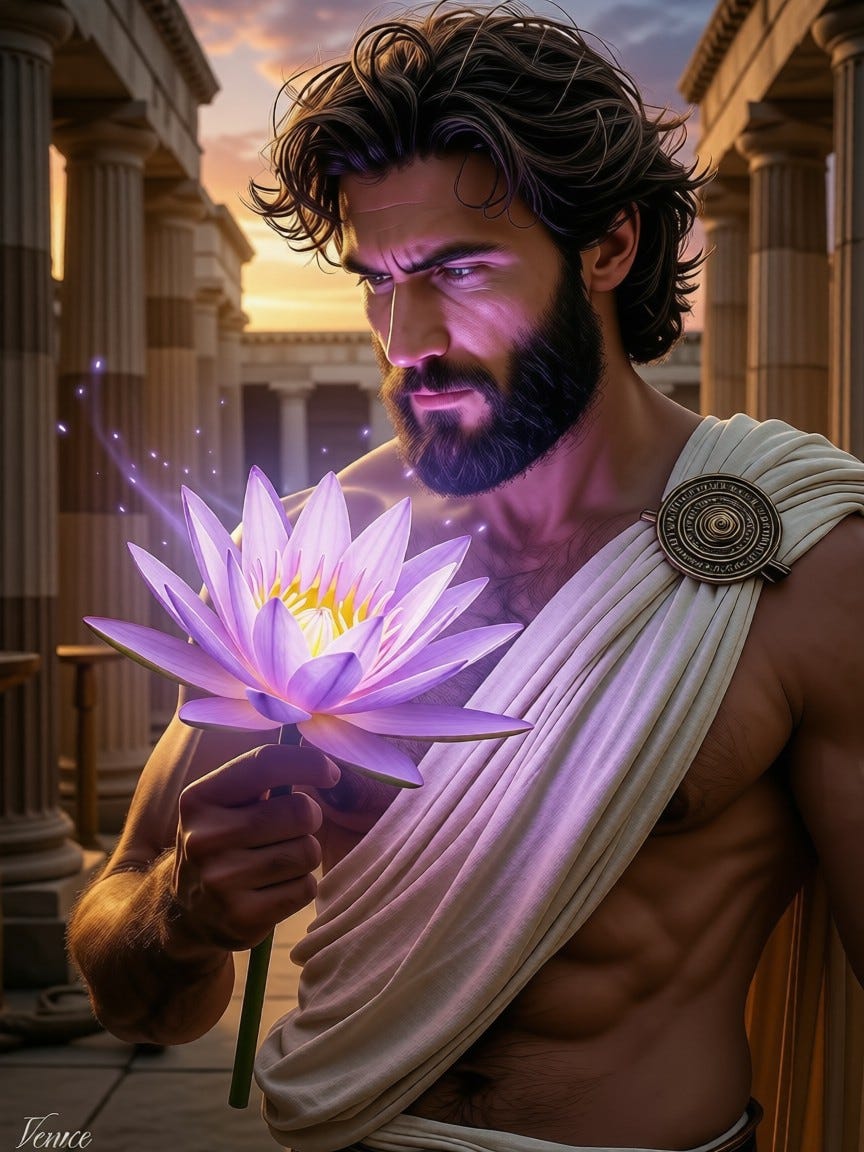
Odysseus woke to sunlight streaming through unfamiliar windows and, for one disorienting moment, didn’t know where he was.
Not in his bed in Ithaca. Not in the tent he’d shared with his captains during the war. Not in any of the countless places he’d slept over the past twenty years—caves and beaches and ships’ decks and beds that belonged to men whose names he’d tried to forget.
Then memory returned: the Phaeacian palace. King Alcinous. The story he’d begun to tell.
Patroclus.
The name hit him like a fist to the chest, the way it always did in those first moments of waking when his defenses were down. Twenty years, and he still reached for him in his sleep. Still woke expecting to find auburn hair on the pillow beside him, gray-green eyes blinking open, that sleep-soft smile that had been his and his alone.
But the bed was empty. It had been empty for twenty years.
Odysseus sat up, pressing the heels of his hands against his eyes. His body ached—not from physical exertion, but from the exhaustion of confession. He’d told them about Polyphemus last night. About what he’d done to survive. About the first time he’d betrayed the promise he’d made in that bed in Ithaca.
And tonight, he would tell them more.
A servant brought him food—bread and honey, olives and cheese, wine mixed with water. Odysseus ate mechanically, tasting nothing. His mind was already back on those ships, sailing away from Troy, believing he was going home.
He had been so naive.
After breakfast, he walked the palace grounds. The Phaeacians left him alone, sensing he needed solitude. He found himself drawn to the cliffs overlooking the sea—that endless expanse of blue that had been both his prison and his path for so long.
The wind smelled of salt and possibility. Somewhere beyond that horizon was Ithaca. Was home. Was Patroclus—if he still lived, if he still waited, if he could still forgive.
“The king says we’ll sail in three days,” a voice said behind him.
Odysseus turned to find Nausicaa approaching, his young face serious in the morning light.
“Three days,” Odysseus repeated. The words felt unreal. After ten years of wandering, three days seemed impossibly short. “And then?”
“And then you go home.” Nausicaa came to stand beside him, looking out at the sea. “Are you afraid?”
“Terrified.” The honesty surprised Odysseus, but after last night’s confessions, there seemed little point in pretending. “What if he’s not there? What if he is there but doesn’t want me anymore? What if I’ve changed so much that even if he forgives me, we can’t find our way back to what we were?”
“Maybe you’re not supposed to find your way back,” Nausicaa said quietly. “Maybe you’re supposed to find your way forward. To something new.”
Odysseus looked at the young prince—so wise for his years, so untouched by the kind of darkness Odysseus carried. “You sound like you’ve loved and lost.”
“I’ve loved and waited.” Nausicaa’s smile was sad. “My father sent him away on a diplomatic mission two years ago. He was supposed to be gone for six months. It’s been two years, and I don’t know if he’s alive or dead. Don’t know if he thinks of me. Don’t know if I’m a fool for still hoping.”
“You’re not a fool,” Odysseus said. “Hope is the only thing that keeps us alive.”
“Is that what kept you alive? Hope?”
Odysseus considered the question. “Hope. Stubbornness. Guilt. Fear. Love.” He paused. “Mostly love. Even when I hated myself, even when I wanted to die, I couldn’t stop loving him. And that love was... relentless. It wouldn’t let me quit.”
Nausicaa nodded slowly. “Tonight, you’ll tell us more of your story.”
“Yes.”
“The parts that hurt to remember.”
“All of it hurts to remember.” Odysseus turned away from the sea. “But yes. Tonight I’ll tell you about the lotus eaters. About how tempting it is to forget. About how close I came to giving up before the journey really began.”
THE PALACE OF ALCINOUS - THAT EVENING
The hall was more crowded than the night before. Word had spread about the stranger’s story—about Odysseus of Ithaca, lost for twenty years, finally telling the tale of his wandering. People had come from across the island to hear.
Odysseus sat in the place of honor again, a cup of wine in his hand, and looked at the sea of expectant faces. So many strangers, waiting to hear his shame. Waiting to judge whether he deserved to go home.
King Alcinous raised his hand, and the hall fell silent.
“Odysseus of Ithaca has agreed to continue his tale,” the king said. “Last night, he told us of his departure from Troy, of the storm that blew him off course, of the first islands he encountered. Tonight, he will tell us more. And we will listen with open hearts and without judgment.”
The king looked at Odysseus, his expression kind. “Whenever you’re ready.”
Odysseus drank deeply from his cup, then set it down. His hands were steady. He had survived worse than an audience.
“Last night,” he began, “I told you a little about Polyphemus. About what I did to survive him. About the first time I betrayed the man I loved.” He paused. “But I need to go back and tell you about the island before that. About the lotus eaters. About the first time I was tempted to give up entirely.”
He closed his eyes, and he was there again—three weeks out from Troy, lost and desperate, seeing land for the first time since the storm.
TWENTY YEARS EARLIER - THE ISLAND OF THE LOTUS EATERS
They had been at sea for three weeks.
Three weeks of rowing because the storm had shredded their sails. Three weeks of rationing water and food because they didn’t know when they’d find land. Three weeks of men dying from injuries sustained in the storm—infections setting in, fevers burning through them, their bodies committed to the sea with prayers that felt increasingly hollow.
When the lookout finally shouted “Land!”, the cheer that went up from the ships was desperate, relieved, almost religious.
The island was beautiful. White sand beaches, clear turquoise water, palm trees swaying in a gentle breeze. As they drew closer, Odysseus could see people on the shore—not armed, not threatening. Waving. Welcoming.
“Could be a trap,” Eurylochus muttered beside him. Odysseus’s second-in-command was always cautious, always suspicious. It had kept them alive more than once during the war.
“Could be,” Odysseus agreed. “But we need water. We need food. And we need to repair the ships.” He looked at his men—exhausted, dehydrated, hollow-eyed. “We don’t have a choice.”
They beached the ships and were immediately surrounded by the islanders. They were beautiful people—men and women both, with sun-darkened skin and easy smiles. They wore simple clothes, flowers in their hair, and they radiated a kind of peace that Odysseus hadn’t seen in ten years.
“Welcome,” their leader said. He was tall, lean, with long dark hair and eyes that seemed to see everything. “Welcome, travelers. You look weary. Come. Rest. Eat. We will care for you.”
Odysseus’s instincts screamed caution, but his men were already following the islanders inland, drawn by promises of food and fresh water and rest. He had no choice but to follow.
The village was small but prosperous. Gardens overflowing with fruit and vegetables. A clear stream running through the center. Houses open to the air, no doors, no locks. No weapons that Odysseus could see.
“You have no defenses,” Odysseus observed to the leader. “No walls, no guards. Aren’t you afraid of raiders?”
The man smiled. “Why would we be afraid? We have nothing worth taking except peace. And peace cannot be stolen—only given away.”
It was the kind of answer that would have made Odysseus roll his eyes before the war. Now, after ten years of violence, it sounded like the most profound thing he’d ever heard.
They were fed—fruit and bread and fish, simple food that tasted like ambrosia after weeks of stale rations. They were given fresh water, clean clothes, places to sleep. And they were offered lotus flowers.
“They grow only here,” the leader explained, holding out a blossom. It was pale purple, delicate, beautiful. “They ease pain. Help you rest. Let you forget your troubles for a while.”
“Forget?” Odysseus looked at the flower with suspicion.
“Not permanently. Just... temporarily. A respite from whatever burdens you carry.” The man’s smile was gentle. “You look like a man who carries many burdens.”
Odysseus thought of Troy. Of the men he’d killed. Of the city he’d helped destroy. Of Patroclus, waiting for him in Ithaca, growing older with every day that passed.
“I do,” he admitted.
“Then rest. Forget. Even if just for a night.”
Odysseus took the flower.
THE PALACE OF ALCINOUS
“I should have known better,” Odysseus said to his audience. “I should have been more careful. But I was so tired. So tired of carrying the weight of the war, of being responsible for all those men, of trying to find my way home when I had no idea where I was. The idea of just... stopping. Of letting go for a few hours. It was irresistible.”
He picked up his wine, drank, continued.
“I ate the lotus. And for the first time in ten years, I felt peace.”
THE ISLAND - CONTINUED
The lotus tasted sweet, like honey and sunlight. Odysseus chewed it slowly, waiting for some dramatic effect. Waiting to feel drugged, disoriented, out of control.
Instead, he just felt... light.
The weight he’d been carrying—the guilt, the grief, the desperate need to get home—it didn’t disappear. But it softened. Became distant. Like something happening to someone else.
He found himself smiling. When was the last time he’d smiled?
Around him, his men were experiencing the same thing. The tension that had been wound tight in all of them since Troy was loosening. They were laughing. Talking. Some were crying, but gently, releasing years of held-back emotion.
Odysseus wandered away from the group, drawn by the sound of the stream. He found a quiet spot beneath a tree and sat, leaning back against the trunk, watching the water flow past.
“Beautiful, isn’t it?”
He looked up to find a young man standing nearby. He was one of the islanders—maybe twenty-five, with dark curls and warm brown eyes and a body that spoke of easy labor in the sun. He was beautiful in an uncomplicated way that made Odysseus’s chest ache.
“Very,” Odysseus agreed.
“May I sit?”
Odysseus nodded, and the young man settled beside him, close enough that their shoulders almost touched.
“My name is Lycus,” the young man said.
“Odysseus.”
“I know. The leader of the fleet. The hero of Troy.” Lycus’s smile was knowing. “We heard about the war. About the horse. About your cleverness.”
“I’m not feeling very clever right now,” Odysseus admitted. The lotus made him honest, stripped away his usual caution. “I’m feeling lost.”
“Lost can be good. Lost means you haven’t found where you’re supposed to be yet.” Lycus plucked a blade of grass, twirled it between his fingers. “Where are you trying to go?”
“Home. Ithaca.”
“And what’s in Ithaca?”
“Everything.” The word came out raw. “Everything that matters.”
Lycus studied him. “Someone waits for you.”
It wasn’t a question, but Odysseus answered anyway. “Yes.”
“Do they know you’re lost?”
“I don’t know. I hope not. I hope they think I’m on my way, that I’ll be there soon.” Odysseus closed his eyes. “I hope they’re not suffering the way I’m suffering.”
“Then why stay here? Why not leave tomorrow, keep searching?”
It was a good question. The logical question. But under the influence of the lotus, logic felt less important than it should.
“Because I’m tired,” Odysseus said quietly. “Because I don’t know if I can make it. Because every day at sea, I lose more men, get more lost, feel more hopeless. Because maybe... maybe it would be easier to just stay here. To forget. To start over.”
Lycus was quiet for a moment. Then he said, “Would you like to forget? Just for tonight?”
Odysseus opened his eyes and looked at him. Lycus was watching him with an expression that was part sympathy, part invitation. His hand rested on the grass between them, close enough to touch.
“I have someone waiting for me,” Odysseus said. But his voice lacked conviction.
“I know. But he’s not here. And you’re suffering. And I’m offering you one night of peace. Of pleasure. Of forgetting that you’re lost and afraid and alone.” Lycus’s voice was gentle, not pushy. “No strings. No expectations. Just... kindness. Between two people who both know what it’s like to be lonely.”
Odysseus should have said no. Should have stood up, walked away, remembered his promise. Should have thought of Patroclus—of their last night together, of the vows they’d made, of the love that was supposed to sustain him through anything.
But the lotus made everything soft and distant. And he was so tired. And Lycus was offering exactly what he needed: to forget, just for a few hours, that he was a man trying to get home to a love that might not survive the journey.
“Just tonight,” Odysseus heard himself say. “Just to forget.”
Lycus smiled and took his hand.
They walked to Lycus’s home—a small house on the edge of the village, open to the breeze, smelling of flowers and salt air. Inside was simple: a bed, a table, not much else. Everything a person needed and nothing they didn’t.
“Lie down,” Lycus said gently. “Let me take care of you.”
Odysseus lay on the bed, and Lycus began to undress him. Slowly, carefully, like unwrapping something precious. He removed Odysseus’s salt-stained tunic, his worn sandals, until Odysseus was naked in the warm evening air.
“You’re beautiful,” Lycus said, running his hands over Odysseus’s chest, his stomach, his thighs. “Scarred, but beautiful.”
Odysseus closed his eyes. Under the lotus’s influence, touch felt magnified—every brush of Lycus’s fingers sent ripples of sensation through his body. It felt good. It felt like relief.
It felt like betrayal.
But the lotus whispered: It’s okay. It doesn’t matter. Nothing matters except this moment.
Lycus undressed himself, and Odysseus opened his eyes to watch. He was lean and sun-bronzed, his body unmarked by war, moving with easy grace. He was nothing like Patroclus—darker, more compact, his beauty uncomplicated by grief or longing. Odysseus’s eyes drifted down to the thick, uncut cock hanging heavy between Lycus’s thighs, the tip already glistening with anticipation.
Maybe that was why it was easier.
Lycus climbed onto the bed, straddling Odysseus’s hips. He leaned down and kissed him—soft, exploratory, tasting of lotus and honey. Odysseus kissed back, his hands coming up to rest on Lycus’s waist, feeling the warmth of his skin.
“Just feel,” Lycus whispered against his mouth. “Don’t think. Just feel.”
So Odysseus tried to stop thinking. Tried to stop comparing this kiss to Patroclus’s kisses, this body to Patroclus’s body, this moment to all the moments he should have been saving for the man waiting for him in Ithaca.
Lycus kissed down his throat, his chest, taking his time. His mouth was warm and skilled, and when he wrapped his lips around Odysseus’s rapidly hardening cock, Odysseus gasped and arched off the bed. Lycus took him deep, his nose pressing against Odysseus’s pubic hair as he swallowed around his length, the head of Odysseus’s cock hitting the back of his throat.
It had been so long. Three weeks at sea with no privacy. And before that, Patroclus—always Patroclus, only Patroclus.
Until now.
Lycus worked him with patient skill, taking him deep, using his tongue and his hands in ways that made Odysseus forget his own name. The lotus made every sensation overwhelming, made pleasure feel like drowning in the best possible way. Lycus cupped Odysseus’s balls, rolling them gently as he bobbed his head, his other hand stroking the shaft in time with his mouth.
“Wait,” Odysseus gasped. “I’m going to—”
But Lycus didn’t stop. He took Odysseus deeper, and Odysseus came with a broken cry, spilling hot jets of cum down Lycus’s throat, his body shaking with release.
Lycus swallowed every drop, then crawled back up to kiss him. Odysseus could taste himself on Lycus’s tongue, and it should have been strange, should have felt wrong, but under the lotus’s spell, it just felt like more sensation, more forgetting, more relief.
“Your turn,” Odysseus murmured, reaching for Lycus’s cock. It was hard and hot in his hand, the foreskin already pulled back to reveal the glistening head, and Lycus made a sound of pleasure as Odysseus stroked him.
“You don’t have to—”
“I want to.” And he did. Wanted to give this stranger pleasure, wanted to be the kind of man who could offer comfort, wanted to prove to himself that he was still capable of gentleness after ten years of violence.
Wanted to forget, just for a little longer, that he was supposed to be someone else’s.
He rolled them over so Lycus was on his back, and Odysseus kissed down his body the way Lycus had done to him. Lycus’s skin tasted of salt and sun, and his body responded beautifully to every touch—arching, gasping, hands tangling in Odysseus’s hair.
When Odysseus took him into his mouth, Lycus cried out. Odysseus had done this before—for Patroclus, only for Patroclus—but the lotus made it feel new, made him focus only on the weight and heat of Lycus’s cock on his tongue, the sounds he was pulling from the young man’s throat, the way Lycus’s thighs trembled on either side of his head. He teased the slit with his tongue, tasting the pre-cum beading there, before taking him deep again.
“Odysseus,” Lycus gasped. “Gods, Odysseus—”
Odysseus worked him deeper, hollowing his cheeks, using his hand to stroke what he couldn’t take. Lycus was close—his breathing ragged, his body tense, his hands gripping Odysseus’s hair almost painfully.
“I’m—I’m going to—”
Odysseus didn’t pull away. He took Lycus’s release, swallowing it down, gentled him through the aftershocks with soft kisses and careful touches.
When he finally pulled away and crawled back up the bed, Lycus was looking at him with something like wonder.
“You didn’t have to do that,” Lycus said softly.
“I know.” Odysseus lay beside him, their bodies close but not quite touching. “But it felt... good. To give something. To be gentle. I haven’t been gentle in a long time.”
Lycus shifted, his eyes dark with renewed desire. “I want more,” he murmured, straddling Odysseus’s hips again. “I want you inside me.”
Odysseus’s cock, already stirring, hardened completely at those words. Lycus positioned himself over Odysseus’s throbbing length, slowly sinking down until Odysseus was buried balls-deep in his tight heat. They both groaned at the sensation, Lycus’s head falling back as he adjusted to the fullness.
“Gods,” Lycus breathed, beginning to move. “You feel... incredible.”
He rode Odysseus with practiced ease, rising and falling in a rhythm that had them both panting. Odysseus gripped Lycus’s hips, guiding him, meeting his thrusts. The lotus heightened every sensation—the tight heat of Lycus’s ass, the slap of skin against skin, the sight of Lycus’s cock bouncing as he rode, the sounds of their shared pleasure.
After a few minutes, Odysseus needed more. He flipped them over, Lycus landing on his back with a surprised gasp. Odysseus hooked Lycus’s legs over his shoulders and thrust back in, deeper this time, harder. Lycus cried out, his hands clutching at the sheets as Odysseus began to fuck him in earnest, his hips pistoning as he drove into Lycus’s tight hole.
“Look at me,” Odysseus commanded, and Lycus’s eyes fluttered open, hazy with pleasure. “I want to see you when I cum inside you.”
The words seemed to push Lycus closer to the edge. He reached down to stroke his own cock, matching Odysseus’s rhythm. “Please,” he gasped. “Harder. Deeper.”
Odysseus obliged, driving into him with abandon, his balls slapping against Lycus’s ass with each thrust. He could feel his release building, the tight heat of Lycus’s hole milking him, pulling him closer to the edge.
“Cum with me,” Odysseus groaned, and Lycus did, crying out as his cock erupted, painting his own chest with streams of white. The sight of it, the feeling of Lycus clenching around him, sent Odysseus over the edge. He buried himself deep, groaning as he pumped Lycus full of his hot seed, his body trembling with the force of his release.
When he finally collapsed beside Lycus, both breathing heavily, the younger man turned to him with a lazy smile.
“Gods,” Lycus murmured. “That was...”
Odysseus didn’t finish the sentence. He just pulled Lycus closer, their bodies tangled together, and for the first time in years, allowed himself to simply feel without thinking of consequences or obligations or the man waiting for him in Ithaca.
“I haven’t been able to the let myself go like that since..”
Lycus turned on his side to face him. “The war?”
“The war. And everything after.” Odysseus stared at the ceiling. “I’ve killed so many men. Done so many terrible things. Sometimes I forget that I’m capable of anything else.”
“You’re capable of this.” Lycus’s hand found his, their fingers intertwining. “Of kindness. Of pleasure. Of peace.”
“For tonight.” Odysseus’s chest felt tight despite the lotus’s softening effect. “Just for tonight.”
“Just for tonight,” Lycus agreed. “And tomorrow, you’ll go back to your ships and your journey and the person waiting for you. But tonight, you can rest. You can forget. You can just... be.”
They lay together in the darkness, and Odysseus felt the lotus pulling him toward sleep. Felt the weight of his guilt and his longing and his fear drifting away like smoke. Felt, for the first time since leaving Ithaca, something like peace.
He fell asleep with Lycus’s hand in his, and he dreamed of nothing at all.
THE PALACE OF ALCINOUS
“I woke the next morning with the worst clarity I’d ever experienced,” Odysseus said. His voice was flat, controlled, but his hands were clenched into fists. “The lotus had worn off. And I remembered everything. What I’d done. What I’d allowed to happen. How easily I’d betrayed him.”
The hall was silent, everyone leaning forward, transfixed.
“I got dressed and left while Lycus was still sleeping. I couldn’t face him. Couldn’t face what I’d done.” Odysseus picked up his wine cup, found it empty, set it back down. “I went back to the ships to gather my men. To leave. To get as far away from that island as possible.”
He paused, his jaw working.
“But my men didn’t want to leave.”
THE ISLAND - CONTINUED
Odysseus found his crew scattered throughout the village, and every single one of them was eating lotus flowers.
“Captain!” Elpenor called out, waving him over. The young sailor was grinning, relaxed in a way Odysseus had never seen him. “Isn’t this place amazing? I feel better than I have in years!”
“We need to leave,” Odysseus said. “Now. Get to the ships.”
“Leave? Why?” Elpenor looked genuinely confused. “We just got here. And it’s so peaceful. So easy. Why would we leave?”
“Because we have homes to get back to. Families waiting. We can’t stay here.”
“Why not?” This from Polites, one of his oldest friends. “What’s waiting for us out there? More storms? More danger? More death? Here, we have everything we need. Food, water, shelter. Peace. Why would we choose suffering over this?”
Odysseus looked around and saw the same expression on every face—contentment, peace, the complete absence of urgency. The lotus had done its work. They’d forgotten why they were traveling, where they were going, what they’d left behind.
They’d forgotten to care.
“Because this isn’t real,” Odysseus said, his voice rising. “This is a drug. An illusion. You’re not at peace—you’re just numb. You’re not happy—you’re just not feeling anything at all.”
“And what’s wrong with that?” Eurylochus asked. He was lying under a tree, a lotus flower in his hand. “After ten years of war, after everything we’ve seen and done, what’s wrong with not feeling for a while? What’s wrong with forgetting?”
“Because if you forget, you lose yourself.” Odysseus’s hands were shaking. “You lose what makes you human. The pain, yes, but also the love. The longing. The hope. The reason you’re fighting to get home in the first place.”
“Maybe I don’t want to go home,” Elpenor said quietly. “Maybe home isn’t worth the journey.”
The words hit Odysseus like a physical blow. Because he’d thought the same thing last night. Had felt the same temptation. Had wondered if it wouldn’t be easier to just stay, to forget, to let Patroclus become a distant memory rather than a constant ache.
But this morning, with the lotus worn off and his guilt sharp and clear, he knew the truth: forgetting wasn’t peace. It was death. A slow, gentle death of everything that made him who he was.
“Get to the ships,” Odysseus ordered. “All of you. Now.”
“No.” Eurylochus didn’t even sit up. “We’re staying.”
Odysseus looked at his men—his brothers, his comrades, the men he’d fought beside for ten years. And he saw that they meant it. They would rather stay here, numb and content, than face the journey home.
He had a choice. He could stay with them. Could eat more lotus, could go back to Lycus’s bed, could let himself forget. Could choose peace over pain.
Or he could leave. Alone if necessary. Could choose the suffering of the journey, the uncertainty of whether Patroclus still waited, the agony of carrying his guilt and his longing and his love.
Odysseus thought of Patroclus. Of their last night together. Of the promise he’d made. Of the way Patroclus had looked at him and said: Promise me you won’t let the war change you so much that you forget your way home.
He’d already broken that promise once—last night, in Lycus’s bed. He wouldn’t break it again.
“Fine,” Odysseus said. “Stay. Forget. Lose yourselves. But I’m leaving. And anyone who remembers why we’re doing this, why we’re fighting to get home, will come with me.”
He turned and walked toward the ships.
For a long moment, no one followed.
Then he heard footsteps behind him. He turned to see Polites jogging to catch up, his face troubled but determined.
“I remember,” Polites said. “I have a wife. Two children. They’re waiting for me. I can’t... I can’t forget them.”
Another man joined them. Then another. Then another.
Not all of them. Not even most of them. But enough. Enough men who still remembered what they were fighting for, who still carried the weight of love and obligation and hope.
Eurylochus was the last to come, moving slowly, reluctantly. “I still think you’re wrong,” he said. “I think we’d be happier here.”
“Probably,” Odysseus agreed. “But happiness isn’t the same as being alive.”
They went back for the men who wouldn’t come willingly. Odysseus had to physically drag some of them—Elpenor fought him, crying, begging to be left behind. Others went quietly, their eyes empty, already mourning the peace they were losing.
It took hours. By the time they had everyone back on the ships, Odysseus was exhausted, his body aching, his heart heavy with the knowledge of what he’d taken from them.
As they pushed off from the shore, Odysseus looked back at the island. Lycus was standing on the beach, watching them leave. He raised a hand—not a wave, just an acknowledgment. A goodbye.
Odysseus didn’t wave back. Couldn’t. Because if he did, he might turn the ship around.
“Captain,” Polites said quietly, standing beside him at the rail. “Did you... did you eat the lotus?”
Odysseus was silent for a long moment. Then: “Yes.”
“And you still chose to leave.”
“Yes.”
“Why?”
Odysseus thought of Patroclus. Of auburn hair and gray-green eyes and a smile that was his alone. Of a promise made in a bed that smelled like rosemary. Of love that was relentless, that wouldn’t let him quit even when quitting would be easier.
“Because forgetting him would be worse than any suffering the journey could bring,” Odysseus said quietly. “Because I’d rather spend the rest of my life trying to get home and failing than spend one more day pretending he doesn’t exist.”
Polites nodded slowly. “I understand.”
They sailed away from the island of the lotus eaters, and Odysseus stood at the rail long after the land had disappeared from view. His body still remembered Lycus’s touch. His mind still remembered the peace of the lotus. His heart still ached with the knowledge that he’d betrayed Patroclus again.
He’d chosen pleasure over loyalty. Chosen forgetting over faithfulness. Chosen his own comfort over the promise he’d made.
And the worst part was that he’d do it again. He knew that now. Knew that he was weaker than he’d thought, more selfish, more capable of betrayal. Knew that the man who’d left Ithaca—the man who’d sworn to come home unchanged—was already gone.
“I’m sorry,” he whispered to the wind, to the sea, to Patroclus across all those miles of water. “I’m so sorry. But I’m still coming home. I’m still trying. That has to count for something.”
The wind didn’t answer. The sea didn’t care.
And Odysseus sailed on.
THE PALACE OF ALCINOUS
“That was the first betrayal,” Odysseus said. His voice was hoarse, and there were tears on his face that he didn’t bother to wipe away. “Not as violent as Polyphemus. But in some ways, worse. Because I chose it. Because I wanted it. Because for those few hours, I let myself forget him. Let myself pretend that peace was more important than love.”
He looked around the hall, meeting the eyes of his audience.
“And that’s when I learned the most dangerous thing about the journey. It wasn’t the monsters or the storms or the gods. It was me. My own weakness. My own capacity for betrayal. My own willingness to choose comfort over commitment when things got hard.”
King Alcinous’s expression was grave but compassionate. “You left the island. You chose to continue the journey.”
“I did. But that doesn’t erase what I did while I was there.” Odysseus’s hands were shaking again. “And it didn’t stop me from doing worse things later. From making worse choices. From betraying him again and again and again until I barely recognized myself anymore.”
Nausicaa leaned forward. “But you kept going. You kept trying to get home.”
“I kept going,” Odysseus agreed. “But I don’t know if that makes me loyal or just stubborn. I don’t know if love is enough to redeem all the ways I’ve failed it.”
The hall was silent.
“After the lotus eaters, we sailed for two weeks,” Odysseus continued. “We lost another ship to a storm. More men died. And then we found the island where Polyphemus lived. Where I learned that sometimes, survival requires you to become the monster.”
He picked up his wine cup—someone had refilled it—and drained it in one long swallow.
“I told you last night what happened with Polyphemus. How I used my body to distract him. How we blinded him and escaped. What I didn’t tell you was what happened after. What it cost me. What it did to me.”
He set down the cup and looked into the fire, seeing not flames but memories.
“Do you want to hear it?” he asked. “The details? The things I’ve never told anyone?”
“Only if you want to tell us,” King Alcinous said gently.
Odysseus was quiet for a long moment. Then he nodded.
“I want to tell you. I need to tell you. Because I’ve been carrying it alone for so long, and I’m so tired of the weight of it.” He took a shaky breath. “I need someone to know. To witness. To understand what I’ve become.”
“Then we’ll listen,” the king said. “All of it. Whatever you need to say.”