


The drive up the mountain is the same every year, and every year I tell myself I’m used to it—the way the sun drowns behind the peaks before you even hit the turnoff, the radio static thickening as the valley closes in, the final stretch of rutted snow that always manages to feel narrower than last winter. Megan grips the wheel with a nurse’s steady confidence, only occasionally flicking her gaze to the mirror to bark at the kids. Her laugh, when it comes, is pure force: bright, involuntary, ringing out against the muffled slush of tires and the drone of the heater.
We round the final bend and the cabin reveals itself between the trees, lights already burning in both stories like someone’s drawn a smile in the frosted dusk. “Last one there’s a rotten egg!” shouts Molly, immediately contradicting every threat we’ve made about not unbuckling before full stop. Adam howls back, tries to kick the door open before we even park. I catch the chaos with one arm and a practiced, “No ma’am,” and we tumble out into the cold together, boots hitting the packed snow in a ragged chorus. The air up here has a bite to it, sharper than the city, tinged with pine and the trace of woodsmoke. My lungs sting with the first breath. It’s good. Cleansing.
The Mercers beat us by ten minutes, just enough for their girls to lay claim to the loft and start a turf war over who gets which sleeping bag. Eliza Mercer stands on the porch, arms crossed and hair immaculate as always, grinning at the melee like a general watching her troops storm the beaches. Megan waves, then leans in conspiratorial to me: “Place your bets, babe. Lizzie’s gonna cave and let Violet have the top bunk, but not before we get two full nights of shrieking.” I’m about to reply when Cal steps into the porch light behind his wife, raising a hand in greeting.
It’s absurd, the way my chest tightens at the sight of him, as if it’s been rewound back to that first awkward handshake at the kids’ swim meet. I tell myself it’s just anticipation—this is the one weekend of the year I let myself be useless, let someone else plan the meals and orchestrate the children’s Olympics and insist on brandy after the kids are down. But Cal’s presence has a charge to it, even from a distance. His grin is wider than Eliza’s, less controlled. I’m the only one who’d notice.
We ferry bags and boxes across the crusted snow, Adam hurling himself into the drift by the porch steps because he’s five and incapable of walking in a straight line when he could instead roll, crawl, or attempt flight. The girls take turns dragging the sled loaded with groceries and gifts, getting as much snow in their boots as humanly possible. I can hear Megan’s voice ahead of me—she’s already comparing Christmas cookie recipes with Eliza, their laughter skipping across the cold like stones on a pond. I hang back for a second, watching the tableau. Four parents, five kids, a cabin in the woods, laughter and noise and the promise of three days suspended from real life. I catch myself smiling like an idiot. The kind of contentment that comes with a side of guilt, because I don’t deserve it and I know it.
Inside, the heat slaps me in the face. Someone’s got the stone fireplace roaring, and the wood beams above our heads creak as the temperature difference settles into the bones of the place. It smells like cedar and the remnants of last year’s pine needles. The kids evaporate into the sleeping loft. Megan and Eliza disappear into the kitchen with a box of wine and a metric ton of Trader Joe’s. I’m left in the entry, arms loaded with coats, staring at Cal as he fusses with the guest hooks on the wall.
“You made it,” he says, as if there was ever a chance we wouldn’t.
“Barely,” I reply, trying to look occupied by the nest of scarves in my hands. “Two near-misses and Molly’s already bled on the upholstery, so, you know. Par for the course.”
He laughs—a real one, soft at the edges. For a split second we’re alone in the foyer, just me and him and the memory of a thousand other nearly-empty rooms. The quiet is thick enough to chew.
“You need a hand?” I ask, nodding at the luggage mountain beside him.
“Nah, got it,” he says, but he’s balancing three duffels and a hard-sided cooler, and the only way it’s staying upright is by the grace of friction and hope. I reach over anyway, grab the top bag, and the moment I shift my weight, my right boot finds the melting ice Megan warned me about not five minutes ago.
My foot shoots forward and the rest of me follows, twisting a half turn as the bag slides out of my grip. Cal moves fast, faster than I expect, grabbing my forearm just below the elbow and catching me before my head can meet the pine-planked floor. His fingers are warm, almost hot, even through the sleeve of my coat. The shock of it floods up my arm, a jolt like a thousand-watt defibrillator. We’re close—closer than I’d let anyone but my wife or my kids. I smell sweat, and something sharper underneath, maybe aftershave, maybe adrenaline.
I right myself instantly, jerk my arm back too quickly. “Shit—sorry. Thanks.”
“No problem,” he says, but his voice is different now. Quieter. I don’t look up, don’t give him the satisfaction of seeing the flush I know is spreading up my neck and over my ears.
We stand there, the two of us, awkward as hell, neither sure what to do with our hands. For a second it’s just breathing—the sound of it, heavy and real, blending with the muted shrieks from the loft. Then Cal sets his own bag down and claps me on the shoulder, a gesture just north of fraternal.
“Let’s get these in before we both freeze,” he says, the moment over, like it never happened.
I follow him into the hall, careful with each step. My pulse still hasn’t slowed.
In the kitchen, Megan’s already unpacked the first bottle. “You’re a vision,” she says, pouring me a glass, eyes bright from the cold or maybe just from being away from the hospital for the first time in weeks. I take the wine gratefully, hands shaking a little as I lift it to my mouth. The taste is tart, almost sour, but I drain half in a single gulp.
“Kids alive?” I ask.
“Mostly. Eliza’s bribing them with the promise of marshmallows if they stay above the stairs until dinner. She’s a damn magician.”
I can hear Eliza’s voice drifting down the stairwell, precise and calm, like she’s narrating a wildlife documentary about predatory children in their natural habitat. Megan leans in and kisses my cheek, her lips cool against my overheated skin. She smells of lotion and the faintest trace of hospital antiseptic, and I have to close my eyes for a second just to recalibrate. This is my wife. This is my life.
Behind us, Cal reappears with the last of the duffels, brushing snow from his sleeves. Our eyes meet for a split second, and something in my gut drops. He looks away first.
The rest of the evening is pure velocity. The children find ways to multiply their own number, their noise filling every square foot of the place. Dinner is a patchwork of frozen pizza, cut veggies, and whatever Eliza managed to microwave before being conscripted into refereeing a game of indoor tag. The four of us eat in shifts, Megan perched on the arm of my chair, wine glass always within reach. Cal sits across from me, a study in nonchalance, but every time our hands pass in the process of refilling plates or wiping up spills, I feel the pulse of that earlier touch—persistent, unwanted, alive.
By the time the last child is sedated with hot cocoa and a Christmas movie, the adults have migrated to the living room. The firelight glows off the stone, flickers in the glass and casts strange shadows against the old antler lamp in the corner. Megan curls up beside me, feet tucked under my thigh. Eliza takes the armchair, eyes already drifting shut. Cal stretches out on the floor, arms folded behind his head, gaze fixed on the ceiling.
It’s cozy, almost cinematic. I let myself sink into it, the warmth, the flicker of orange light, the layered sound of wind outside and embers inside and my wife breathing against my shoulder. For a second—just a second—I manage to forget the jolt of Cal’s hand on my arm, the way his eyes flickered, the flush that still lingers underneath my skin.
But when Megan finally rises to put the kids to bed, and Eliza disappears down the hall to prep for “adult presents” (her words, not mine), it’s just me and Cal in the hush. He sits up, brushing the stray pine needles off his sweater, and catches me looking.
“You okay, Holloway?” he asks, and it’s half a joke, half a real question.
I force a laugh. “Old man bones. Tomorrow’s sled run is going to finish me off.”
He grins, then lets it fade. “You sure?”
His eyes are unreadable in the firelight—brown, yes, but shifting, uncertain. For a second I almost tell him. Almost. But I don’t. I never do.
“Yeah,” I say, swallowing it down. “All good.”
He nods, a little too slowly, and stands. His shoulder brushes mine as he passes, just enough to make my breath catch.
In the empty space he leaves, I can still feel the echo of his hand on my arm, the static charge humming under my skin. It lingers, long after the fire dies down and the rest of the house falls silent.
The next morning, the cabin wakes up roaring. I am roused first by the thud of running children overhead, then by the smell of coffee and the sound of Megan using her indoor voice—which, for the record, is still louder than most chainsaws. The windows sweat condensation, and outside the world is frosted and luminous, snow curling off the pine branches in thick white slabs.
I pad into the kitchen, blinking against the light, and find Megan and Eliza hunched over the island, heads bent conspiratorially over the logistics of Christmas Eve dinner. Megan’s got her “I am scheduling fun and you will LIKE it” face on; Eliza, to her credit, looks genuinely invested, even as she corrects Megan’s times and doubles back over the order of Santa gifts and movie marathons. It’s oddly soothing to watch them—two different species, but together they run this family machine like an old married couple.
Someone’s made coffee. I pour a mug and drink it black, letting the heat scorch my tongue. A scream from upstairs rattles the light fixtures. Eliza just lifts an eyebrow, unbothered. “That’s the sound of Molly losing her spot in the pecking order,” she says. “She’ll recalibrate.”
“It’s character building,” Megan agrees, already wrist-deep in her phone calendar, thumbs flying. “Can you check the generator, babe? Last year we blew the fuse on movie night.”
“On it,” I say, and slip out to the mudroom.
The generator is fine. The generator is always fine, but Megan needs to know it’s been checked, and I need the excuse to be out of the house for five minutes. The cold hits harder out here, my breath fogging instantly. I crunch through the crusted snow, feel my toes numbing, and pretend I’m some rugged woodsman instead of a guy who can barely hang a shelf straight. There’s a certain peace in the ritual, even if I’m doing nothing.
When I come back inside, Cal is at the entry bench, untangling a knot of tiny mittens. He’s got his “dad mode” on—voice pitched soft, patience radiating from every pore as he methodically sorts lefts from rights and offers suggestions like a consultant, not a dictator. I watch for a second, unnoticed. He’s different around the girls, lighter, like he believes in the world’s goodness for as long as they need him to. For a moment, I want to say something. Instead I clear my throat and stomp the snow off my boots. Cal glances up, and the smile he gives me is small, private, barely there. I feel it anyway.
We trade off kid-wrangling duties until lunch. The older ones set up a fortress of couch cushions and demand to be served “snack platters” by their parental underlings; the little ones ping-pong from art projects to indoor sledding down the stairs, shedding glitter and construction paper in their wake. There are moments when I almost forget what’s between me and Cal, moments when it’s just four adults trying not to lose their minds before the holiday hits maximum velocity.
But then there are the moments in between: a passing in the hall where his hand brushes my shoulder, accidental but not; the way he finds the opposite end of the couch but sits facing me, legs bracketed wide, voice directed at the kids but eyes flickering to mine whenever he thinks I’m not looking. I am always looking. I am the world’s worst poker player.
Dinner is a minor miracle—two rotisserie chickens, three sides, a pyramid of rolls, and not a single child brawling over the wishbone. The adults eat last, seated at the oversized oak table that came with the cabin and is probably worth more than my car. Megan refills my wine glass before I even ask. Eliza says, “Leave some for Santa, Meg,” and Megan laughs and tips the bottle higher. The woodstove hums at our backs, heat radiating up through the soles of my feet.
The conversation slides, as it always does, into old stories—first years at the hospital for Megan and Eliza, disastrous camping trips, the time Molly tried to flush an entire stick of deodorant and took down the plumbing for a week. I love these stories, the way they cement us into each other’s lives, but I can’t help clocking the moments when Cal and I don’t join in. We’re satellites, orbiting the central warmth, always just a half-second out of phase.
After the second bottle is gone, Megan leans over to me, chin on my shoulder. “So, are you guys still doing the dads’ overnight thing tomorrow? You’re not backing out on tradition?”
I can feel my whole body stiffen, but I try to play it cool. “We’d never. Right, Cal?”
He gives a little salute with his fork. “Wouldn’t be Christmas Eve without it.”
Eliza grins and knocks her glass against his. “Four years running now. Guess you’re stuck with each other.”
Cal looks at me, and for a heartbeat we are the only two people in the room. There’s a question in his eyes, something fragile and loaded, and I know I should look away. I don’t. He smiles, soft at the edges. I feel it in my teeth.
Megan notices none of this. She’s busy plotting out the next day, the crafts and the cookie decorating and the exact timing of The Polar Express so the kids will be calm for bedtime. “Just make sure you’re back before sunrise, okay? I want everyone present and accounted for. It’s Christmas.”
“Wouldn’t miss it,” I say, and mean it, even if the words taste bitter and bright at the same time.
After dinner, the cleanup is a communal project—kids scraping plates, Eliza marshaling the troops, Megan blasting “Santa Baby” and dancing with Adam until he’s pink-faced and giddy. I catch Cal watching us, hands in his pockets, and the look he gives me is… complicated. Like he’s seeing every layer of this life I’ve built and can’t decide if he envies or pities me for it.
We settle in for the night, kids sprawled across the den in sleeping bags, adults gathered in the living room for brandy and board games. It’s a ritual, like everything else—so familiar that even the arguments over Monopoly rules are predictable. Megan has her legs across my lap, Eliza drapes herself over the armchair, and Cal sits on the floor, back against the fire, knees drawn up, fingers drumming on the hearthstone. Every so often, his eyes find mine. It’s like a dare.
The night winds down, and Megan is the first to fold, scooping up Adam and carrying him to the guest room. Eliza hovers in the kitchen, refilling the water pitcher and prepping the next day’s breakfast with the efficiency of a drill sergeant. It’s just me and Cal, again, like the universe is running out of moves.
He stands, stretches, and winces—“Old injury,” he jokes, though I know the story: a high school wrestling match, torn ligaments, a stubbornness that still shows in the way he never admits when something hurts. He walks over and leans against the wall, hands behind his back.
“Ready for tomorrow?” he asks, voice low, nearly lost in the crackle of the fire.
I nod. “You?”
He shrugs. “Always.”
We don’t say anything else for a long minute. The quiet settles in, not heavy, but loaded with everything we’re not saying. I want to reach out, to touch his arm or his hand or just the sleeve of his shirt. I don’t. I never do.
He pushes off the wall and crosses the room, pausing by the base of the stairs. “Good night, Nate,” he says, softer than before.
“Night, Cal.”
He lingers at the bottom step, waiting for something. When I don’t move, he nods once and disappears upstairs.
I stand in the silent room, staring at the empty glass in my hand, and feel the fracture lines running through me—hairline, invisible to everyone but him, but there all the same.
Cal is a ritualist. I don’t mean that in the spiritual sense—he’s never been one for churches or incense, and he can’t recite a single line of Latin—but everything about the way he moves through the world is precise, deliberate, faithful to the smallest traditions. I picture him now, alone in the guest room with the door latched, laying out his gear in perfect alignment on the borrowed twin bed: thermal bag, silver flashlight, first aid kit with the tape edges flush. Even the PowerBars are squared to the hem of the blanket, like some sad, carbohydrate-based color guard.
He’s always been this way, even before. When the kids were babies, he could swaddle a newborn so tightly you’d think they’d been shrink-wrapped at the factory. I think it’s what drew me in, back then—the idea that someone could impose order on a life I’d only ever known in permutations of chaos.
I’m not supposed to be watching him, but I am, from the hallway mirror hanging opposite his door. He moves with focus until he hits a snag: his jacket, draped on the chair like a shed skin, and the hesitation that comes before he reaches into its inner pocket.
He pulls out a length of ribbon—dark, maybe navy or black, hard to tell in the light—and a folded square of cloth. His hands are still, but his chest rises and falls a little too fast. He doesn’t open the cloth. Just traces the edge with his thumb, like he’s checking for sharpness or heat. I don’t need to see his face to know what it looks like; I’ve seen it in myself.
I duck into the kids’ room before he can catch me spying. Molly and Adam are tangled in a heap of limbs and blanket, already half-asleep and dreaming of Legos or gingerbread or whatever else makes their hearts thump double-time in December. I squeeze in beside them, working my way through our ritual: one story, one silly voice, one prediction about tomorrow’s weather. Adam wants blizzard, Molly wants enough sun to make “giant killer icicles.” I promise them both. I can’t remember the last time I kept a promise to myself.
When I return to the hallway, the guest room door is ajar. Eliza stands in the frame, one hand braced on the lintel, surveying her husband’s surgical packing job with a fondness I can’t decipher—pride, amusement, resignation. She crosses to him and adjusts his collar, not smoothing it so much as marking him, and he lets her, even leans into it. Their conversation is too low to catch, but I don’t need words. She wants him to have fun. She wants him to come back in one piece. She wants—above all—to know that this tradition matters, because so much of their life has become split between obligations and schedules and the neverending battle to keep the walls upright around the family they’ve built.
He bends to her, receives a kiss on the cheek. For a heartbeat his eyes flick to the mirror, and I am sure—absolutely sure—he sees me. But he doesn’t acknowledge it. He never does.
After, I find Megan in our room, unpacking the last of our bags. She’s changed into sweats and an old college T-shirt, her hair up in a slapdash knot. She looks tired, but happy. I watch her from the doorway, wanting to memorize it: the way she hums under her breath, the careless grace in how she moves. I wonder, sometimes, if she knows me as well as she thinks she does.
“You look like you’re plotting,” she says, not turning around.
“Just enjoying the view,” I reply, and it’s only half a lie.
She crosses to me, fits herself against my chest. “You packed for tomorrow?”
“Yeah. Cal’s got the rest. It’s his Super Bowl.”
She laughs. “Don’t freeze to death. I promised the kids their dad would make it back for stockings and cinnamon rolls.”
“I’ll crawl if I have to.” I kiss the crown of her head, the smell of her shampoo grounding me in the moment. She pulls back, searching my face with that nurse’s eye for microfractures, for anything hairline or suspect. I must pass, because she just squeezes my hand and says, “I’m glad you have this, you know.”
“This?”
“The tradition. The—” She shrugs. “The friend.”
Something inside me bends at the word. I want to say, “You have no idea,” but instead I just smile, and nod, and hold her a little too tight. I think of what comes tomorrow, and how much I need her to believe this is enough, that all of it can coexist.
She lets me go first, tucking in beside the kids. I lie on my back, staring at the shadow-play on the ceiling, listening to the wind grind against the eaves. In the silence, my mind unspools, running through the day in reverse: Eliza and Cal, Cal and the ribbon, the memory of his hand on my arm and the sensation that my body doesn’t quite belong to me anymore.
It’s once a year. It’s contained. It doesn’t touch my real life.
I repeat it until sleep comes, and even then I’m not sure I believe it.
By Christmas Eve morning, the world’s gone white, every edge softened under fresh powder. Even the sound in the cabin is muffled, like someone’s wrapped the place in batting. I wake to the smell of cinnamon and the muffled thud of boots against the entry mat. Megan’s already up, plating waffles for the kids, hair still wet from her shower, skin flushed with purpose.
She beams when she sees me. “You’re up. Thought I’d have to send a rescue party.”
“Too cold to sleep,” I say, though the bed was plenty warm.
The girls, both sets, are still in pajamas—bright fleece, animal prints, hair static-stuck straight up. They’re midway through a syrup war, sticky fingers and shrieks, and the adults just let it happen. Adam crawls onto my lap, presses his forehead against my chin. I breathe him in, memorizing the mix of syrup and shampoo.
Cal arrives a few minutes later, backpack slung low, scarf looped twice around his neck. He’s still groggy, eyes puffy and red, but he offers the table a lazy salute before dropping into the seat beside me. His leg presses against mine under the table. Neither of us moves away.
Eliza floats through, topping off mugs and orchestrating the last-minute logistics of the day: who’s prepping dinner, who’s got first shift with the kids, when to start the movie marathon. She catches Cal’s arm in passing and straightens his scarf, her touch more habitual than romantic. “Don’t freeze up there,” she says, and hands him a battered thermos. “You’ll need this.”
Cal grins. “You trying to get rid of me?”
“Not until you teach the kids how to actually build a snow cave. Last year’s attempt nearly broke our insurance deductible.”
They spar a little, familiar and effortless. I envy it. I envy how easy it is for them, the absence of sharp edges. I envy how she doesn’t look at him like a ticking clock.
Megan sidles up beside me, checks my pack and fusses with the straps. “Everything you need?”
“Pretty sure I’m the one who keeps forgetting the matches,” I say.
She smacks my shoulder, gentle. “That was once. And you improvised with a magnifying glass. You’re a legend.”
She’s joking, but she means it, in that way she always believes in me a little more than I deserve. I squeeze her hand, not wanting to let go.
The kids, sensing impending separation, swarm Cal and me in alternating waves. Molly insists I promise to bring back “real icicles,” as if I can pocket them and keep them from melting. Adam just says, “Come back fast,” like it’s a spell. I promise everything, knowing I’ll have to break at least one of those vows.
We suit up in the mudroom: boots, gloves, hats pulled down so far they muffle our ears. Megan helps zip my parka, her hands cold even through the fabric. She leans up and kisses me, lips dry, breath sweet. “Enjoy the hike,” she whispers. “You deserve it.”
I nod, words jammed in my throat. I wonder if she hears the rattle in my chest, the heaviness that’s only grown since last night.
At the door, Cal turns and meets my eyes. For a second there’s nothing but honesty—unmasked, naked, a flash of the kid he used to be before we learned to hide. Then he looks away, focusing on the snowy trail ahead.
We step out together, snow squeaking underfoot. The cold is absolute, cutting through every layer. I inhale and it’s as if my lungs are packed in glass. But I don’t mind. There’s clarity in it. Purpose.
Behind us, the cabin glows warm—yellow in the blue of early morning, alive with laughter and the ritual chaos of holiday. The wives wave from the doorway, arms around each other, like they’re posing for the card we’ll never send.
As we walk, our shoulders bump, just enough to register. Cal hums softly, some old winter camp song, off-key and low, just for us. The trees swallow us, shadows stretching long and blue.
I don’t look back. If I did, I might not be able to go.
We keep moving, into the woods, into the day, into the brittle space we’ve carved out for ourselves in a world that keeps trying to close over us. Cal says nothing, and neither do I, not for a long, long time.
We keep moving because the cold demands it. The first stretch is easy—packed snow, old tire grooves, the memory of a plowed road. We set a pace that could pass for a jog if you squint, breath coming sharp and fast, the woods closing around us until the sound of the world is only boots crunching and lungs fighting for heat.
For a while, we say nothing. I half expect Cal to launch into one of his random factoids about the trail—how elevation affects temperature, why snow creaks more at zero than at twenty—but he walks beside me in silence, gaze fixed forward, footprints tight to mine. There’s no wind yet, just the steady hush of snowfall filling the space between pine trunks. Each step is a clean incision in the crust.
It’s supposed to be a hike, but the truth is it’s an excuse, and we both know it.
The first time we did this, it wasn’t tradition yet—just an accident dressed up as practicality. The kids were younger, the wives were still in that phase where they believed a weekend away could reset a whole year, and Cal and I were still learning the shape of each other in public: two dads, two husbands, two guys who could talk about snow tires and work schedules and never once risk a real sentence.
We’d volunteered to “check the trail” because it sounded useful. Because it got us out of the cabin. Because neither of us knew how to say we needed air.
Up on the ridge, the wind had stripped the world down to essentials—white, rock, breath. We’d found the shallow bowl by mistake, ducked behind the basalt to get out of the worst of it, and laughed like idiots at our own competence. Cal had passed me a flask. Our gloves had bumped. I’d felt it in my teeth.
He’d looked at me a beat too long, and I’d understood something I didn’t have language for yet: that there were versions of myself I could keep buried in the city, but not up here. Not with him. Not in the clean, punishing cold that made lying feel like extra weight you couldn’t afford to carry.
We’d gone back down with our faces stung raw and our mouths full of harmless stories. At the breakfast table, Megan had asked if we had fun, and I’d said, “Yeah,” like it meant nothing.
Back then, it almost did.
Every year, the same loop: climb the ridge, find the spot, build a fire, drink the beer we carried up, talk about everything except what matters. By the time we reach the overlook, the ritual will have worked its way through both of us, or at least convinced us we tried.
We cross the bridge at the creek—the wood iced over, treacherous. I lead, one hand on the rail, the other testing each board before I trust my weight to it. Behind me, Cal’s breath fogs in white pulses, always in rhythm with my own, like he’s tuning his body to mine without realizing it.
At the far end, the path narrows and tips up, a steady grade flanked by young spruce. I can feel the slope in my calves, the old ache setting in. I keep my eyes on the trail, on the animal tracks spooling ahead of us: rabbit, maybe, or something smaller. The first time we did this, I was sure Cal would make a game of tracking every print, but he’s silent, just matching my stride, his steps always half a length behind.
Eventually, he breaks. He always does.
“You think it’ll stick?” he asks, meaning the snow.
“Probably. Temp’s dropping. Megan said it’s supposed to blizzard tonight.”
He nods, the kind of nod you do to yourself, not the other person. “Saw the barometer this morning. No way it holds. We’ll get dumped on.”
We will. The last half-mile is notorious—a north face, always windblown, visibility close to zero when the weather flips. I don’t mind; there’s something cleansing about being the only two idiots in a hundred acres willing to trudge through whiteout. The way the world disappears, how it whittles you down to the space inside your own parka, the sound of your own breath.
Cal’s always liked the hard parts best. The final push, the stretch where most people turn back. He claims it’s for the view, but I know it’s about the silence—the kind you have to earn.
“How’s your foot?” he asks, not looking at me.
“Fine. You?”
“Ice is bad this year. Saw the patch at the bridge?”
“Almost ate shit. You’d have had to carry me out.”
He snorts, just a hint, like he’s already rehearsed the scenario. “You’d just yell for Megan. She’d helicopter in a rescue sled.”
I try to picture it. I can’t decide who’d be more annoyed—her, or me.
The trail kinks left, threading through a stand of old-growth pine. The trunks are so close together you have to turn your shoulders to slip between them. We do it in sequence, Cal shadowing my exact line. At one tight spot, my pack snags on a limb, jolting me to a stop. Before I can work it free, Cal’s hand is there—steady, efficient, thumb brushing the buckle, untangling the strap without a word.
My body reacts before my brain catches up. Heat spikes under my jacket, the sweat of embarrassment or something dumber, something primitive. I try not to look at him, but his face is right there, close enough that I can see the stubble frost-silvered along his jaw. For a second, we’re kids again, sneaking smokes under the bleachers, waiting for the grownups to find us. He releases the strap, and the touch lingers, a line of static through every layer of fleece.
“Thanks,” I say, voice brittle.
He just shrugs and keeps moving.
The next stretch is steeper. I drop my head and watch my feet, counting the steps between markers—blaze paint on the trees, faded but visible if you know what to look for. I try to focus on the details: the color of the bark, the smell of pitch in the air, the way my breath rasps in and out like I’m sucking wind through a straw. Anything but the way Cal’s presence keeps leaking through the edges of my attention.
He hums sometimes, a low, tuneless sound that I can barely hear but feel in my chest. Once, when the trail opens up for a moment and the sky goes wider above us, he starts to whistle—just two notes, the kind of tune you forget as soon as it stops. I almost tell him to knock it off, but I can’t bring myself to break the spell.
We hit the first switchback, and the trail gets mean. Snow up to the knees in places, drifts where the wind’s scraped the hillside clean and dropped it all in one angry heap. I break trail because I always do, calves burning, lungs raw. Cal never asks if I want to swap; he knows I’d say no. Instead he keeps close, steps in every print I make, the pattern so perfect that if you looked back, you’d think only one person had passed this way.
It’s not until the third switchback, with the wind finally picking up, that he puts a hand on my back. Just for balance, just for a second, as the ground shifts under us and I start to slide. He catches me, steady as a tree, and my body overreacts again, all nerves and adrenaline, a flush of something that can’t possibly be just cold.
“You good?” he says, breathless.
“Yeah.” I can’t look at him. “It’s just—steep.”
He smiles. Not a grin, not even a smirk—just the ghost of one, enough to show he knows what’s really going on.
We keep going. The snow’s falling heavier now, big flakes that stick to lashes and beard, turning Cal’s eyebrows white. I almost laugh, but the sound gets stuck behind my teeth. For the next quarter mile, we move as one, no words, just the pulse of movement and the noise of snow underfoot.
There’s a spot, about two-thirds up, where the trees open to a clearing. The sky is gunmetal, low clouds pressing down, but there’s light here, a weird, blue-white glow that makes everything look more real than real. Cal stops, pulls off his glove, and offers me a flask. I pretend I don’t want it, but my fingers are already closing around the metal.
He waits until I’ve had a pull before he speaks. “You ever think about bailing?”
He’s not talking about the trail.
I hand the flask back. “All the time.”
He doesn’t push, just screws the cap back on and tucks it away. He looks at me for a long second, eyes dark, then glances at the path ahead.
“We’re almost there,” he says, and I can’t tell if he means the hike or something bigger.
The last stretch is always the worst—wind howling down the saddle, snow stinging any skin you’ve left uncovered, the world narrowing to a corridor of white and pain and effort. I can feel Cal right behind me, so close I can hear the scrape of his jacket, the soft grunt every time we hit a bad patch.
At the final rise, my legs give a little. Cal’s hand is on my arm before I can hit the ground, grip so tight it pinches through the coat. He hauls me upright and holds me there, breathing hard.
He looks down at my hand on his. Doesn’t move.
The wind screams, rattles the trees, but we just stand there, stuck in the middle of the trail, locked together by accident or inertia or something neither of us wants to name.
When we do start walking again, it’s side by side, pace slowed, our shadows bleeding into one shape against the white.
The top is close now. I can feel it. The world is all cold and light, but the place where Cal’s hand touched me is burning, a heat that won’t quit, no matter how much snow falls to smother it.
The trail narrows as the ridge begins to show its teeth. The trees thin out until there’s nothing left to hide behind—no trunks, no branches, just rock and sky and the brutal honesty of weather. The wind hits us in sudden fists, stealing breath, forcing us into the same rhythm: step, brace, inhale, step.
Cal doesn’t reach for me again. He doesn’t have to. He stays close enough that I can feel him without looking—his presence like a second layer under my coat, like a hand hovering just off my skin. Every so often I catch the scrape of his boot behind mine, the soft clink of gear, the controlled way he moves when the ground turns slick. He’s watching the trail, but I know he’s watching me too.
I tell myself it’s practical. I tell myself it’s what you do when the mountain starts to turn mean.
But the truth keeps surfacing anyway, stubborn as heat: that his touch wasn’t an accident, and neither is the way my body keeps replaying it like a warning I don’t want to heed.
We crest the last rise and the world opens up into a bowl of black basalt and blown snow. The wind is worse up here—cleaner, louder, like it’s trying to strip language right out of our mouths. Cal gestures toward the rock seam that cuts the gusts, and we move without arguing, without debating, like we’ve done this enough times to know where shelter lives.
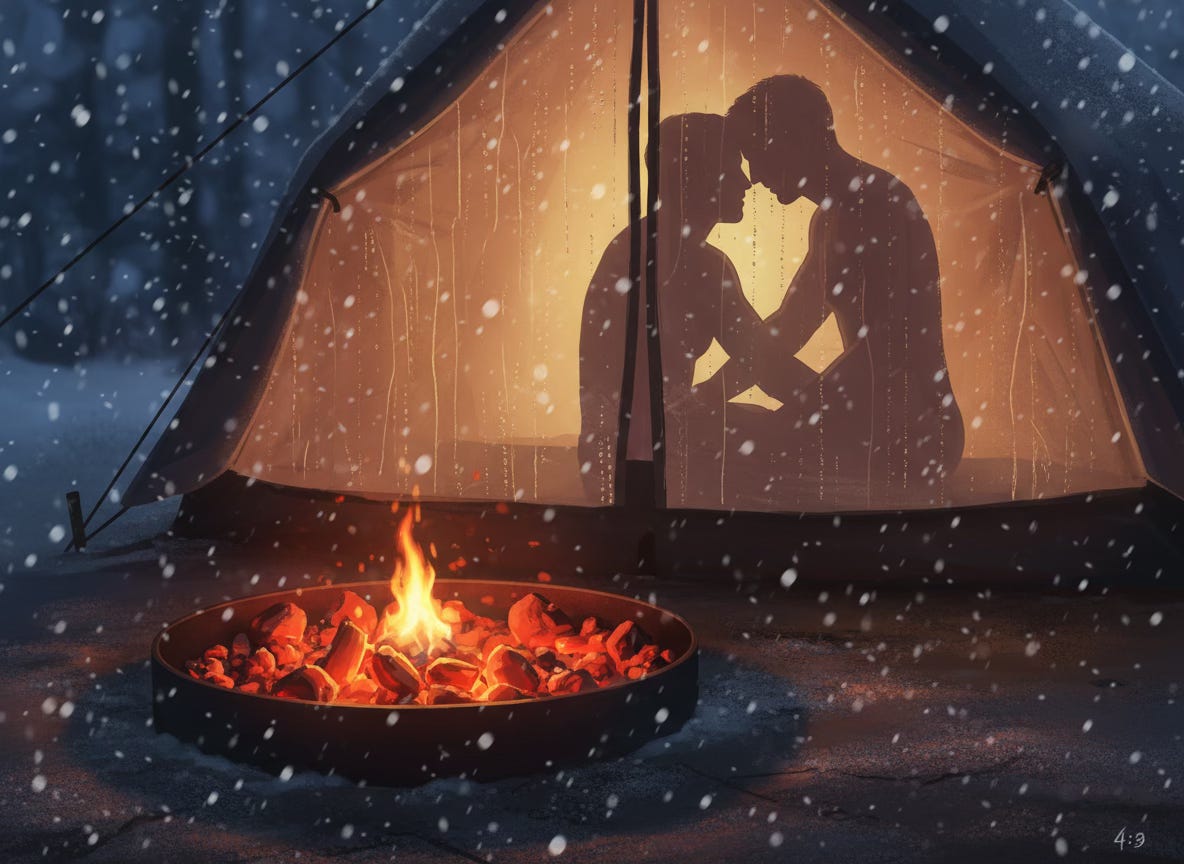
We drop our packs in the lee of the stone. My shoulders ache with relief the second the straps come off. Cal’s hands are efficient, practiced—stakes, lines, the tent unfurling in a snap of fabric that sounds too loud in the open air. I help where I can, fingers clumsy in gloves, mind too full of everything I’m not saying.
When the tent is up, the space between us feels smaller than it should. Not because the nylon is tight, but because the decision is.
Cal looks at me once, a question in his eyes that he doesn’t put into words. My throat tightens. I nod, barely.
And then we climb inside.
Outside the tent, the wind makes a sound like a living thing—howl, then whimper, then a long, low moan. Cal sits cross-legged, arms braced on his knees, eyes locked on the nylon wall like it’s a window and not a barrier. I try to match his stillness, but my legs jitter, my fingers drum against my thighs, every muscle in me tuned to the frequency of waiting.
Eventually, he moves. “We should get the fire started,” he says, voice flat, but I hear the old hunger under the frost.
I follow him out, boots crunching on the packed drift we built for a windbreak. The snow’s letting up, the sky gone pearl gray. We work in tandem—he stakes down the tent lines while I dig out the fire pit, our movements practiced, automatic, the rhythm of the other campouts. He lugs the bundled wood from his pack, sets it in a tepee, then roots in the gear for a lighter. It’s not there.
I roll my eyes. “Seriously? The prepper forgot a lighter?”
He flashes a smile, teeth white against the stubble. “Didn’t forget. Wanted to see if you’d bring the matches this year.”
I pull the battered matchbox from my pocket, toss it underhand. He catches it one-handed, palms the box, and for a second he just holds it, staring at the scarred surface like it’s an artifact.
He kneels in front of the fire ring, striking the match with a slow, almost reverent motion. The tip blooms blue, then gold, then gone in an instant. He does it again, and again, as if each failure is a necessary part of the ritual.
On the fifth try, the kindling catches, a curl of smoke then a guttering flame. He shields it with his body, breathing life into the ember, coaxing it until it’s real. When the fire’s burning steady, he sits back on his heels, shoulders slumping as if the act has spent him.
I crouch beside him, hands extended to the heat. Our arms brush. Neither of us moves away.
The silence between us is almost peaceful, the only sounds the crackle of burning pitch and the wind pacing outside the rock bowl. But the peace is a lie, and we both know it.
He doesn’t look at me when he says it. “We don’t have to do anything you don’t want.”
I laugh, too loud. “Cal. We do this every year.”
“Doesn’t mean we have to.”
I want to tell him that’s what I’m afraid of, but instead I just say, “You brought the ribbon, didn’t you?”
Year Four was when it stopped being an accident.
We’d been careful for years—careful in the way people are when they think caution is the same thing as control. We’d built rules out of silence. We’d made a religion out of not touching. We’d convinced ourselves that wanting was harmless as long as it stayed theoretical.
That year the storm came in early, mean and sudden, and we’d ended up pinned behind the rocks longer than planned. Cal’s hands had been shaking when he dug through his pack, not from cold—he’d been cold a hundred times and never looked like that—but from the decision he’d already made.
He’d shown me the cloth and the ribbon like a confession. Not a joke. Not a dare. An offering.
I remember the way my stomach dropped, the way my mouth went dry. I remember thinking: this is either a line we never uncross, or it’s the beginning of something we won’t be able to put back in the box.
He’d asked me—quiet, steady, like he was trying to be a good man even while he wasn’t. I could have said no. I could have turned it into a story we laughed about later, something harmless and stupid.
Instead, I’d nodded.
After, we’d hiked down with our faces blank and our bodies buzzing, and we’d sat at the table with our wives like nothing had changed. Like we hadn’t just built a new kind of tradition out of the same old lie.
Year Four was when the mountain stopped being a place we visited.
It became a place we belonged to.
He glances up, startled, then lets the smile break through. “Maybe.”
I close my eyes, feel the fire soak into my bones. “It’s always the same, isn’t it?”
He shrugs. “Tradition.”
I stare at the flames. “Once a year, mountain only. No talking about it after.”
He nods. “No names. No guilt. Just—”
“Just us,” I finish.
He reaches over, fingers curling around my wrist. The touch is light, barely there, but my whole body snaps to it. I wonder if he can feel my pulse hammering through the glove.
I wait for him to make the next move. He doesn’t.
Instead, he releases my wrist, then tugs off his glove, exposing raw, red knuckles. He extends his bare hand, palm up, an offering.
I take it. Our fingers knot together, and the sensation is so sharp I have to look away. He squeezes, then lets go.
The sun’s gone now, the world outside reduced to shadow and wind. The fire’s the only light left, orange and violent, throwing our shapes against the rocks in grotesque, oversized silhouette.
He says, so soft I almost miss it: “Tell me to stop.”
I don’t.
He moves first, scooting closer, the heat from his body suddenly more intense than the flames. His thigh presses to mine, then his hand lands on my knee, resting there, heavy and warm through all the layers. He doesn’t squeeze, doesn’t push. Just anchors me.
I cover his hand with my own.
We sit like that, two statues, until the fire collapses in on itself and the wind outside threatens to blow us clear off the mountain. Then he turns to me, the movement slow, deliberate, and tips his forehead against my temple. I smell sweat, woodsmoke, the faint ghost of that expensive cologne his wife buys him for Christmas.
He whispers, “Tent?”
I nod. Stand up. My knees threaten to buckle, but I steady myself, then lean down to grab the zipper tab. The sound it makes—sharp, metallic—cuts through the air. He follows me in, silent as a shadow.
Just the fire, and the trust, and the knowledge that nothing else matters.
The silence in the tent is so thick I can hear the ghosts of our own breath, exhalations seamed together like lines on a lifeline. Outside, the storm has relented into a lull—just a low, predatory growl as the wind shifts the snow against the walls. Inside, the air is fever-warm, dense with the perfume of sweat and polyester and the metallic note of skin just freed from wool. Cal lies on his side, face half in shadow, his shoulder nudging the tent’s curve. He’s unzipped his jacket and stripped off the top layer, chest flushed pink in the ambient cold, every rib and muscle more visible than I remember from last year.
I’m half in my own sleeping bag, half out of it, legs tangled in a way that would be comical if there weren’t so much intent in the way he watches me. Neither of us speaks. The last words—“Same trust?” “Always”—still ring in my skull, so loud I can’t risk adding anything to the world.
He’s the one who moves first, always. A finger hooks the hem of my shirt, tugs upward. I let him. He peels it slow, as if every inch of cotton deserves its own farewell, until the fabric pools at my neck and he has to ask, “Up?” I raise my arms, surrender. The cold is a slap, but his hands on my sides are a counter-shock, steady and warm. He pushes the shirt over my head and tosses it aside, leaving my torso bare to the tent’s hollow light.
For a second, he just looks. His eyes don’t blink, just move down the length of me like he’s cataloguing a new artifact at the museum. I want to joke—“Take a picture, it’ll last longer”—but I can’t find my voice. My heart is making enough noise for the both of us.
He slides closer, knees bumping mine, the sleeping bag a halfhearted boundary between us. His hand, careful as a parent with a feverish child, traces the line from my collarbone down the center of my sternum. It’s not a sexual touch, not yet, just a way of saying: I remember you. He doesn’t rush. I want to crawl out of my skin.
When his palm lands flat at the base of my ribcage, he lets it rest there, pressing just enough to remind me he’s got the upper hand. “Okay?” he asks, a whisper lost under the louder thud of my blood.
I nod, jaw clenched so tight I hear my teeth creak.
He doesn’t need more. His other hand moves to my belt, fingers deft and sure. I flinch, then force myself to relax. He unthreads the buckle with surgeon’s grace, undoes the button, slides the zipper slow enough I have time to regret every carbohydrate from the past calendar year. My boxers ride low, waistband already damp with sweat.
He stops at the boundary—tentative, respectful, all the things you’re supposed to be. He waits for me to give him something: a yes, a please, a go. I nod again, barely more than a twitch, but it’s enough.


