

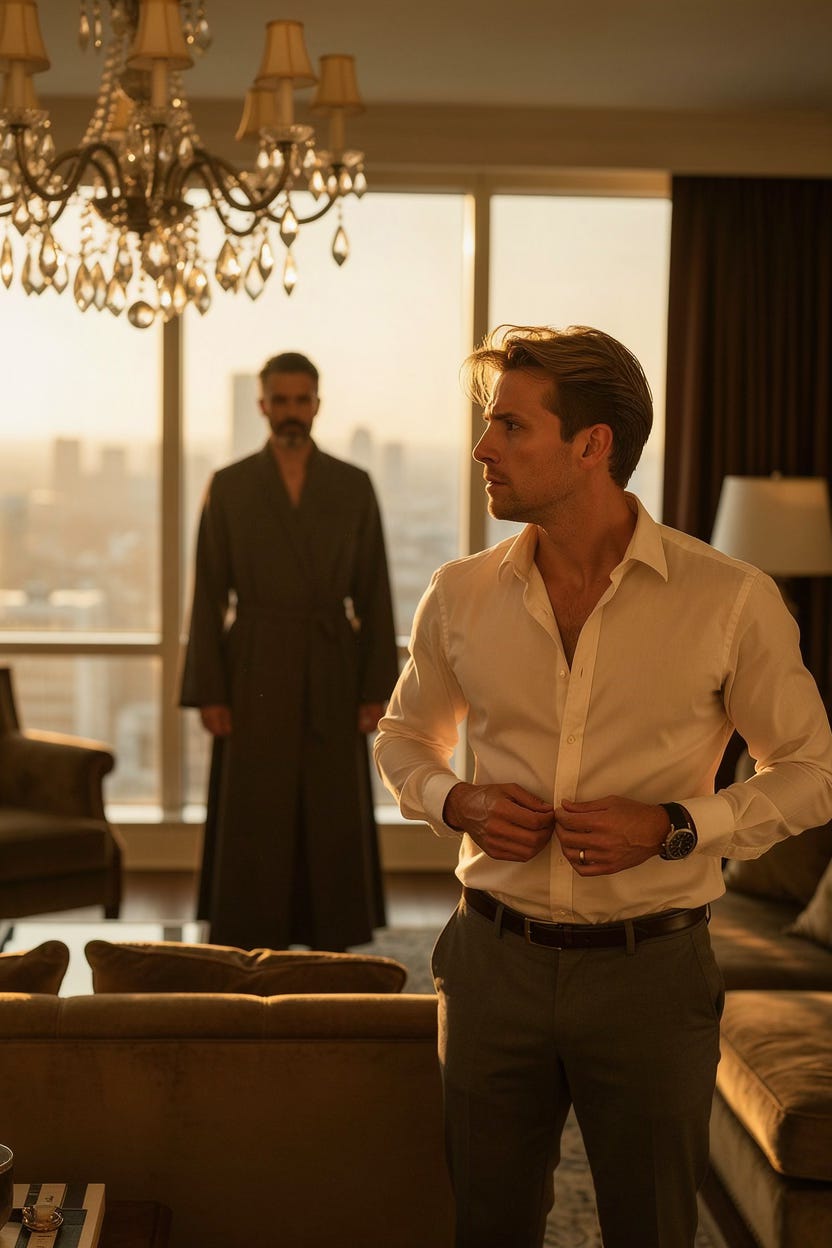
Declan woke to the scent of linen and cedar, a scent that was not his own. It clung to the air, to the impossibly high-thread-count sheets tangled around his waist, to the skin of the man whose breath warmed the back of his neck. For a disorienting moment, suspended between the last threads of a dream and the stark reality of morning, he was nowhere. Then it all rushed back in a silent, seismic wave: the bar, the note, the keycard, the penthouse. The man. Matthias Crane.
His eyes opened to a room bathed in the soft, diffuse light of a Chicago morning filtered through floor-to-ceiling windows. The city was a muted, gray-and-gold tapestry thirty-four floors below, its sounds a distant, forgotten hum. The silence up here was a physical thing, thick and expensive, absorbing everything but the quiet rhythm of Matthias’s breathing behind him.
Declan didn’t move. He cataloged the sensations with a clarity that felt almost painful. The dull, pleasant ache in muscles he hadn’t known he possessed. The memory of hands—Matthias’s hands—mapping his skin with a possessiveness that had felt like being claimed. The lingering taste of expensive whiskey and something else, something uniquely *him*, on the back of his tongue. He was lying naked in the bed of the man who, as of yesterday, owned the company that signed his paychecks. The absurdity of it was a cold knot in his stomach, but it was tangled up with a warmth, a deep-seated thrum of satisfaction that made the cold knot feel like a lie.
He’d prepared himself for this moment. On the elevator ride up last night, his heart hammering against his ribs, he’d scripted it. He’d wake alone, or to a cleared throat and a polite but distant offer of coffee before being shown the door. He’d anticipated the awkward shuffle of finding his clothes, the stilted “thanks, that was… something,” the silent, mutually agreed-upon pact to pretend it never happened. A secret, delicious, reckless conference hookup. A story to file away and maybe, maybe, revisit alone in the dark months from now.
He had not prepared for this. For the heavy, warm arm draped over his hip, the fingers loosely curled against his abdomen. For the feeling of another body pressed against his back, solid and real and still. For the intimacy of shared sleep. This felt… domestic. And that was infinitely more dangerous.
Declan shifted minutely, a subtle test. The arm around him tightened, just for a second, a reflexive, sleepy pull that brought him flush against the solid wall of Matthias’s chest. The movement ceased. Matthias’s breathing didn’t hitch or change. He was still asleep. Or perhaps he was just that controlled, even in unconsciousness.
Declan lay there, breathing in the cedar-and-linen scent of him, feeling the steady beat of a heart against his spine. He was a logistics coordinator from Denver. He was good at his job because he understood systems, flow, cause and effect. He could map the most efficient route for a shipment of microchips from Seoul to Stuttgart, accounting for customs, weather, and fuel costs. But this—this man, this room, this feeling—defied all known logistics. There was no map for this. He was adrift.
A soft sound, not quite a sigh, ruffled the hair at his nape. “You’re thinking too loudly.”
The voice was a low rumble, sleep-roughened and intimate, directly in his ear. It sent a shiver down Declan’s spine that was entirely separate from the morning chill in the air.
Declan froze, then slowly turned onto his back. Matthias was propped up on one elbow, watching him. His dark hair was slightly mussed, a single lock falling across his forehead in a way that should have looked boyish but didn’t. It looked… human. His eyes, that intense, watchful gray Declan had become so fixated on across the bar, were softer in the morning light, but no less penetrating. He wasn’t smiling, but his expression was open, calm. There was none of the predatory intensity from the night before, the sharp-edged charm that had felt like being hunted. This was something else. Something steady. Something real.
“I… was just…” Declan’s voice was a dry croak. He cleared his throat, suddenly, absurdly aware of his own nakedness in the brightening light of day. “Taking inventory.”
A ghost of a smile touched Matthias’s lips. “And? Is the stock satisfactory?”
The question, the quiet humor in it, threw Declan further off balance. “The accommodations are… above spec.”
Matthias’s smile deepened, a real one this time, crinkling the corners of his eyes. It transformed his face, making him look younger, warmer. More dangerous. “Good. I’ll be sure to inform management.”
He shifted, leaning over Declan to reach for a panel on the nightstand. His chest brushed against Declan’s, and the contact was electric, a jolting reminder of the night’s intimacies. Matthias pressed a button. Somewhere, a quiet hum began, and a panel of the vast window slid away, letting in a breath of cool morning air and the distant, murmuring sound of the city waking up. The scent of rain-washed streets and a faint, fresh chill mingled with the cedar in the room.
“Coffee?” Matthias asked, as if this were a normal morning. As if this were a ritual.
“Please,” Declan said, his voice a little steadier. He watched as Matthias rose from the bed. He moved with an unselfconscious grace, completely at ease in his own skin. He was a study in contrasts: the powerful breadth of his shoulders, the sleek muscle of his back, the faint, pale lines of old scars that hinted at a history Declan couldn’t begin to guess at. He was both a corporate titan and a man who had, just hours ago, whispered things in the dark that had made Declan’s breath catch. He pulled on a dark robe that hung nearby, its fabric looking impossibly soft.
Matthias didn’t leave the room. He moved to a sleek, minimalist console against one wall and began preparing coffee with an espresso machine that looked like it belonged in a laboratory. “How do you take it?”
“Black is fine,” Declan said, pushing himself up to sit against the enormous headboard. He pulled the sheet up to his waist, a gesture that felt both prudish and necessary. He needed some kind of barrier, however flimsy, against the surrealism of the moment.
Matthias nodded, his back still turned. “A purist. I approve.” He worked with a quiet efficiency, the soft clink of porcelain the only sound for a moment. “Did you sleep well?”
It was such a normal, mundane question. The kind you’d ask a partner. A lover. The word echoed in Declan’s mind, strange and terrifying. “Yes,” he said, and it was the truth. He’d slept more deeply than he had in years, cocooned in that darkness and quiet and warmth. “You?”
“Extraordinarily well,” Matthias said, and there was a weight to the words that felt significant. He turned, holding two small white cups. He brought one to Declan, his fingers brushing Declan’s as he handed it over. The touch was deliberate. A spark. “I find your presence… calming.”
Declan took a sip. The coffee was rich, complex, and perfect. Of course it was. “Calming isn’t the word I’d use for last night.”
Another near-smile. “Last night was something else entirely. This morning, however… this is calm.” He gestured with his cup toward the open window. “The quiet after the storm.”
He didn’t sit on the bed, but leaned against the console, watching Declan. He was giving him space, Declan realized. Not crowding him. The power dynamic was still there, an invisible current in the air—the billionaire in his penthouse, the employee in his bed—but Matthias was subtly, masterfully, refusing to weaponize it. He was making Declan feel like a guest. Like a choice.
“About last night…” Declan began, the words feeling clumsy. “The… NDA. My job…”
Matthias took a slow sip of his coffee, his gaze steady. “Is perfectly secure. I told you that. It remains true. The document you signed was a standard confidentiality agreement for a private social engagement. It has nothing to do with Vanguard.” He set his cup down. “And it has no expiration date.”
Declan felt the words land. *No expiration date.* It was a statement of fact, but it felt like a promise. A threat. A possibility. “Right. Discretion.”
“Discretion,” Matthias agreed. “For my protection, of course. But also for yours. My world… attracts attention. The kind that can be unkind to those caught in its periphery.” He looked at Declan, and his gaze was utterly serious. “I don’t want any unkindness directed at you.”
The statement was so blunt, so unexpectedly protective, that Declan had no response. He’d been braced for a reminder of his place, a cool delineation of the lines between them. He wasn’t prepared for this. For the quiet intensity of I don’t want any unkindness directed at you.
“Why me?” The question was out before he could stop it, a raw and honest thing that hung in the fragrant air between them. It was the question that had been burning in him since the note had been pressed into his hand, the question that had kept him awake on the flight to Chicago, the question that had echoed with every beat of his heart in the elevator. Why him? A man who could have anyone.
Matthias didn’t look away. He didn’t offer a practiced, charming answer. He seemed to consider the question, turning it over as if it were a rare and interesting artifact. He pushed away from the console and walked slowly back to the bed, but he didn’t sit. He stood beside it, looking down at Declan with that unnerving, focused calm.
“You were watching the panel on digital asset tracking,” he said, his voice quiet, almost conversational. “The one right before the cocktail hour.”
Declan blinked, thrown completely. Of all the answers he’d imagined, this was not one of them. “I… yes. It was relevant to my work. The speaker was—”
“You were the only one,” Matthias interrupted gently. “The room was full of people networking, checking their phones, thinking about their dinner reservations. But you were leaning forward in your chair. You had your notebook out. You weren’t just listening; you were… absorbing. You asked a question about cross-border latency that the speaker couldn’t answer. You looked… frustrated. Not angry, not petulant. Frustrated by the inefficiency of it all. A problem you wanted to solve.”
Declan stared at him, the coffee cup warm and forgotten in his hands. He remembered the moment vividly. A dry, technical talk that most people had tuned out. He’d been annoyed by the speaker’s glossing over of a critical logistical flaw. “How did you…?”
“I was at the back of the room,” Matthias said. “I like to watch the audience sometimes. See who’s engaged. Who’s thinking.” He paused, his gaze drifting over Declan’s face. “You have a very expressive face when you’re concentrating. It’s… compelling.”
He said it not as a flirtation, but as a simple statement of fact. A data point.
“Then, later,” Matthias continued, “at the bar. Everyone else was trying to be noticed. Talking too loudly. Laughing too much. Positioning themselves. You were just… there. In the corner. Nursing that terrible whiskey sour. You looked like you’d rather be anywhere else, but you were enduring it. You weren’t trying to be anything for anyone. You were just… you.”
He finally sat on the edge of the bed, not touching, but close enough that Declan could feel the heat of him. “I am surrounded by people who are performing. Every minute of every day. They perform ambition. They perform loyalty. They perform desire. It’s exhausting.” His voice dropped, became more intimate. “You weren’t performing. You were just a man, in a room, having a bad drink and wishing he were home. It was the most honest thing I’d seen all week.”
Declan’s throat was tight. He didn’t know what to do with this. It felt like being seen, truly seen, in a way that was more disarming than any seduction. Matthias hadn’t been drawn to a performance. He’d been drawn to the lack of one. He’d seen Declan’s quiet frustration, his boredom, his essential *self*, and he’d wanted it.
“That’s… a lot of insight from a distance,” Declan managed.
“I’m a very good judge of character,” Matthias said. “It’s how I’ve survived. And when I see something real, I know it. And I act on it.” He reached out then, not for Declan’s body, but for the hand holding the coffee cup. He took it, his fingers wrapping around Declan’s, warm and steady. He lifted the cup from Declan’s grasp and set it on the nightstand. The action was so simple, so domestic, it stole the air from Declan’s lungs. “So. That’s ‘why you’. Because you are authentic. And that is… a rare commodity.”
He didn’t let go of Declan’s hand. He held it loosely in his own, his thumb tracing a slow, absent circle on the back of Declan’s knuckles. The touch was not overtly sexual. It was… grounding. Connective.
Declan looked down at their joined hands. His own, pale, long-fingered, a faint smudge of ink still on his index finger from yesterday’s notes. Matthias’s, larger, stronger, the skin tanned and calloused in places, the nails perfectly groomed. A hand that could sign billion-dollar deals and then, hours later, trace patterns on a lover’s skin with a devastating, focused tenderness.
“I don’t know what this is,” Declan whispered, the confession torn from him. “I don’t know the… the logistics.”
A soft huff of laughter escaped Matthias, a genuine, surprised sound. “Logistics.” He shook his head, his thumb still moving in that hypnotic circle. “Declan, this isn’t a shipment of microchips. There’s no customs to clear, no optimal route to map. This is… an exploration.”
He leaned in closer, his gray eyes capturing Declan’s. “Last night was… a beginning. A very, very good beginning. This morning is… another part of it. A different kind.” He gestured with his free hand toward the open window, the cityscape beyond. “The sun is up. The world is out there. My schedule today is brutal. Yours, I assume, involves a flight back to Denver. The… ‘logistics’, as you call them, are about to reassert themselves.”
Declan’s heart sank, a cold plunge back to reality. Of course. This was the moment. The polite dismissal. The return to normalcy.
But Matthias didn’t let go of his hand. “I want to see you again.”
The words were quiet. Certain.
“I… what?” Declan’s mind, so adept at mapping complex systems, went blank.
“I have a proposition,” Matthias said, his voice dropping into that low, compelling register that felt like a physical touch. “Not a business one. A… personal one.”
Declan could only stare, his heart hammering against his ribs again, a frantic, hopeful drumbeat.
“My company has a regional office in Denver,” Matthias continued. “It’s a hub for our western operations. The current director is… adequate. But the role requires more than adequacy. It requires vision. Someone who sees the systems, the flows, the… logistics… not just as numbers on a screen, but as a living, breathing puzzle. Someone who gets frustrated by latency issues and wants to fix them.”
He paused, letting the words hang in the air. Declan felt the world tilt on its axis. He couldn’t be saying what Declan thought he was saying.
“It would be a significant promotion,” Matthias said, his gaze unwavering. “A substantial increase in responsibility. And in compensation. It’s a role you are, frankly, perfect for. Your file is impressive. This wouldn’t be a gift, Declan. It would be an acknowledgment of your talent. A talent I saw in a conference room before I ever spoke to you.”
Declan’s mouth was dry. “You… you’ve seen my file?”
“Of course,” Matthias said, as if it were the most natural thing in the. “After I saw you in that panel. I was… curious.”
He’d looked him up. The billionaire CEO had seen a man in a audience, been intrigued, and had his personnel file pulled. The thought was terrifying. Thrilling.
“And this… proposition…” Declan said, his voice unsteady. “It’s… contingent?” He couldn’t bring himself to say the words. Contingent on this. On us.
Matthias’s expression hardened, just for a fraction of a second. “No.” The word was sharp, final. “Absolutely not. The offer of the position is separate. It stands, regardless. It is based on your merit. If you choose to take it, our… personal… exploration would be separate. It would require… discretion, of course. But it would not be a condition of your employment. I would never do that.” He said it with a cold, flat certainty that brooked no argument. It was a line he would not cross. “The two things are parallel tracks. One is professional. One is… this.”
He gestured between them, to the bed, to the morning light, to the quiet intimacy of the room.
“You would be offering me a job,” Declan said, trying to make his brain work, to process the sheer scale of what was happening. “And… asking me out on a date.”
A slow, real smile spread across Matthias’s face, transforming his features again. It was a smile of genuine amusement and something else… something like fondness. “When you put it so simply, it sounds almost… normal.” He leaned forward, his voice a whisper. “But Declan, I think we both know this isn’t going to be normal.”
He finally released Declan’s hand and stood, his robe whispering against itself. “You don’t have to answer now. In fact, I’d prefer you didn’t. Think about the job. It’s a big step. It would change your life.”
He moved toward the console again, his back to Declan, a deliberate severing of the intense connection. The space he left behind felt charged, cold. “Your flight is at 1:15 PM. A car will be here for you at 11:30. It will take you directly to the terminal. Your luggage is already en route.” He spoke with the calm efficiency of a personal assistant, yet the words were a dismissal all the same. The spell was broken. The sun was higher now, sharpening the edges of the room, bleaching the soft mystery from the shadows. The penthouse was just a room again. A very beautiful, very expensive room.
Declan pushed back the sheet and stood, the polished concrete floor cool beneath his bare feet. His clothes from last night—the suit he’d felt so confident in—were folded neatly on a low chair by the door. Someone had been in the room while they slept. The thought was a cold trickle down his spine. He dressed quickly, his fingers fumbling with buttons, the fine wool of the suit jacket feeling alien against his skin. He was reconstructing himself, piece by piece, into the man who belonged on a plane back to Denver. The man who had come here.
Matthias remained at the console, his attention on a tablet that had appeared in his hands. He was already elsewhere. In another meeting, another country, another layer of his empire. The shift was seamless, absolute. Declan felt a strange, hollow ache behind his ribs. He was being managed. Efficiently. Logistically.
He finished dressing and stood, awkward, by the bed. “Thank you,” he said, the words absurd. “For… the coffee.”
Matthias looked up from his tablet, his gaze refocusing on Declan with an effort that was barely perceptible. “Of course.” He paused, his eyes scanning Declan from head to toe, a final, assessing look. “The car will be downstairs.”
It was not a question. There was no invitation to linger, no offer of breakfast, no suggestion of a future phone call. Just the stark, logistical fact of the car. The silence stretched, thick with everything that had been said and everything that had been left terrifyingly unsaid. The job. The “exploration.” The two parallel tracks that Matthias had laid out with the precision of a master engineer. Declan felt the weight of the choice already settling on his shoulders, a yoke he hadn’t asked for but couldn’t seem to shrug off.
He nodded, a stiff, jerky motion. “Right. Okay.” He turned and walked toward the door, half-expecting Matthias to say something else, to call him back, to offer one more piece of the puzzle. But there was only the soft tap of a stylus on glass.
The door sighed open for him and closed behind him with a quiet, final click. The hallway was a silent, carpeted tunnel. He found the elevator, his fingers trembling as he pressed the button for the lobby. The descent was a slow, sinking feeling in his gut. The mirrored walls showed him a man in a rumpled suit, his hair tousled, a faint, unfamiliar scent of cedar and clean, male skin clinging to his collar. He looked exactly like what he was: a man leaving a place he did not belong.
The car was a silent, black sedan. The driver did not speak. Declan slid into the cool leather interior and watched the cityscape flow past the tinted windows. Chicago was awake now, loud and brash and real. The storm had washed everything clean, leaving the morning sharp and bright. He replayed the conversation in his head, each word a stone dropped into the still pool of his consciousness, sending out ripples that distorted everything.
A rare commodity. He had been seen, not for his potential, not for his ambition, but for his quiet, frustrated authenticity. It felt like a violation and a benediction all at once. Matthias hadn’t offered him a fantasy. He’d offered him a reflection of himself, polished and held up to the light, and declared it valuable. The job offer was the proof. It was real. It was based on merit. It was the most terrifyingly seductive thing Declan had ever encountered.
The airport was a jarring cacophony of noise and light after the cathedral quiet of the penthouse. He checked in, his movements automatic. He went through security, the impersonal pat-down a stark contrast to the remembered intimacy of Matthias’s hands. He found his gate and sat, surrounded by the mundane buzz of travelers, and felt like an alien creature dropped into a human colony.
He pulled out his phone. His inbox was already full. Emails from his team in Denver, a reminder about a project deadline, a message from his mother asking if he’d had a good trip. The normalcy of it was a physical blow. He opened his personnel file in his mind, trying to see what Matthias had seen. A solid record. Competent. A good analyst, a decent manager. But a director? Head of a regional office? It was a leap into the stratosphere. It was a leap he had never allowed himself to want.
He thought of his apartment in Denver. Neat. Quiet. A view of a parking lot. He thought of his job. The predictable rhythm of it, the small frustrations, the minor victories. It was a life he had built carefully, a system that worked. It was a life that, until last night, had felt sufficient.
The plane was a smaller, regional jet. He took his seat by the window, his body thrumming with a restless energy that felt entirely separate from the caffeine. He stared out at the tarmac, at the ground crews going through their motions, and saw not planes and trucks and people, but flows. Systems. Logistics. He saw the inefficiency Matthias had spoken of. The latency. He saw the puzzle.
He had built a life that was a perfect, closed loop. And Matthias Crane, with a few quiet words and an impossible offer, had thrown a wrench into the center of the machine. He hadn’t just offered Declan a job or an affair. He had offered him a different version of himself. A version who ran things. A version who saw the big picture. A version who was worthy of the focused, unnerving attention of a man like that.
The flight attendant began her safety demonstration. Declan didn’t hear a word. His mind was mapping a new route, one with no customs, no clear boundaries, no known destination.
The flight was smooth, the sky a vast, empty blue. He tried to sleep, but his brain was a live wire. He kept feeling the ghost of that thumb tracing circles on his hand. He kept hearing the words. I don’t want any unkindness directed at you. It was a possessiveness so profound it felt like a shelter.
He landed in Denver just after three. The air was thinner, drier. The mountains were a hazy blue wall to the west, familiar and solid. He collected his bag—the single, neat roller he’d packed for a two-day trip that had become something else entirely—and took a cab home.
His apartment welcomed him with a smell of lemon cleaner and stillness. He dropped his bag by the door and went to the kitchen, pouring a glass of water he didn’t want. Everything was exactly as he’d left it. The clean counters. The mail stacked neatly on the table. It felt small. Cramped. Like a diorama of a life.
His phone buzzed. A text. An unknown number.
The car was satisfactory, I trust. M.
Declan’s breath caught. He stared at the screen. Of course Matthias had his number. He’d probably had it before Declan had even boarded the flight to Chicago. He thought of the personnel file. *I was curious.*
He typed back, his fingers clumsy. Yes. Thank you.
The reply was immediate. Good. Think about the proposition. Both of them. No need to reply.
And that was it. No further pressure. Just the simple, staggering fact of the connection. He was in the system now. On Matthias Crane’s radar. He stood in the middle of his quiet, orderly kitchen and felt the walls of his world stretch and distort, making room for a possibility so vast it threatened to swallow him whole.
He unpacked. He showered, washing the last traces of Chicago, of cedar, of him, from his skin. He dressed in soft, worn jeans and a t-shirt. He tried to make dinner. He tried to watch television. But his mind was a trapped bird, beating itself against the cage of his old life.
He found himself at his desk, his laptop open. He pulled up the public corporate structure for Vanguard Logistics. He found the Denver office. The current director was a man named Edgerton. His LinkedIn profile was a study in bland corporate success. Adequate, Matthias had called him. Declan could see it. He was a caretaker, not a visionary. The role was bigger than the man.
He began to sketch. Not notes for a project, but a map. He drew the flow of Vanguard’s western operations. He traced the routes, the hubs, the choke points. He saw the latency. He saw the solutions. His blood hummed with a kind of focused excitement he hadn’t felt in years. It was the feeling from the conference room, magnified a hundredfold. It was a puzzle he was meant to solve.
The professional track was clear. It was a risk, a massive leap into the unknown. But it was a leap he knew, in his gut, he was capable of making. It was the other track that terrified him. The parallel track. The one that wasn’t about supply chains or efficiency metrics, but about Matthias’s quiet voice in the morning, the warmth of his hand, the unnerving focus of his attention. An exploration, he’d called it. Declan’s own reflection stared back at him from the dark screen of his laptop—a man who mapped risk for a living, who lived by predictability. This was not predictable. It was a vortex. A man like Matthias didn’t have affairs; he acquired experiences. And Declan felt, with a cold, sinking certainty, that he had just been marked as a particularly interesting one. The phone on his desk buzzed again, a sharp vibration against the wood. He didn’t need to look to know it was him. The connection was live now, a thread pulled taut between his quiet kitchen and a penthouse high above another city. He let it ring, the sound a tiny, insistent pulse in the vast silence of the choice before him.
The phone went silent. Then, a moment later, a single, sharp buzz. A command, not a request. Declan’s hand hovered over the device, his breath caught in his throat. He could feel the pull of it, a gravitational force emanating from that unknown number. To answer was to step onto the track, to accept the map being drawn for him. He saw his reflection in the dark screen once more—the man in the soft, worn t-shirt, the man who lived by systems—and then he saw the ghost of the other man, the one who traced patterns on skin and spoke of exploration. His fingers closed around the cool plastic. He picked it up.
He brought the phone to his ear but said nothing. The silence stretched, electric, until Matthias’s voice came through, low and intimate. “I’ve been thinking of your hands on my console.”
The words were a bolt of lightning straight to Declan’s core, paralyzing and electric. His own fingers, which had just been tracing the grain of his desk, curled reflexively into his palm as if burned by the memory. He could feel the phantom slickness of the touchscreen, the cool, hard certainty of the glass under his fingertips, the faint vibration of the system humming beneath them. The silence on the line was no longer empty; it was a canvas for the vivid, technicolor memory Matthias had just painted. He could smell the faint ozone of the penthouse, the clean scent of Matthias’s skin, feel the vertigo of looking down at the glittering city from that impossible height. His own quiet kitchen, his familiar desk, the worn fabric of his t-shirt—it all dissolved into a distant, faded photograph. There was only the voice in his ear and the image it conjured: his own hands, competent and familiar, not on his own keyboard, but on the nerve center of another man’s empire, and the man himself watching, approving, wanting.
Declan swallowed, the sound harsh in the quiet room. “You’re not playing fair,” he managed, his voice rough. “You left me with logistics. Supply chain inefficiencies. Not... this.”
Matthias’s low chuckle vibrated through the phone. “My apologies. I find the two are often intertwined. The flow of goods. The flow of energy. Both require... precision. A steady hand.”
Declan’s gaze fell on the map he’d been sketching—the lines of transit routes, the circles marking inefficiencies. His professional mind tried to latch onto the problem, to retreat into the safety of data. But the heat in his veins belonged entirely to the personal.
“You mapped the western corridor’s latency this afternoon, didn’t you?” Matthias asked, as if reading the blueprint of his thoughts. “The Salt Lake City bottleneck. You saw it.”
“How could you possibly—”
“I have your flight itinerary. The timing. I know your mind. You landed, you went home, you attempted normalcy. It failed. You sat down and you worked. It’s what you do when the world tilts. You find your center in the work.”
Declan closed his eyes. “This is invasive.”
“It’s accurate.” There was no apology in the tone. “Did you see the solution?”
“Consolidation of the Reno and Boise hubs,” Declan said without hesitation, the analyst in him overriding the man whose pulse was racing. “Recalibrating the trucking routes through the passes based on real-time weather data instead of the static schedules Edgerton’s office keeps renewing. It’s not complicated. It’s just... work.”
“It’s vision,” Matthias corrected gently. “Edgerton sees schedules. You see systems. That is the proposition. The professional one.” A beat of silence, thick with implication. “The other proposition is more immediate. And requires less analysis.”
Declan’s hand tightened on the phone. “What does it require?”
“Curiosity. An answer. Are you curious, Declan?” The question hung in the air, stripped of pretense.
The apartment felt smaller than ever, the walls pressing in. He looked at the neat stack of mail, the view of the dimly lit parking lot. He thought of the next day, the meetings, the project deadlines. He could say no. He could hang up. He could return to the life he had built, brick by careful brick.
He thought of Matthias Crane watching him work, the intense, singular focus. He thought of the offer—not just the job, but the terrifying, exhilarating permission to become the man seen in that reflection.
“Yes,” he said, the word leaving him like a breath he’d been holding for a decade. “I’m curious.”
“Good.” The satisfaction in Matthias’s voice was a palpable thing. “Then pack a bag. The car will be downstairs in twenty minutes. It will bring you to a private hangar. My plane is waiting.”
Declan’s mind reeled. “Now? It’s... I have work tomorrow. Responsibilities.”
“Edgerton is adequate. He will manage. Your responsibilities are shifting. The first of them is to satisfy my curiosity. And your own. Are you coming?”
The question was a cliff’s edge. Declan stood, his body moving before his mind had fully processed the command. He walked to his bedroom, the phone still pressed to his ear, and pulled his travel bag from the closet. “What about the job? The... professional track?”
“We will discuss it. Over dinner. There is a restaurant in Zurich with a view I think you’ll appreciate. It’s not as high as mine, but the chocolate is better.”
Declan froze, a pair of trousers in his hand. “Zurich?”
“The proposition was for the head of the European division, Declan. Not Denver. The Denver office is a stepping stone you have already outgrown in your mind. I saw it on your map. You weren’t solving for Denver. You were solving for the continent. The car is waiting.”
The casual enormity of it left him breathless. Europe. Zurich. A dinner view.
He heard the soft rustle of fabric on the other end of the line, the sound of someone moving, sitting. “The choice is still yours. You can hang up. You can go to your meeting tomorrow. The offer will remain on the table for forty-eight hours. But the car,” Matthias said, his voice a near-whisper now, “is for tonight. It is for the man who is curious now.”
Declan zipped the bag shut. He had thrown a few things inside—a suit, a sweater, toiletries. It was an impulse. An insanity.
“I’m coming down,” he said.
He heard the soft exhalation, the sound of a smile. “I know.” The line went dead.
Declan stood in the silence of his bedroom, the bag at his feet. He looked around at the neat, ordered space—the bed made with precision, the books lined up on the shelf by height. It was a life built on knowing what came next.
He picked up the bag, walked to his front door, and turned off the light. He didn’t look back.