


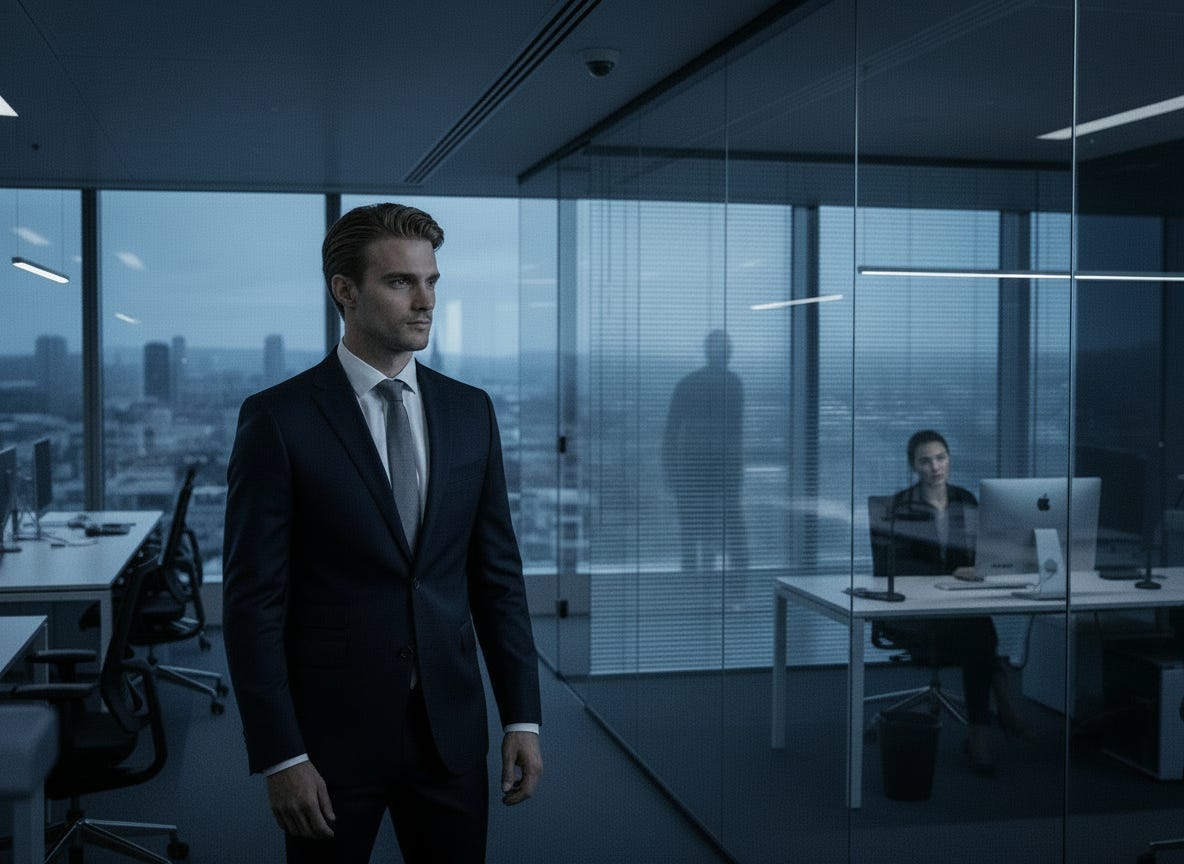
The glass doors of Vanguard’s Zurich headquarters parted without a sound, swallowing Declan into a cathedral of polished steel and cold, filtered light. This time, there was no visitor’s badge clipped discreetly to his lapel, no assumed name in the logbook. This time, he walked with the quiet, irrevocable weight of ownership. The air itself felt different—thinner, sharper, as if the building were holding its breath.
For weeks, he had moved through these same corridors as a ghost, a silent auditor sifting through the digital entrails of the European division. He had known its secrets as data points, as anomalies in spreadsheets, as whispers in encrypted channels. Now, he was to become its architect, its surgeon. Its executioner, if necessary.
Matthias’s voice, low and textured as worn velvet, had laid out the new reality just hours before, his body a warm, solid presence against Declan’s back in the dim light of their hotel suite. “The shadow play is over, Declan. They’ve grown too comfortable in the dark. We turn on the lights. You are the lights. Your presence is the provocation. If the rot is here, your arrival will make it move. It will have no choice.”
And so Declan moved. His footsteps, the soft click of fine leather on marble, were the only sound in the vast, soaring atrium. A receptionist looked up, her practiced smile faltering for a fraction of a second as she registered him—not as a guest to be processed, but as a fact to be acknowledged. He did not break stride, his gaze fixed on the bank of elevators ahead. He could feel the invisible threads of attention pulling taut around him—the security guard subtly straightening his posture, a pair of analysts pausing their hushed conversation by a potted olive tree. They didn’t know his name yet, but they recognized the gravity he carried. It was the gravity of a new orbit, a celestial body entering their system, destined to pull everything into a new alignment.
The elevator was a capsule of silent, swift ascent. He watched the numbers climb—a countdown to ignition. The doors slid open on the top-floor executive suite, a landscape of muted grays and deep, sound-absorbing carpets. A woman with a severe blonde bob and eyes the color of winter frost was waiting for him, her posture as perfect and unyielding as a diamond blade.
“Mr. Frost. Matthias Crane’s office advised you would be arriving.” Her voice was cool, efficient, devoid of warmth. “The leadership team is assembled in the primary conference room. I’m to take you directly in.”
“Lead the way,” he said, his own voice a calm, even counterpoint to her chill.
She walked with a clipped, precise gait, her heels making no sound on the plush carpet. She opened a set of double doors carved from a single slab of dark wood, and a roomful of faces turned toward him.
The air in the conference room was stale with recycled oxygen and the metallic tang of suppressed anxiety. A long, obsidian table dominated the space, its surface reflecting the cool blue glow of multiple data dashboards displayed on the far wall. Around it sat a dozen men and women, the upper echelon of Vanguard Europe. They wore their power like expensive armor—custom-tailored suits, sharp watches, gazes honed in boardroom battles. But today, their armor had a new crack, a new uncertainty, and his name was Declan Frost.
He did not sit. He moved to the head of the table, placing his palms flat on the cool obsidian, and let his gaze travel slowly over each of them. He saw curiosity, wariness, resentment carefully masked behind neutral expressions.
“Good morning. For those who haven’t parsed the corporate announcements yet, I’m Declan Frost. Effective immediately, I am assuming the role of Vice President, European Division.” He let the words hang, a simple declaration that landed with the force of a verdict. “My mandate from Global is straightforward: to rebuild. To assess, to stabilize, and to restore this division to its foundational performance metrics.”
A man with a florid complexion and an expensive tie—Henrik, Head of Capital Markets, according to the mental dossier Declan had memorized—cleared his throat. “A rebuild implies a collapse, Frost. Our numbers have been consistently strong. The dashboards speak for themselves.” He gestured vaguely toward the wall of screens, where lines and graphs all trended pleasingly upward in verdant green.
Declan’s eyes didn’t leave Henrik’s face. He offered a small, cold smile that didn’t reach his eyes. “They do speak, Henrik. They speak very clearly. They’re a little too… articulate. A little too perfect. My first task will be to understand not just what they’re saying, but why they’re saying it with such unwavering, flawless consistency. In nature, that’s a warning sign. In business, it’s an invitation to look deeper.”
The room went quieter, if that were possible. The hum of the climate control seemed to fade away. Declan shifted his weight, his attention moving across the table. “I’ll be reviewing all reporting lines. All performance protocols. I’ll be meeting with each of you individually, starting today. We’ll begin with a deep dive into the quarter-to-date revenue recognition models. Bring your leads. Bring your sources. And bring your patience.”
He was disruption, distilled. Calm, observant, impossible to dismiss. His confidence was not a bluff; it was a blade, and it was sharpened by the private, thrilling knowledge that Matthias was watching. He could feel the man’s presence like a physical touch—a hand on the back of his neck, a whisper in the dark, a king observing his champion enter the lists. This performance was for him, and the thought sent a current of fierce, possessive energy through Declan’s veins.
It was then that the door opened again. The woman from the lobby didn’t enter, but held the door for the person who did.
She moved into the room with an aura of controlled stillness that seemed to recalibrate the very atmosphere. Her hair was a dark, intricate crown of braids coiled at the nape of her neck, revealing a neck that was both elegant and strong. Her suit, the color of midnight, was impeccably cut, molding to a form that was both powerful and graceful. Her eyes, a striking, clear amber, scanned the room once, taking in the tension, the new dynamic, and finally, him. Elara Vance. Chief Operating Officer. The architect of the very numbers he had just questioned.
“My apologies for the delay,” she said, her voice a rich, melodic alto that carried effortlessly in the hushed room. It was a voice that could read a bedtime story or a death warrant with the same compelling resonance. “The Singapore call ran long. You must be Declan Frost.”
She extended a hand. Her grip was firm, dry, and brief. A transaction of touch, nothing more. Her gaze, however, held his for a beat longer than was strictly professional. It was a look of pure, unvarnished assessment. She saw his new title, his authority, and she was measuring its density, its tensile strength.
“Elara Vance,” she said, though he already knew. “Welcome to Zurich. Though ‘welcome’ might not be the right word, given the context of a rebuild.” A faint, perfectly calibrated smile touched her lips. It was a smile that acknowledged the sword hanging over the table, even as it pretended to be a pleasantry.
“Context is everything,” Declan replied, matching her tone. “I find a clear-eyed view of the foundation is the best place to start. Before you start adding new floors.”
“Or before you discover the foundation needs more than a fresh coat of paint,” she returned smoothly, her amber eyes glinting. “My numbers are my numbers, Mr. Frost. They are built on process, not theatrics. I assume your audit will reflect that.”
“I’m not here for theatrics either, Ms. Vance. Just the truth. However it presents itself.”
Their exchange was a volley of courteous, razor-edged thrusts. Questions that sounded harmless. Answers that revealed nothing. A dance of implications beneath the placid surface of corporate dialogue. The rest of the room watched, silent spectators at a duel whose first moves were too subtle for them to parse. But Declan felt it. He felt her—a formidable intelligence, a will as tempered as steel, and a layer of composure so absolute it felt like its own kind of vulnerability. She was a locked room, and he had just been handed the first key.
He felt the phantom weight of Matthias’s approval, his satisfaction. This is why you, the man had murmured into his skin. You read people cleanly. You can apply pressure without leaving a bruise. Now, apply it.
Elara took her seat, her posture never relaxing. She folded her hands on the table, a queen consolidating her territory. “Shall we begin, then? Henrik, why don’t you walk us through the QTD dashboard? I’m sure Mr. Frost is eager to see the… foundations.”
As the meeting droned on, a litany of figures and forecasts that felt increasingly like an elaborate stage play, Declan’s focus narrowed. He watched Elara. He noted how she listened—not just to the words, but to the spaces between them. She asked few questions, but when she did, they were surgical, precise, revealing a mind that tracked five layers of implication beneath the surface of every statement.
He watched the subtle shift of her gaze when Henrik stumbled over a projection, the minute tightening of her lips when another director used the word “anomaly” to describe a minor dip in emerging markets. She was a conductor, her attention the baton that kept the entire orchestra in time, her silence more commanding than any outburst. Declan felt a strange, prickling sensation at the back of his neck—not the familiar, possessive warmth of Matthias’s regard, but something else. A current of recognition. He was not the only predator in this room.
The meeting concluded with the brittle, unsatisfying clatter of tablets being gathered and chairs being pushed back. The executives filed out, their murmurs a low, anxious hum. Henrik shot Declan a final, resentful glance before disappearing through the door. Only Elara remained, slowly collecting a single, leather-bound notebook from the table. She did not look at him, but her stillness was an invitation.
“A thorough introduction,” she said, her voice soft now, meant only for him in the cavernous, emptying room.
“Thorough is the baseline,” Declan replied, coming to stand on the opposite side of the obsidian slab. “Clarity is the goal.”
“Clarity can be blinding if the light is too direct.” She finally looked up, and her amber eyes were no longer assessing a corporate rival. They were examining a fellow strategist. “You came in here and declared the patient sick before you’d even taken its pulse. That’s a bold opening gambit.”
“The pulse was the first thing I took. The rhythm was a little too… perfect. A metronome set by a master clockmaker, not a human heart.”
A ghost of a real smile—not the calibrated corporate one—touched her lips. It was fleeting, but it transformed her face, revealing a sharp, unexpected humor. “And you presume to know the difference?”
“I’ve spent a lifetime listening to the difference.”
She closed her notebook with a soft, final snap. “My office is down the hall. If you’re serious about your deep dive, you’ll need more than dashboard passwords. The real architecture isn’t on those screens.” She turned to leave, then paused at the door. “Ten minutes. Bring your own coffee. Mine is terrible.”
The door sighed shut behind her, leaving Declan alone in the sudden, ringing silence. The air still vibrated with the confrontation, with the unspoken challenges thrown and parried. He walked to the window, looking out over Zurich. The city was a pristine grid of order and wealth laid out beneath a flat, pearl-gray sky. It was a beautiful machine, but like all machines, it had its flaws. Its secrets.
He felt the familiar, grounding weight of his phone in his inner pocket. He didn’t need to check it to know Matthias would have already received a summary of the meeting. There would be no text, no call. His approval would be a later, private thing, a reward for a job well begun. The thought was a shard of warmth in the sterile chill of the boardroom.
Elara Vance’s office was not what he expected. It was not a corner suite with panoramic views, but an interior room, larger than most but deliberately removed from the postcard perfection of the cityscape. The walls were lined not with corporate awards or bland stock photography, but with books. Real books. Leather-bound volumes on economic history, treatises on geopolitical theory, dense academic texts on behavioral psychology. A massive, intricately carved wooden desk sat in the center, its surface clear but for a single, sleek terminal and an antique brass compass, its needle pointing stubbornly north.
She was standing by a small, discreetly hidden wet bar, pouring hot water from an electric kettle into two plain ceramic mugs. “I warned you,” she said, without turning around. “Swiss efficiency does not extend to the quality of the coffee bean. This is merely hot, brown water with a memory of bitterness.”
Declan placed his own untouched takeaway cup from the lobby on the edge of her desk. “I’ll take my chances.”
She handed him a mug. The ceramic was warm against his palm. She took a sip of her own and grimaced slightly, a surprisingly human expression. “So. The rebuild. Where would you like to start? The official, polished, board-approved data streams? Or the raw, un-sanitized feeds from the trading floors in Frankfurt and Milan? The ones that sometimes… hiccup.”
Her choice of words was deliberate. A ‘hiccup’ could be a multi-million-euro anomaly smoothed over before it ever reached a dashboard.
“The hiccups,” Declan said. “Always start with the hiccups.”
She gave a curt nod, as if he’d passed a small, initial test. She moved to her terminal, her fingers flying across the keyboard with an economist’s precision. A complex array of data feeds bloomed across the main screen, a chaotic, churning river of numbers and symbols compared to the placid lake of the boardroom dashboards. “This is the circulatory system,” she said. “The dashboards are just the skin. Healthy color, good temperature. But the pulse… the pulse is here.”
For the next hour, she guided him through the labyrinth. She spoke not in the bland jargon of corporate finance, but in the precise, evocative language of a master craftswoman explaining her loom. She pointed out patterns—a tiny, recurring latency in a Milanese commodities feed that always preceded a favorable price shift for a specific subsidiary; a ‘data-entry lag’ from a Frankfurt desk that consistently masked the true volatility of a particular asset. She showed him the seams where the perfect tapestry was woven together, the nearly invisible stitches that held the illusion of seamless, effortless profit.
She was not confessing. She was teaching. She was showing him the machine from the inside, demonstrating its complexities, its necessary fictions. She was proving her own mastery of it. And in doing so, she was revealing the fault lines.
“This,” she said, zooming in on a cascade of trades from three weeks prior, “wasn’t a hiccup. This was a seizure. A series of high-frequency trades executed from a shell entity registered in Luxembourg. They were designed to look like noise, like algorithmic error. But they weren’t. They were a probe. A test of the system’s defenses.”
Declan leaned closer, his shoulder nearly brushing hers. He could smell her perfume—something subtle and clean, like rain on cold stone. “A test for what?”
“To see if the system would correct itself automatically, or if it would require… manual intervention. Human intervention. It did. The correction was applied. Smoothly. Invisibly. By me.” She turned her head, her amber eyes catching the cool light from the screen. “That correction is what shows up on Henrik’s dashboard as a routine market rebalancing. It is, in fact, the only thing standing between Vanguard Europe and a nine-figure loss.”
The room seemed to tilt on its axis. She wasn’t hiding the rot. She was the one containing it. She was the architect, but also the surgeon, operating on a patient that didn’t know it was sick.
“Who?” Declan asked, his voice low.
“The Luxembourg entity is a ghost. The trades were routed through a nest of servers in Macau before that. The signature is… familiar, but faint. Like a song you heard once, long ago, and can’t quite place.” She leaned back, her gaze intent on him. “This is the foundation you’re here to inspect, Mr. Frost. Not the pretty facade. The thing beneath. The thing that’s cracking. Your arrival, your ‘rebuild,’ is the tremor that will tell us if the fault line is going to hold or if it’s going to break wide open.”
She was watching him, waiting to see if he understood the magnitude of what she was showing him. She had handed him not a key, but a live wire.
“You’ve been fighting this alone,” he stated.
“My job is to ensure the stability of this division. That sometimes requires preventative measures. Un-sanctioned measures.” Her expression was flinty. “I report facts, not suspicions. And what I have are very strong suspicions. Until now, there was no one to report them to who would understand the… nuance.”
The unspoken words hung between them. Until you.
Declan held her gaze, the hum of the server rack in the corner the only sound. He saw it then, the flicker of something behind her formidable composure. Not fear. Not anxiety. It was the fierce, lonely vigilance of a sentinel who has been guarding a wall for so long she’s forgotten what the world outside it looks like.
“Matthias sent you,” she said, and it wasn’t a question. It was a confirmation. “He finally saw the shadow.”
“He sees everything.”
“He sees enough.” She looked away, back at the screen, at the river of data flowing relentlessly past. “Your audit will be a useful distraction. A loud, official search for termites in the porch, while the real work is done in the basement. They’ll be so busy showing you the pristine living room, they might get careless about the foundations.”
She was proposing an alliance. A secret, silent partnership within the larger game. It was a breathtakingly audacious move.
“You’re taking a significant risk,” Declan said. “Showing me this. Trusting me.”
Elara’s smile was thin, sharp. “I’m not trusting you, Mr. Frost. I’m assessing you. This is your next test. The real question is whether you’ll pass it.” She gestured at the screen, at the ghost in the machine she had just revealed. “And what you’ll do with the information if you do.”
Declan did not look at the data. He kept his eyes on her, on the fine lines of tension at the corners of her mouth, the unwavering focus in her amber gaze. She was not offering friendship; she was offering a blade, hilt-first, to see if he would cut himself on it or use it. He felt the familiar, cold thrill of the hunt, the same sensation that had first drawn Matthias to him—the ability to navigate the intricate, unspoken rules of power and deception.
“A test implies a right answer,” he said, his voice low, almost a murmur meant for the quiet hum of the servers and the scent of old books. “But this feels more like a choice. Your data, your ‘hiccups’—they aren’t just anomalies. They’re breadcrumbs. And you’re not just following them. You’re laying them.”
Her expression did not change, but something in her stillness shifted, a subtle recalibration, like a safe’s tumblers falling into place. “Explain.”
“The Luxembourg shell, the Macau servers—you found them. You traced them. But you didn’t plug the leak. You’re monitoring it. You’re letting it run. Why? Because you’re not just containing the threat. You’re studying it. You want to see where it leads. Who it leads to.”
For a moment, the only sound was the faint electric hum of the server rack and the soft, steady breath Elara released. She did not deny it. She turned fully toward him, her body language an open challenge. “Containment is a temporary fix. Understanding is permanent. If I stop this… probe… today, it will simply reappear tomorrow, wearing a different mask. My job isn’t to swat flies. It’s to find the nest.”
“And burn it,” Declan finished.
“If necessary.”
He took a slow sip of the terrible coffee. It was, as advertised, hot water with a memory of bitterness. But it was sharp, bracing. Like the conversation. “And where does my ‘rebuild’ fit into this? Am I the smoke you’re using to draw them out? The noise to cover your signal?”
“You’re the tremor,” she repeated, her voice dropping even lower, conspiratorial. “Your presence, your audit—it’s a seismic event. It will force movement. Everyone will be watching you, explaining themselves to you, hiding their petty little sins from you. And while they’re distracted by the inspector general…” She let the sentence hang, her meaning clear. They would be looking the other way while the real predator moved.
“You want me to be the loud, official distraction.”
“I want you to be exactly what you said you were. A man here for the truth. This is the truth.” She tapped a key, and the screen changed, showing a complex web of interconnected entities, a spider’s silk of financial pathways. “This is the architecture beneath the architecture. My suspicion—and it is only a suspicion, one I cannot voice in a boardroom without being labeled paranoid or, worse, incompetent—is that we are not being targeted by a competitor. This is an inside job. A very, very sophisticated one.”
The words landed in the quiet room with the weight of a stone dropped into deep water. An inside job. It was the unspoken fear of every corporation, the rot from within. But this was no simple embezzlement. This was a surgical strike, a systemic probe designed to test the very integrity of the division.
“Who?” The question was automatic, but he already knew the answer was not simple.
“I don’t know. Not yet. The signature is… elegant. It’s not greed. It’s not desperation. It’s… intellectual. Almost artistic. Someone is doing this because they can. Because they enjoy the puzzle. The patterns are too clean, too clever. It’s a game to them.” Her voice held a note of grim admiration, the respect one hunter might have for another’s skill, even as they prepared to take the shot.
Declan felt the phantom touch of Matthias’s hand on his shoulder, a silent command. This is why you. He was here to hunt a hunter. To apply pressure without leaving a bruise. But Elara was proposing they do more than apply pressure. She was proposing they set a trap.
“Your official audit will proceed,” she continued, her voice all business again, as if they were discussing quarterly projections. “You will request all the standard documents. You will interview Henrik and his team. You will find minor discrepancies—everyone has them—and you will make a show of noting them. You will be the perfect, diligent VP. And I will give you everything you need to play that part.”
“And in return?”
“In return, you give me your eyes. Your perspective. You are an outsider. You see the forest. I’ve been staring at the trees for so long, I’ve memorized every knot in the bark. I need someone to tell me if the wind is changing.”
It was a delicate, dangerous bargain. She was asking him to work outside his mandate, to divide his loyalty between the official mission from Global—from Matthias—and this secret, parallel investigation with her. But he understood, with a clarity that felt like ice water in his veins, that this *was* his mission. Matthias hadn’t sent him to audit spreadsheets. He’d sent him to find the crack in the foundation. Elara Vance was the only one who knew exactly where to look.
“We’ll need a protocol,” he said. “A way to communicate. Something outside official channels.”
A flicker of approval in her eyes. “I have one. An encrypted server. A ghost channel buried in the data stream we use for high-frequency latency tests. It’s invisible to internal audits. We can use it.”
“Show me.”
For the next twenty minutes, she did. It was a masterclass in corporate subterfuge. The ghost channel was a thing of beauty—a digital whisper in the cacophony of the market, a secret room built within the walls of the very system they were investigating. She showed him how to access it, how to leave messages that would look like corrupted data packets to anyone else.
As she worked, her fingers deft on the keyboard, he studied her profile. The elegant line of her neck, the focused intensity in her gaze. She was a paradox—the consummate corporate operator, the architect of the flawless facade, and a clandestine sentinel guarding a truth so volatile it could shatter the entire edifice. He felt that strange prickling recognition again. They were the same breed. Predators who wore suits. Hunters who worked in boardrooms.
When she finished, she leaned back. “That’s the back door. Use it sparingly. Only for this.”
He nodded. “Understood.”
She stood then, a clear signal that the clandestine meeting was over. The professional mask settled back into place. “Your first official meeting with Capital Markets is in one hour. Conference Room B. Henrik will be prepared. He’s already sent three emails trying to reschedule.”
Declan rose as well. “I’m sure he has.”
She walked him to the door, her movements fluid and precise. As he reached for the handle, she spoke again, her voice softer, almost intimate in the dim light of the book-lined room. “Declan.”
He turned. It was the first time she’d used his first name.
“This isn’t a corporate rivalry,” she said, her amber eyes holding his. “This isn’t about territory or title. This is about survival. The thing that’s out there… it’s not just coming for the company. It’s coming for the people who built it. People like me. And now, people like you.”
The words were a warning and an invitation, all at once. Then the mask was fully back. “Good luck with Henrik. He responds best to direct, unambiguous questions. He’s easily flustered by nuance.”
“Noted.”
He stepped out into the bright, sterile hallway, the door sighing shut behind him. The transition was jarring—from the shadowy, intellectual sanctuary of her office to the corporate gloss of the corridor. He felt the weight of the two realities he was now inhabiting: the public audit and the private war.
He walked toward Conference Room B, his mind replaying the last hour. Elara Vance was not what he had expected. She was more. She was a locked room, and she had just handed him not just a key, but the blueprints to the entire building.
Henrik was indeed waiting, florid and agitated, surrounded by a phalanx of junior analysts clutching tablets. The meeting was a pantomime of corporate diligence. Declan asked his direct, unambiguous questions. Henrik blustered, his answers a mix of defensiveness and jargon. The analysts fluttered around him, pulling up charts and graphs that all sang the same perfect, verdant song of profit. Declan took notes, his expression neutral, his mind elsewhere.
He was listening for the hiccups.
He heard one, forty-five minutes in. A junior analyst, a woman with sharp eyes and a nervous tic in her jaw, was explaining a complex derivative roll when she mentioned a “data normalization adjustment” applied in the Frankfurt portfolio. It was a throwaway line, buried in a torrent of technicalities. But Declan saw it. A flicker of tension in Henrik’s shoulders, a minute tightening of the man’s lips before he smoothly cut in, redirecting the conversation to a safer, more profitable quarter. The hiccup. The seam in the tapestry. The analyst, a woman named Lena, had handed him a breadcrumb without even knowing it. Declan made a note on his pad—not of the derivative, but of her name. Lena. Sharp eyes. A nervous tic.
When the meeting concluded with promises of more data and future sessions, Declan lingered as the analysts filed out. Henrik hovered, a sheen of sweat on his brow despite the room’s cool air. “I trust that was… satisfactory, Mr. Frost? We run a tight ship here. Very tight.”
“Very thorough,” Declan agreed, his tone bland, noncommittal. He watched Lena gather her things, her movements quick, efficient. She avoided his gaze, but he felt the weight of her awareness. She knew she’d said something. She didn’t know what, but she knew.
He waited until Henrik had bustled out, then approached her as she was sliding her tablet into a leather satchel. “Ms.…?”
“Reinhart,” she said, her voice clipped, her accent distinctly Frankfurt. “Lena Reinhart.”
“Declan Frost.” He didn’t offer a hand. “Your explanation of the Frankfurt roll was… precise. That normalization adjustment—was that a manual input or an automated protocol?”
Her eyes flickered, a tiny, startled bird. “Automated. Standard procedure.”
“It seemed to require a rather… significant human oversight signature. According to the logs.” He was bluffing. He hadn’t seen the logs. But Elara’s ghost channel had shown him the architecture of such things, the places where a human hand could guide an “automated” process.
Lena’s jaw tightened. The tic returned. “The protocol flags anomalies. A human confirms. Standard,” she repeated, but the word had lost its certainty.
“Of course.” He gave her a thin, professional smile. “Thank you for your time.”
He left her standing there, a still, pale figure in the bright, empty conference room. He had planted a seed. A seed of doubt, of fear. He had let her know that he saw the seam. Now he would wait to see if she ran to her superior to report the inquiry, or if she went to ground. Either reaction would be a data point. A tremor on his own private seismograph.
Back in his temporary office—a glass-walled cube with a view of the sterile plaza below—Declan accessed the ghost channel. He navigated the encrypted interface with the ease Elara had shown him. It felt like stepping into a silent, secret room. He typed a single, coded line.
Saw a stitch. Frankfurt. Lena Reinhart. Needle twitched.
He didn’t expect an immediate reply. Elara was a creature of immense control. But less than a minute later, the response appeared, letters forming on the screen as if whispered from the machine itself.
Reinhart is a junior. Clever. Not powerful. A conduit. Watch her. Do not spook. The signature is not hers.
He felt a jolt of satisfaction. Confirmation. They were in sync. This was the dance. He was the tremor; she was the deep, listening earth.
His next move was the official one. He spent the afternoon buried in the “sanitized” data streams, the placid lake of boardroom dashboards. He requested files, sent polite but firm emails, played the part of the diligent, slightly pedantic auditor from Global. He was the noise. The distraction.
At six o’clock, the floor began to empty. Through his glass wall, he watched the analysts and associates pack up, their faces slack with the day’s fatigue. He saw Lena Reinhart leave, her posture rigid, her satchel clutched tightly. She did not look in his direction.
When the hum of the floor had faded to near-silence, he rose. He wasn’t going home. He took the elevator down to the lobby, then descended further, into the sub-levels, following the map Elara had sketched for him in her office—not on paper, but in words, a verbal blueprint of the building’s unseen veins.
The air changed. The corporate gloss gave way to the smell of concrete, ozone, and humming electricity. This was the basement. The foundation. The server rooms were down here, vast, chilled spaces filled with the low thrum of machines. But he wasn’t heading for the main data halls. He was looking for something older, something forgotten.
At the end of a poorly lit corridor, behind a heavy, unmarked door that should have been locked but wasn’t, was the original trading floor communications hub. It had been decommissioned a decade ago, but the hardware remained—a relic of a bygone era of finance. Elara had told him about it. A place with no current data feeds, no active monitoring. A dead zone.
Inside, the air was still and thick with dust. Racks of obsolete servers stood like tombstones, their indicator lights dark. But in the corner, a single, standalone terminal was powered on, its screen a dull, greenish glow. A direct, hardwired line. A line that didn’t appear on any network schematic. Elara’s personal back door to the past. A place where the data ghosts of old trades still whispered.
He sat before it. The chair creaked. He typed a series of commands, the sequence she had given him. The screen flickered, then resolved into a raw, command-line interface. It was like looking into the soul of the machine, before the graphical interfaces, before the dashboards. This was the bedrock.
He began to pull. Not the data from three weeks ago that Elara had shown him. He went back further. Six months. A year. He was looking for the first hiccup. The first tremor. The first time the elegant, artistic signature had pressed against the fabric of Vanguard Europe.
It took time. The data was vast, unformatted, a river of pure code. But he had the hunter’s patience. He filtered, searched, parsed. And then he found it. Not a probe. Not a test.
A greeting.
Eleven months ago. A single, tiny trade. Executed from a server farm in Zurich. A trade so small, so insignificant, it was beneath the notice of any filter. A trade that lost exactly 1,000 euros. A perfect, round number. A deliberate, calculated loss. It wasn’t a test of the system’s defenses. It was a signature. A calling card.
Attached to the trade log was a text string, hidden in a comment field usually reserved for system notes. It wasn’t code. It was a line of poetry.
Die stille Wasserrose glüht.
Declan’s German was functional, not poetic. The silent water lily glows. It meant nothing to him. And yet, it meant everything. It was art. It was intellect. It was the game.
He copied the line. He felt the cold thrill again. This was the hunter’s track. He was not just following breadcrumbs. He was starting to see the shape of the beast. It was someone who didn’t just want to break the machine. Someone who wanted to leave a mark. To be known.
He wiped his activity from the terminal, powered it down. He stood in the silent, dusty room, the faint scent of old metal and static in his nostrils. The ghost had just spoken. It had a voice. It liked poetry.
As he emerged back into the bright hallway, his phone buzzed. A notification for a new email. Official channel. From Henrik. “Further to our meeting, please find attached the Q3 derivatives reconciliation package. Trust this meets your requirements.”
Declan smiled, a cold, private smile. The pantomime continued. The loud, official search for termites on the porch. And he, the inspector, now had the scent of the thing in the basement. The silent water lily glowed. And he would find out who had planted it.


