
Zurich didn’t change.
That was the insult.
The corridor outside Declan’s office still smelled like citrus cleaner and money. The glass still held reflections like they were part of the architecture. The new security men still stood where Matthias had placed them, posture too still to be decorative.
Declan walked toward Room B because the ghost wanted him there.
Not because he was obedient.
Because he was done pretending he didn’t understand what bait was.
He kept his pace unhurried. He kept his face neutral. He didn’t look down at his phone when it buzzed again, because he refused to be trained into flinching at vibration.
He reached the door to Room B.
The blinds were open.
The room was empty.
A clean table. Water carafe. Four chairs. A view of Zurich that made the city look harmless.
Declan stepped inside and let the door click shut behind him.
For a moment, he stood very still and listened.
Nothing.
No breath. No footfall. No shift of fabric.
Just the hum of the building and the faint, distant sound of someone laughing in the corridor like their day belonged to them.
Declan walked to the glass wall and looked out. He could see the corridor. He could see Anika’s desk. He could see the angle where the reflection would catch his office monitor if the brightness was high.
He could see the stage.
He turned back to the table, set his briefcase down, and opened it.
The Zurich audit binder sat inside like a heart he’d removed and wrapped in paper.
He didn’t take it out.
He didn’t give the room the satisfaction of seeing what mattered.
Instead, he pulled out a thin folder—blank, boring, the kind of thing every executive carried—and placed it on the table.
He opened it.
Inside was nothing but a single sheet of paper.
On it, in his own handwriting, three words:
SHOW YOUR HAND.
Declan sat down and waited.
He waited like a man who knew predators didn’t rush. They circled. They tested. They got close enough to smell your fear and decide whether it was worth biting.
His phone buzzed again.
He ignored it.
He watched the glass.
He watched the corridor.
He watched the reflection.
Minutes passed.
No one came.
No one touched the door.
No new file appeared.
The ghost didn’t like a room where Declan controlled the sightlines.
Declan felt a cold satisfaction settle behind his ribs.
He stood, closed the folder, slid it back into his briefcase, and left Room B without looking around like a man who expected to find a person hiding under the table.
He wasn’t going to perform paranoia.
He was going to force the ghost to spend resources.
Back in his office, he shut the door and pulled out the AFTERIMAGE photo again.
The sliver of dark sleeve in the reflection was barely there. A suggestion. A smear of motion.
But it was enough.
He opened his log and added one line beneath the last entry.
Inference: operator is comfortable being near me.
Secondary inference: operator is comfortable being near my space.
He stared at the word comfortable.
Then he did the thing he’d been avoiding.
He called Matthias.
Matthias answered on the first ring. “Declan.”
Declan kept his voice level. “We need to talk in person.”
A pause. Not fear. Not surprise. Just Matthias shifting into the tone he used when he was moving pieces. “Where are you?”
“My office,” Declan said. “Close the door when you come in.”
Matthias arrived seven minutes later.
Declan heard him before he saw him—footsteps in the corridor, the subtle change in air pressure when someone with authority moved through space and people made room.
The door opened.
Matthias stepped inside and closed it behind him with a quiet click that felt like a seal.
He didn’t speak right away.
He looked at Declan’s face like he was reading for damage.
Declan didn’t offer softness. He didn’t offer reassurance. He didn’t offer the version of himself that made other people feel calm.
He handed Matthias the printed page from his keyboard.
HBA.
YOU’RE LEARNING.
Matthias read it once. Then again.
Something in his jaw tightened. Not anger. Containment.
Declan opened his laptop and pulled up the AFTERIMAGE image.
Matthias leaned in.
The photo filled the screen: Declan’s hands on the keyboard, the spreadsheet visible, the white text at the bottom—I CAN SEE WHAT YOU SEE.
Matthias didn’t react the way Declan expected.
He didn’t swear.
He didn’t slam a fist into the desk.
He went very still.
The kind of stillness that meant the violence had moved inward.
“How,” Matthias said quietly.
Declan’s mouth went dry. “That’s the point. They’re not beating your security. They’re riding permission. And they’re close enough to take a photo from inside my office.”
Matthias’s eyes flicked to the bookshelf wall.
Declan watched the micro-movement and felt his stomach tighten.
“You already know about the panel,” Declan said.
Matthias didn’t deny it. “Facilities access.”
Declan nodded once. “And the calendar. The rooms. The service account. IT confirmed they don’t have visibility into edits made via third-party sync tools.”
Matthias’s gaze sharpened. “Third-party.”
Declan held his eyes. “This isn’t one person. It’s a network. And it started before Zurich.”
Matthias’s expression didn’t change, but the air in the room did. It went colder.
Declan leaned forward slightly. “Chicago.”
Matthias blinked once. “Chicago.”
“The stills,” Declan said. “The printer pages. The first proof. We need to trace where it came from. Not the file. The request.”
Matthias stared at the photo again, then closed the laptop with controlled precision.
“Pack,” Matthias said.
Declan’s pulse kicked. “Now?”
Matthias’s eyes lifted. “Now.”
Declan didn’t ask for details. He didn’t ask for reassurance. He didn’t ask what it would cost.
He stood, grabbed his coat, and moved like a man who’d already decided he was done waiting for the next breach to become physical.
Matthias stepped close—too close for an office—and adjusted Declan’s collar the way he had that morning.
Two fingers. Steady pressure. Eye contact.
Declan let it happen for exactly two seconds.
Then Matthias said, low, “Stay with me.”
Declan swallowed. “I am.”
Matthias’s gaze held his for a beat longer than necessary.
Then he stepped back and the boardroom mask slid into place like it had always been there.
“Let’s go,” Matthias said.
Chicago met them with heat and noise and a sky that looked too wide.
Declan hadn’t realized how much Zurich’s clean order had been holding him together until he stepped into O’Hare and felt the city hit his nervous system like a remembered hand.
The airport smelled like coffee and sweat and floor polish. The announcements were louder. The people moved faster, less polite about space.
Declan’s shoulders tightened without his permission.
Matthias walked beside him like he owned the air.
Not in a loud way.
In a way that made other people unconsciously step aside.
They didn’t stay at the conference hotel.
Matthias had chosen a different one—new security, new staff, new cameras. Neutral ground.
Declan appreciated the logic.
He hated that he needed it.
In the car, Matthias didn’t touch him. He didn’t offer comfort. He didn’t ask Declan to talk about fear.
He said, “Tell me what you remember.”
Declan stared out the window at the city sliding past. “The bar,” he said. “The mirror behind it. The way you looked at me like you’d already decided.”
Matthias’s voice was quiet. “And after.”
“The elevator,” Declan said. “The keycard. The hallway carpet. The sound of your door closing.”
He swallowed.
Matthias didn’t push.
Declan’s fingers tightened on his own knee. “I didn’t think about cameras. Not then.”
Matthias’s gaze flicked toward him. “You weren’t supposed to.”
Declan let the sentence land.
Not supposed to.
That was the whole point of an origin.
They checked into the hotel under names that weren’t theirs.
Matthias’s security moved like a shadow around them—present, efficient, invisible. Declan watched the choreography and felt the old irritation rise: more people meant more surface area.
But he didn’t say it.
Not yet.
They dropped their bags and didn’t rest.
Matthias didn’t come to Chicago to be soothed by a bed.
They went straight to the original conference hotel.
The lobby was the same.
Declan hated that it was the same.
The bar was still there, polished wood and soft lighting and the mirror that had once held Matthias’s reflection like a secret.
Declan’s throat tightened.
He didn’t slow down.
Matthias’s hand brushed his lower back—barely a touch, accidental on paper.
Declan felt it like a jolt.
He kept walking.
They asked for the security manager.
The front desk smiled the way people smiled when they recognized money and authority and didn’t know which one mattered more.
A man in a suit led them through a service corridor that smelled like bleach and old carpet and something fried.
Declan’s stomach turned.
The security office was colder than the lobby.
Monitors. Keyboards. A wall of screens showing angles of hallways and elevators and doors.
A man with tired eyes and a practiced smile stood to greet them.
“Mr. Crane,” he said, as if he’d been expecting Matthias his whole life.
Matthias didn’t correct him.
He didn’t confirm.
He just said, “We need records.”
The security manager’s smile tightened. “That depends.”
Declan stepped in, voice calm. “We’re not asking for favors. We’re asking for the chain.”
The man blinked. “The chain.”
“The request,” Declan said. “Who asked for the footage. How. Through what channel.”
The security manager hesitated, then turned to a filing cabinet and pulled out a folder.
He placed it on the desk like it weighed more than paper should.
“This was handled through legal,” he said carefully. “Risk, technically. Not police.”
Matthias’s gaze sharpened. “Not police.”
The manager shook his head. “No report. No subpoena. It came in as a risk review request. Liability exposure. Guest safety.”
Declan felt his spine go cold.
Risk review.
Clean language.
Permission.
“Who submitted it,” Declan asked.
The manager slid a page forward.
Declan read the letterhead.
Not the hotel.
Not a government agency.
A law firm.
Outside counsel.
Matthias’s hand came down on the desk, not hard, but with enough weight to make the manager flinch.
“What was the basis,” Matthias asked.
The manager swallowed. “They claimed there was a potential incident involving a high-profile guest. They requested footage for internal review.”
Declan’s jaw tightened. “High-profile.”
The manager’s eyes flicked to Matthias’s face, then away quickly. “Yes.”
Declan looked at Matthias.
Matthias looked back.
Something passed between them—an understanding that didn’t need words.
This wasn’t about Declan.
Declan had been a handle.
Matthias asked, “Who authorized compliance.”
The manager exhaled. “Our legal team. It looked legitimate. The firm had the right language, the right references. It wasn’t unusual.”
Declan heard the sentence like a slap.
It wasn’t unusual.
That was the ecosystem.
Matthias said, “And the firm.”
The manager hesitated, then said the name.
Declan felt the letters settle into his brain like a stamp.
Helix Blackstone Advisory.
HBA.
The same clean initials that had been placed on his keyboard in Zurich like an offering.
Declan’s mouth went dry. He forced his tongue to relax against the back of his teeth.
Fear started in the body.
Control was a decision.
“Helix,” Matthias repeated softly, like he was tasting something bitter.
The manager nodded. “They were also listed as a conference sponsor. Risk advisory partner.”
Declan’s eyes narrowed. “Show me.”
The manager pulled up the conference sponsor list on his computer.
There it was.
Helix Blackstone Advisory.
Logo. Booth number. A line of text describing them as “strategic risk and governance consultants.”
Clean.
Respectable.
A front.
Matthias stared at the screen for a beat too long.
Declan watched him and saw the moment Matthias’s mind moved backward—past Zurich, past the takeover, past the conference—into a history Declan didn’t have access to.
Someone had been building a file.
Not on Declan.
On Matthias.
Matthias’s voice was quiet when he spoke. “Who’s your outside counsel contact?”
The manager swallowed. “I can’t—”
Matthias’s gaze lifted. “You can.”
The manager’s throat bobbed. He looked at Declan like he wanted help.
Declan didn’t offer it.
He said, gently, “We’re not asking you to break the law. We’re asking you to tell us who used the law as a tool.”
The manager exhaled and typed.
A name appeared. A firm contact. A phone number.
Declan read it and felt the shape of the next layer: counsel tied to someone with board access. Someone who could call something “risk” and make it real.
Matthias’s jaw tightened.
Declan said, low, “This wasn’t Zurich.”
Matthias’s eyes flicked to him. “No.”
Declan’s voice stayed calm, but his pulse didn’t. “Zurich was when they started using it.”
Matthias’s gaze held his for a beat.
Then Matthias turned back to the manager. “Print everything.”
The manager hesitated. “Sir—”
“Print,” Matthias repeated.
The printer whirred.
Declan flinched before he could stop himself.
The sound wasn’t loud.
It was just too familiar.
Paper sliding out like a message.
Declan’s breath hitched.
Matthias’s hand found his wrist.
Not a grip.
A steadying touch.
Declan looked down at it.
Then up at Matthias.
Matthias’s eyes were dark, controlled, and for a moment the billionaire mask cracked just enough to show something human underneath.
Declan’s chest tightened.
He leaned in.
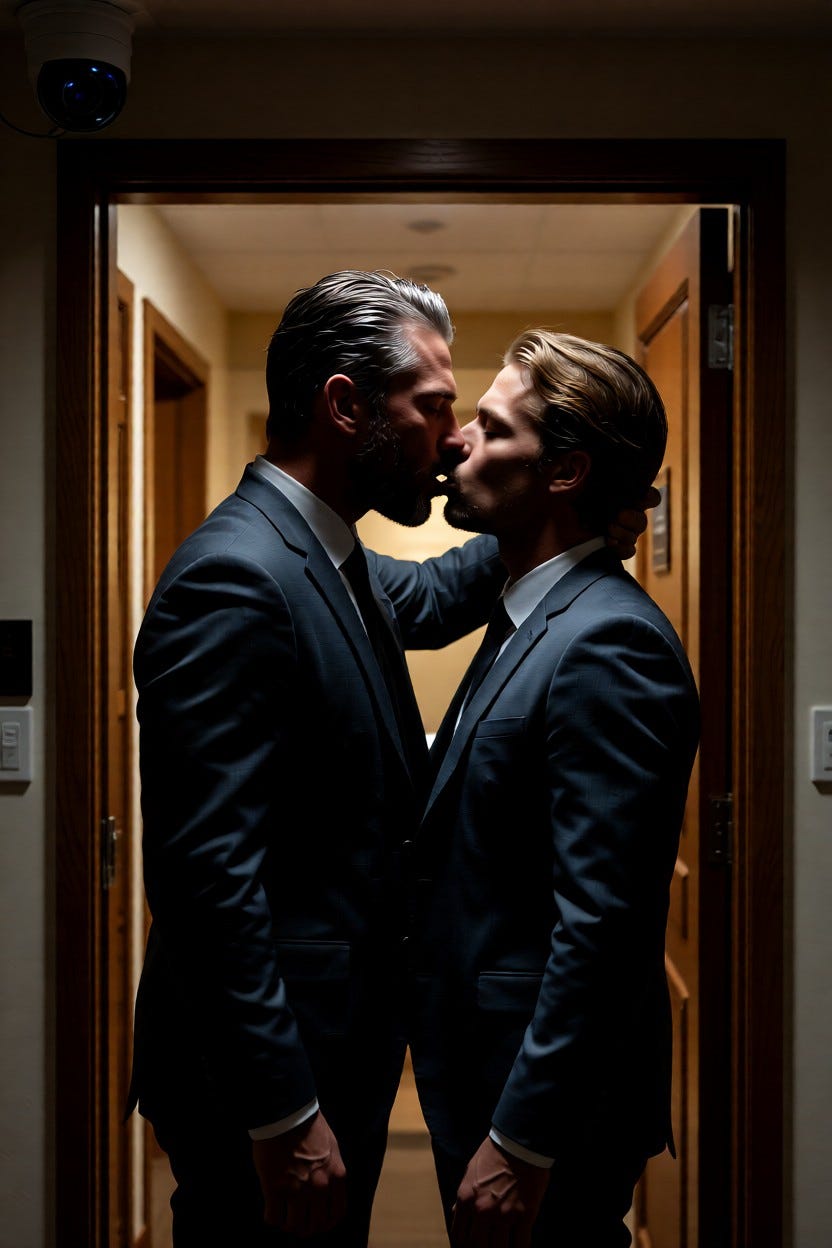
He kissed Matthias.
Right there in the security office doorway, half-shadowed, half-visible—too quick to be a performance, too real to be denied.
Matthias froze for half a second, then kissed him back, just as brief.
Then Declan pulled away and the world rushed back in: the hum of monitors, the smell of bleach, the security manager’s startled silence.
Declan’s stomach dropped.
He realized, with sudden clarity, that there were cameras.
Of course there were cameras.
He’d just kissed Matthias in the one place in the building designed to see everything.
Declan’s face went still.
Matthias didn’t look away.
He said, low, as if answering the panic Declan refused to show, “It happened.”
Declan swallowed. “It shouldn’t have.”
Matthias’s thumb brushed Declan’s wrist once. “We’re not going to pretend it didn’t.”
Declan’s pulse hammered once, hard.
Then he stepped back and the executive mask slid into place like armor.
“Thank you,” Declan said to the manager, voice smooth. “We’ll take copies.”
The manager nodded too quickly, eyes wide.
The printer spit out the last page.
Declan took the stack without shaking.
He didn’t look at the cameras.
He didn’t look at the manager.
He didn’t look at Matthias.
He looked at the paper like it was the only thing in the room that mattered.
Because paper was what made violence look like process.
They left the hotel with the documents in a folder that could’ve been quarterly projections.
Outside, the Chicago air hit Declan’s face like a slap.
Matthias didn’t speak until they were in the car.
Then he said, “That was a mistake.”
Declan’s throat tightened. “Yes.”
Matthias’s gaze stayed on the window. “Not because it happened.”
Declan looked at him.
Matthias’s voice was quiet. “Because they want us to think it matters.”
Declan’s mouth went dry.
Matthias finally turned his head. “Does it matter to you.”
Declan’s pulse kicked again, sharp and clean.
He didn’t answer with softness.
He answered with truth.
“Yes,” he said.
Matthias’s gaze held his.
Then Matthias nodded once, like he’d just accepted a risk he’d been calculating for months.
“Good,” Matthias said.
Declan stared at him. “Good?”
Matthias’s mouth twitched—not a smile. Something colder. “If they’re building a file, I’d rather it contain something real than something they manufactured.”
Declan’s breath left him in a slow exhale he didn’t realize he’d been holding.
The car moved through Chicago traffic like a blade.
Declan looked down at the folder in his lap.
Helix Blackstone Advisory.
Outside counsel.
Risk review.
Permission.
He thought of Zurich. The maintenance panel. The service account. The visitor badge printed as “external.”
Different city.
Same hand.
Back at their hotel, they didn’t go straight to the bed.
They went to the table.
Matthias spread the documents out like a map.
Declan sat across from him and began building the chain: request letterhead, counsel contact, conference sponsor list, invoice codes.
Matthias watched him with a kind of quiet focus that felt like hunger.
Not for sex.
For clarity.
For control.
Declan traced a line with his finger. “Helix is the clean front,” he said.
Matthias’s gaze sharpened. “And the dirty.”
“Lives in the vendors,” Declan finished.
Matthias leaned back slightly. “Tell me.”
Declan flipped to the last page the security manager had printed—an attachment list, the kind of thing most people never read.
Vendor coordination. Security review. Access control consultation.
One name appeared in the orbit like a shadow.
SableHaus Systems.
Declan stared at it.
He felt his stomach tighten the way it had tightened in Zurich when the word “must” became “may”.
SableHaus.
A security hardware and access control contractor.
The kind of company that installed panels and cameras and keycard readers and then left behind “authorized vendor” badges and master codes and maintenance schedules.
Matthias’s voice was quiet. “That’s not Zurich.”
Declan’s eyes lifted. “No.”
Matthias’s gaze went colder. “But it can reach Zurich.”
Declan nodded once. “If they’re in the same ecosystem, they don’t need to be inside Vanguard. They just need to be inside the vendors Vanguard trusts.”
Matthias stared at the name on the page like it had insulted him.
SableHaus Systems.
Declan watched the stillness settle into Matthias’s posture—shoulders squared, jaw set, the kind of calm that meant the math had turned ugly.
Matthias’s eyes lifted. “And vendors trust vendors.”
Declan nodded once. “And vendors trust paperwork.”
Matthias’s mouth tightened. “Risk.”
Declan felt the word click into place. Risk wasn’t a department. It was a permission slip. A clean stamp you could press onto anything until it looked legitimate.
Matthias leaned forward, fingertips resting on the documents. “Helix commissioned the footage.”
Declan didn’t correct him. He didn’t soften it. “Helix commissioned the right to ask for it.”
Matthias’s gaze sharpened. “Through counsel.”
“Through counsel,” Declan agreed. “So it looks like governance, not stalking.”
Matthias sat back. The hotel room was quiet in the way expensive rooms were quiet—thick carpet, sealed windows, air conditioned to a temperature that made skin feel too awake.
Declan’s phone buzzed on the table.
He didn’t look at it.
Matthias did.
Not at the screen—at Declan’s face.
“You’re waiting for it,” Matthias said.
Declan’s throat tightened. “I’m not waiting. I’m listening.”
Matthias’s eyes narrowed slightly. “For what.”
Declan forced his tongue to relax. “For the next afterimage.”
Matthias held the look for a beat, then reached across the table and turned Declan’s phone face-up with two fingers.
The screen lit.
No sender name.
Just a blank contact and a single line of text.
CHICAGO LOOKS GOOD ON YOU.
Declan’s stomach dropped in a clean, cold way.
Matthias read it once.
Then his gaze lifted, slow and deliberate.
Declan felt it like pressure in his chest.
“They’re here,” Declan said quietly.
Matthias didn’t ask who. He didn’t ask how. He didn’t ask if Declan was sure.
He simply said, “Yes.”
Declan’s hands stayed flat on the table. He refused to curl them into fists. He refused to give his body away.
Matthias’s voice lowered. “When did you tell them we were coming.”
Declan’s mouth twitched. “I didn’t.”
Matthias’s eyes went colder. “Then they didn’t need you.”
Declan looked down at the documents again—Helix, counsel, sponsor list, SableHaus.
A network that didn’t require a leak inside Vanguard when it could rent access through vendors and legal channels and “risk.”
Declan exhaled once. “They didn’t follow us,” he said. “They anticipated us.”
Matthias’s gaze flicked to the door, then to the ceiling, then to the window—quick, controlled checks. Not panic. Assessment.
Declan watched him and felt something shift inside his ribs.
Matthias wasn’t used to being watched.
He was used to being the one who watched.
Declan reached out before he could talk himself out of it and placed his fingertips on Matthias’s wrist.
Matthias looked down at the touch.
Then back up.
Declan didn’t offer comfort. He offered a decision.
“We don’t react,” Declan said. “We collect.”
Matthias’s thumb turned under Declan’s fingers, a small, deliberate press. “And we audit origin,” he said.
Declan nodded.
Matthias’s gaze held his. “Tell me what you need.”
Declan’s pulse kicked—sharp, clean. He didn’t want to say it out loud, because saying it would make it real.
But it was already real.
“I need your history,” Declan said quietly. “Board contacts. Old counsel. Anyone who ever called you a risk.”
Matthias’s jaw tightened. “That’s a long list.”
Declan’s eyes didn’t move. “Then we start with the ones who could commission a file.”
Matthias stared at him for a beat.
Then he nodded once.
“Fine,” Matthias said. “We start with the board.”
Declan’s phone buzzed again.
Another message.
Blank sender.
YOU KISS LIKE YOU WANT TO BE CAUGHT.
Declan felt heat rise in his face—anger, humiliation, something sharp and intimate.
He kept his expression neutral.
But Matthias saw it anyway.
Matthias reached across the table and took the phone, not gently, not roughly—just decisively. He read the message, then set the phone down like it was something dirty.
His voice was quiet when he spoke. “They’re trying to turn your body into evidence.”
Declan swallowed. “It already is.”
Matthias’s gaze sharpened. “No.”
Declan looked at him.
Matthias’s tone was controlled, but there was something underneath it now—something that wasn’t billionaire calm. Something that had teeth.
“Evidence is what they can use in a room full of people,” Matthias said. “This—” He nodded at the phone. “—is just a voice trying to get inside your head.”
Declan’s chest tightened. He wanted to believe that.
He didn’t.
Not fully.
Because the kiss had happened in a security corridor. Because cameras existed. Because the ghost had just proved it could follow the emotional thread.
Declan leaned back in his chair and forced his breathing even. In. Out.
Matthias gathered the documents into a single stack with precise movements. He slid them into a folder.
Then he stood.
Declan watched him.
Matthias walked to the door, checked the lock, then crossed to the window and pulled the curtain back a fraction—just enough to see the street below.
He didn’t linger.
He didn’t perform fear.
He returned to the table and placed both hands flat on it, leaning in toward Declan.
“Listen to me,” Matthias said.
Declan’s pulse jumped. The tone wasn’t soft. It wasn’t a request.
Declan held his gaze. “I’m listening.”
Matthias’s voice dropped. “Helix is a front. Counsel is a conduit. Vendors are the bloodstream.”
Declan nodded once.
Matthias continued, “If SableHaus is in their orbit, then Zurich isn’t just compromised by a person. It’s compromised by a contract.”
Declan felt the sentence land like a weight.
A contract.
Something signed.
Something filed.
Something that looked clean.
Matthias’s eyes stayed on his. “We’re going back to Zurich with a different question.”
Declan’s throat tightened. “Which is?”
“Who installed the locks,” Matthias said. “Who maintains them. Who holds the master codes. Who can open a panel and call it routine.”
Declan’s mind flashed: the maintenance panel behind the bookshelf wall. Eight seconds of angle. Enough for a camera. Enough for a photo.
He nodded once. “SableHaus.”
Matthias’s mouth tightened. “SableHaus.”
Declan’s phone buzzed a third time.
He didn’t look.
Matthias did.
He picked it up, glanced at the screen, and something in his expression shifted—small, but real.
He turned the phone so Declan could see.
A photo.
Not a still. Not a grainy security capture.
A clean, modern image taken from across a street.
Declan and Matthias exiting the original conference hotel earlier that day, folder in hand, faces visible.
Time-stamped.
And beneath it, in the same clean white text as the Zurich photo:
ORIGIN CONFIRMED.
Declan’s stomach went cold.
Matthias stared at the photo for a long beat.
Then he set the phone down.
Slowly.
Carefully.
Like he was placing a weapon on a table.
Declan’s voice came out low. “They’re not warning us.”
Matthias’s gaze lifted. “No.”
Declan swallowed. “They’re documenting us.”
Matthias nodded once.
Declan felt the room tighten around them—carpet, curtains, air conditioning, the illusion of safety.
He looked at Matthias. “What do we do?”
Matthias didn’t answer right away.
He reached for Declan’s hand.
Not a wrist. Not a collar. Not a guiding grip.
A full handhold.
Warm. Firm. Real.
Declan’s breath caught.
Matthias’s voice was quiet. “We stop treating this like a ghost.”
Declan’s fingers tightened around his. “And treat it like what?”
Matthias’s eyes went dark. “A supply chain.”
Declan stared at him.
Matthias continued, “We audit every vendor touchpoint. Every access control contract. Every maintenance badge. Every ‘authorized’ presence in that building.”
Declan nodded slowly. “And Helix?”
Matthias’s mouth tightened. “And Helix.”
Declan’s pulse steadied—not because he felt safe, but because he felt oriented.
A hunt had rules.
A network had nodes.
Nodes could be mapped.
Matthias squeezed Declan’s hand once. “We’ll start with SableHaus,” he said. “And we’ll start with the board contact behind counsel.”
Declan’s throat tightened. “We don’t have the name.”
Matthias’s gaze sharpened. “Not yet.”
Declan held the look. “You do.”
Matthias didn’t deny it.
That was answer enough.
Declan’s phone buzzed again, like a pulse that didn’t belong to him.
A final message.
Blank sender.
TELL HIM WHO YOU CALLED FROM THE STAIRWELL.
Declan’s blood went cold.
He didn’t move.
He didn’t blink.
Across the table, Matthias watched his face change by a fraction.
Matthias’s voice was soft, dangerous. “What did they just say?”
Declan’s mouth went dry.
The burner phone in his pocket felt suddenly heavy, like a stone.
Declan forced his voice steady. “Nothing.”
Matthias’s eyes narrowed. “Declan.”
Declan held his gaze.
He could feel the trap closing—not from Matthias, but from the ghost. A wedge. A pressure point. A way to turn secrecy into fracture.
Declan swallowed once.
Then, very carefully, he said, “They know I have a parallel line.”
Matthias went still.
Declan continued, “They don’t know who. But they know I called.”
Matthias’s jaw tightened. “When?”
“Zurich,” Declan said. “Stairwell.”
Matthias stared at him for a long beat.
Then he nodded once, slow.
Assessing.
“Bring it,” Matthias said.
Declan blinked. “What?”
“The phone,” Matthias said, voice flat. “Bring it to Zurich. We’ll treat it like evidence.”
Declan’s pulse kicked. “You want to see it?”
“I want to protect it,” Matthias corrected. “And you.”
Declan’s throat tightened with something that wasn’t fear.
He nodded once. “Okay.”
Matthias’s gaze held his. “We leave tonight.”
Declan’s mouth went dry. “Back to Zurich?”
Matthias nodded. “To Vanguard.”
Declan looked down at the documents again—Helix, counsel, SableHaus—then at the photo on his phone.
Origin confirmed.
He felt the afterimage of Chicago settle behind his eyes like a burn.
Then he lifted his gaze to Matthias and said, quietly, “They think they’re writing the story.”
Matthias’s mouth tightened. “Let them.”
Declan’s pulse steadied.
Matthias finished the sentence like a blade sliding into place.
“We’ll audit the author.”